Kitagawa Utamaro (1753–1806) raised bijin-ga — pictures of beautiful women — to an art of sustained attention and elegance. Cherry-viewing at Gotenyama No 1 shows a group of women in elaborate kimonos gathered beneath cherry blossoms at Gotenyama, the famous hanami hill in present-day Shinagawa, Tokyo. Utamaro places his figures with the careful deliberation of a director: the soft bloom above serves as background, the patterned textiles below carry colour and detail.
The stretched proportions of his bijin figures — slightly elongated necks and slender, tapering fingers — are characteristic of Utamaro's mature style, developed in the late Edo period when his prints were among the most sought-after in Edo's urban print culture. The composition is horizontally arranged, the women set out like figures in a seasonal frieze, with the cherry blossoms dissolving softly into the background.
This gallery-style edition brings the warmth of the print's palette — pal . . . Read More >>
Kitagawa Utamaro (1753–1806) raised bijin-ga — pictures of beautiful women — to an art of sustained attention and elegance. Cherry-viewing at Gotenyama No 1 shows a group of women in elaborate kimonos gathered beneath cherry blossoms at Gotenyama, the famous hanami hill in present-day Shinagawa, Tokyo. Utamaro places his figures with the careful deliberation of a director: the soft bloom above serves as background, the patterned textiles below carry colour and detail.
The stretched proportions of his bijin figures — slightly elongated necks and slender, tapering fingers — are characteristic of Utamaro's mature style, developed in the late Edo period when his prints were among the most sought-after in Edo's urban print culture. The composition is horizontally arranged, the women set out like figures in a seasonal frieze, with the cherry blossoms dissolving softly into the background.
This gallery-style edition brings the warmth of the print's palette — pale pink, ivory blossom, lively kimono pattern — into rooms that value seasonal beauty and classical imagery. It works well as a focal point in a dining room or living area, and equally well in a bedroom.
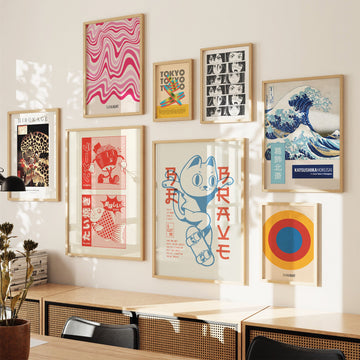
This is a gallery-style edition. On fine-art paper and framed prints, a wide printed border surrounds the image in the manner of a museum mat, holding the same proportion whether the sheet is small or large. The canvas edition is stretched over a solid wooden frame instead, and hangs without a border or additional framing. Each version is produced in Europe to order.
Frequently asked questions
What was hanami, and why was Gotenyama significant?
Hanami — flower viewing — was one of the great seasonal rituals of Edo. Gotenyama was one of the most esteemed hanami sites, a hill in present-day Shinagawa, visited by merchants, geishas, and the urban elite.
What is bijin-ga, and why is Utamaro its principal master?
Bijin-ga means pictures of beautiful people. Utamaro's mastery lay in the ability to suggest inner character through gesture and details of dress rather than facial expression alone, which influenced the European Impressionists.
How does the canvas format suit this print?
The satin canvas gives the kimono patterning and blossom gradations warmth and a light texture that suits the decorative character of the print. The canvas edition is stretched over a wooden frame and hangs without a border, while the paper and framed versions carry the wide printed border.
Which room designs suit it best?
Dining rooms and living areas with natural light work well. The spring palette also creates a natural focal point in a bedroom beside light wood furniture and white walls.
<< Read Less
Japan historical period: Edo 江戸 (1603-1868)
Check out other artwork of Kitagawa Utamaro
#Art
•
#Blossoms
•
#Cherry Blossom
•
#Classic
•
#Gallery-style
•
#Geisha
•
#Japan
•
#Japanese
•
#Japanese Traditional
•
#Japanese Woodblock Print
•
#Kimono
•
#Kitagawa Utamaro
•
#Traditional
•
#Ukiyo-E
•
#Utamaro Kitagawa