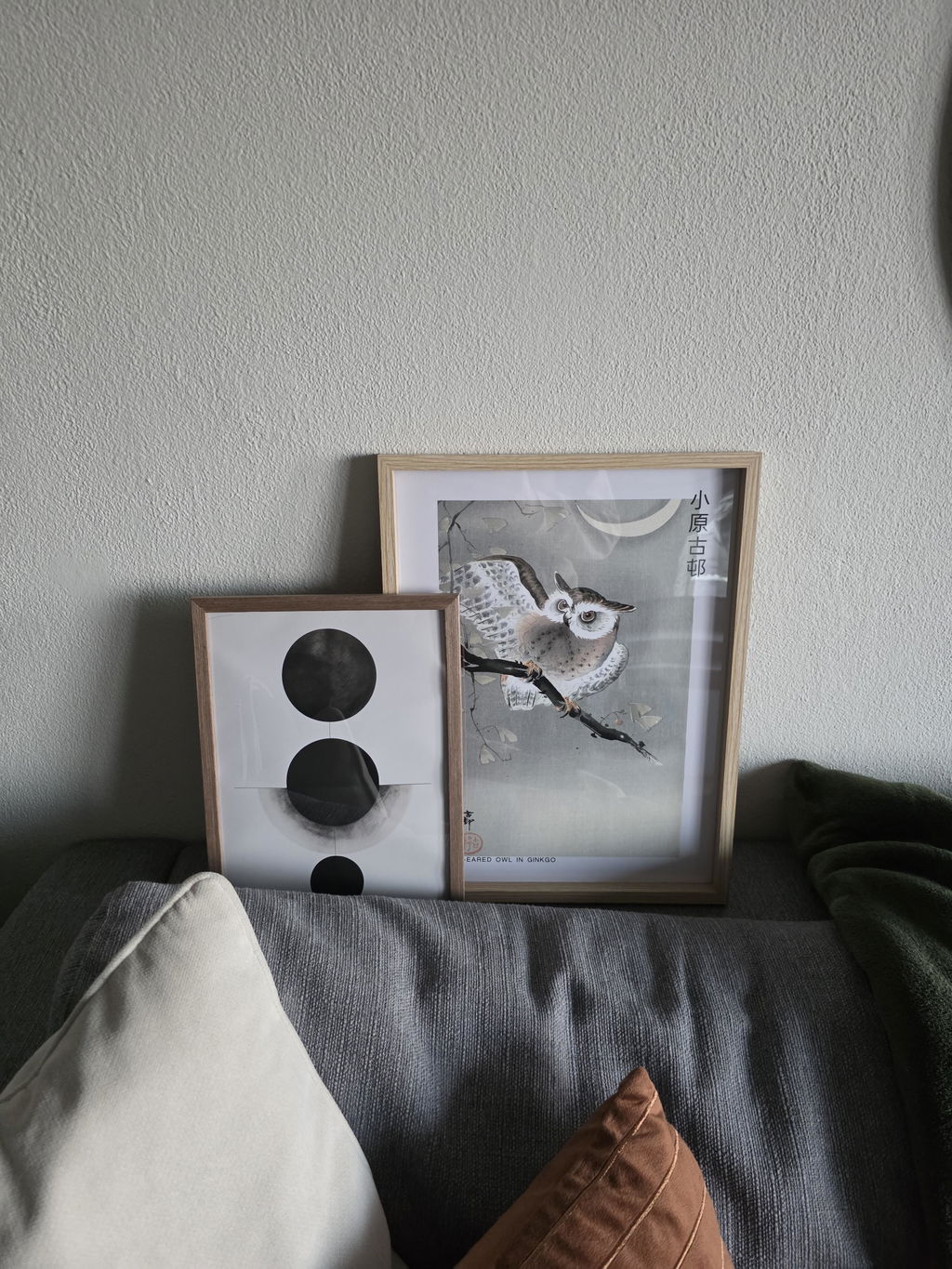
A long-eared owl sits among ginkgo leaves, its ear tufts raised and its eyes wide in the dark. The print is by Ohara Koson (1877–1945), one of the foremost bird-and-flower, or kachō-e, artists of the shin-hanga movement. Owls and other night birds recur in his work, and here the bird is set against a quiet nocturnal ground.
Koson worked in the shin-hanga manner, designing the image for a carver and printer to render in colour woodblock. The ginkgo's fan-shaped leaves are drawn with care, their forms answering the rounded body of the owl. Flat areas of dark tone hold the night, while fine lines pick out the feathers and the veining of the leaves.
On a wall the print brings a calm, nocturnal presence. It suits a bedroom, a study or a quiet corner, and its deep tones with touches of yellow-gold sit well beside wood, warm textiles and low light. The owl's gaze gives the room a steady focal point.
This is a gallery-style edition. On fine-art paper and framed prin . . . Read More >>
A long-eared owl sits among ginkgo leaves, its ear tufts raised and its eyes wide in the dark. The print is by Ohara Koson (1877–1945), one of the foremost bird-and-flower, or kachō-e, artists of the shin-hanga movement. Owls and other night birds recur in his work, and here the bird is set against a quiet nocturnal ground.
Koson worked in the shin-hanga manner, designing the image for a carver and printer to render in colour woodblock. The ginkgo's fan-shaped leaves are drawn with care, their forms answering the rounded body of the owl. Flat areas of dark tone hold the night, while fine lines pick out the feathers and the veining of the leaves.
On a wall the print brings a calm, nocturnal presence. It suits a bedroom, a study or a quiet corner, and its deep tones with touches of yellow-gold sit well beside wood, warm textiles and low light. The owl's gaze gives the room a steady focal point.
This is a gallery-style edition. On fine-art paper and framed prints, a wide printed border surrounds the image in the manner of a museum mat, holding the same proportion whether the sheet is small or large. The canvas edition is stretched over a solid wooden frame instead, and hangs without a border or additional framing. Each version is produced in Europe to order.
Frequently asked questions
What bird is shown in this print?
A long-eared owl, named for its raised ear tufts, perched among the leaves of a ginkgo tree.
What tree appears in the image?
A ginkgo, recognisable by its fan-shaped leaves, whose forms echo the rounded body of the owl.
Did Ohara Koson often depict night birds?
Yes. Owls and other nocturnal birds recur across his bird-and-flower work in the shin-hanga period.
What does "gallery-style" mean here?
On fine-art paper and on framed prints, a wide border is printed around the image, like a matted gallery print. The border is part of the artwork and keeps its proportion at every size. The canvas edition is stretched over a wooden frame instead and hangs without a border.
<< Read Less
Japan historical period: Taisho 大正 (1912-1925)
Check out other artwork of Ohara Koson
#Bird
•
#Branch
•
#Crescent Moon
•
#Ginkgo
•
#Japanese Art
•
#Japanese Woodblock Print
•
#Kacho-E
•
#Moon
•
#Night
•
#Nocturnal
•
#Ohara Koson
•
#Owl
•
#Shin-Hanga
•
#Ukiyo-E