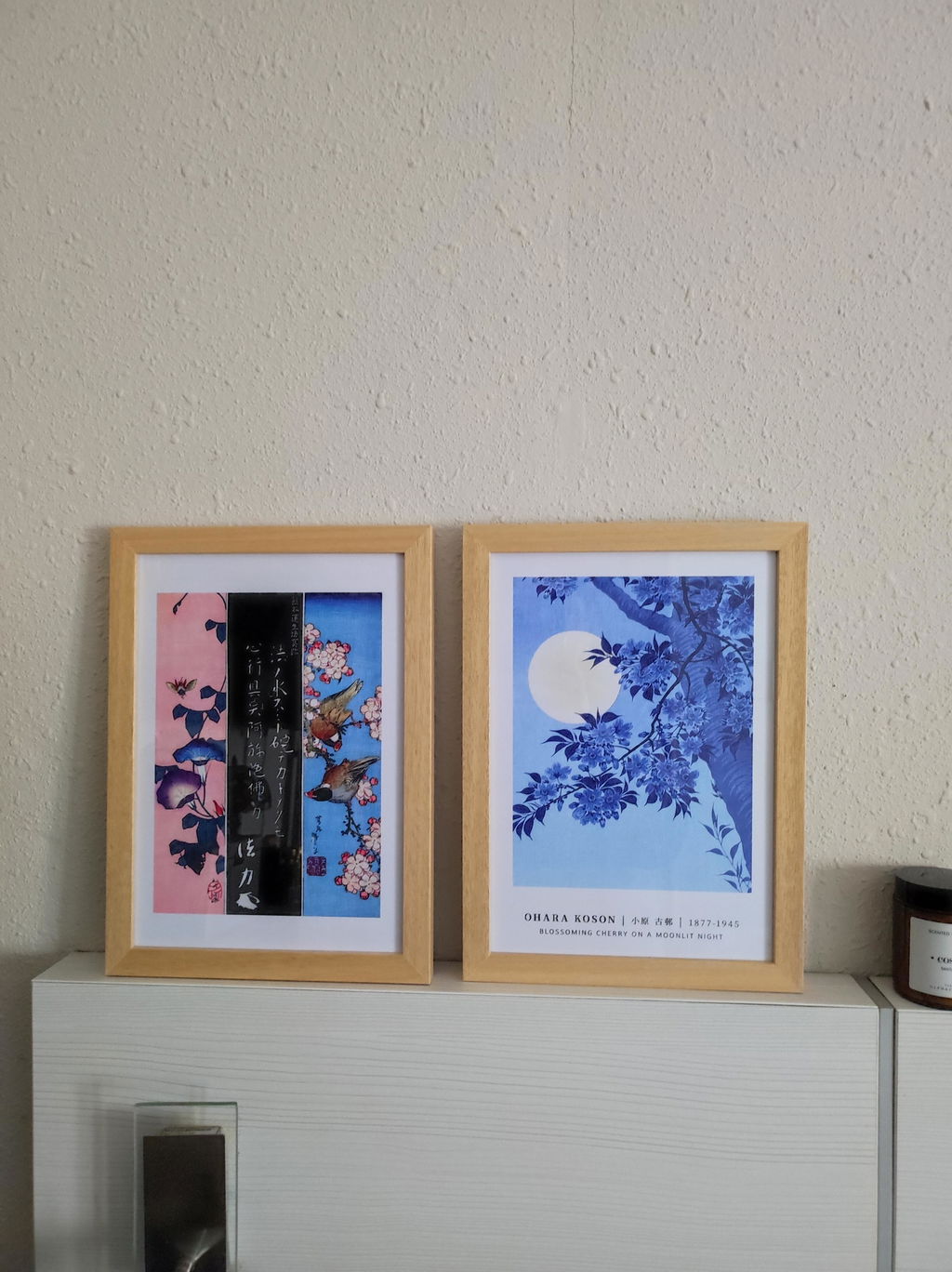
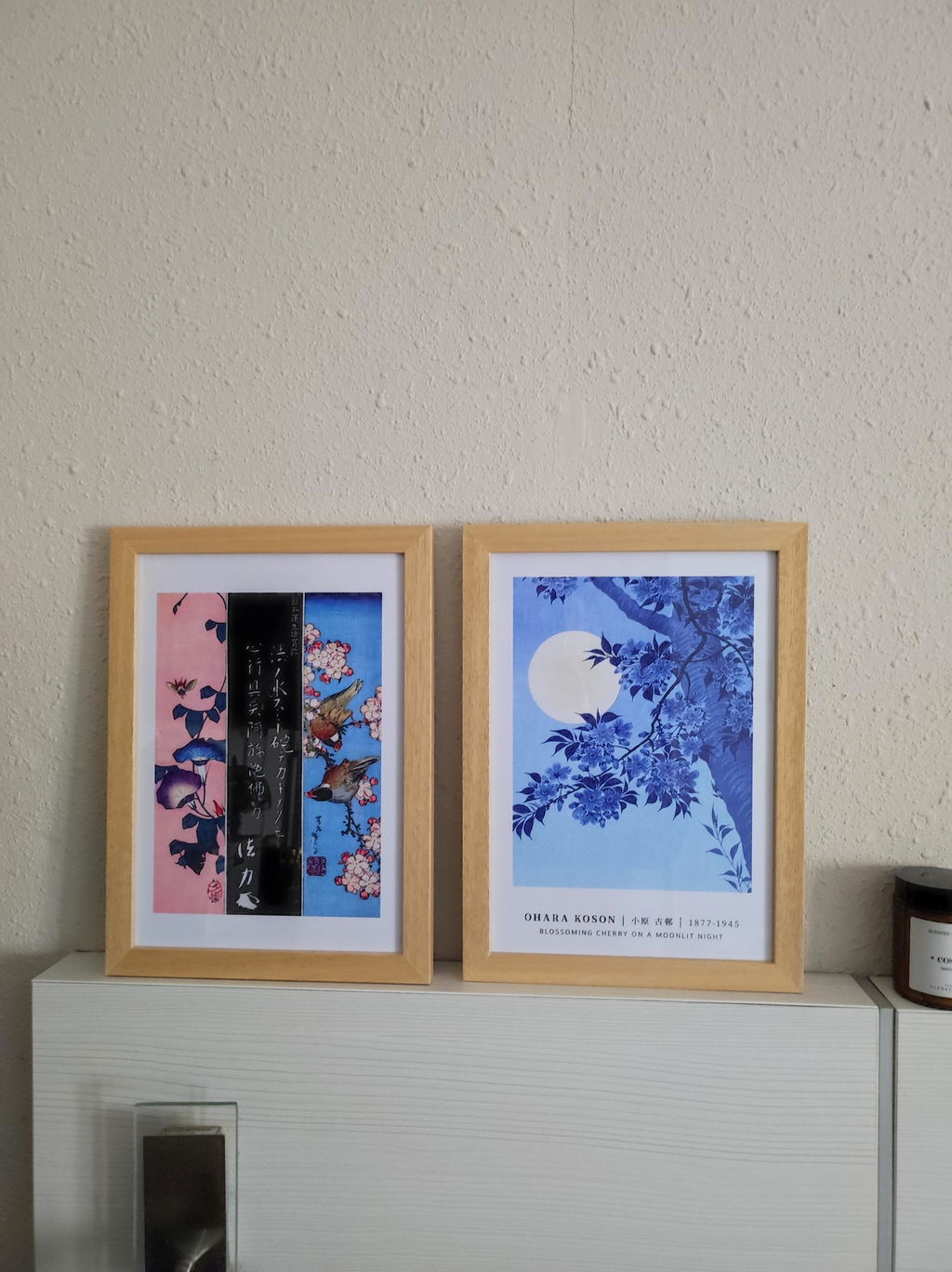
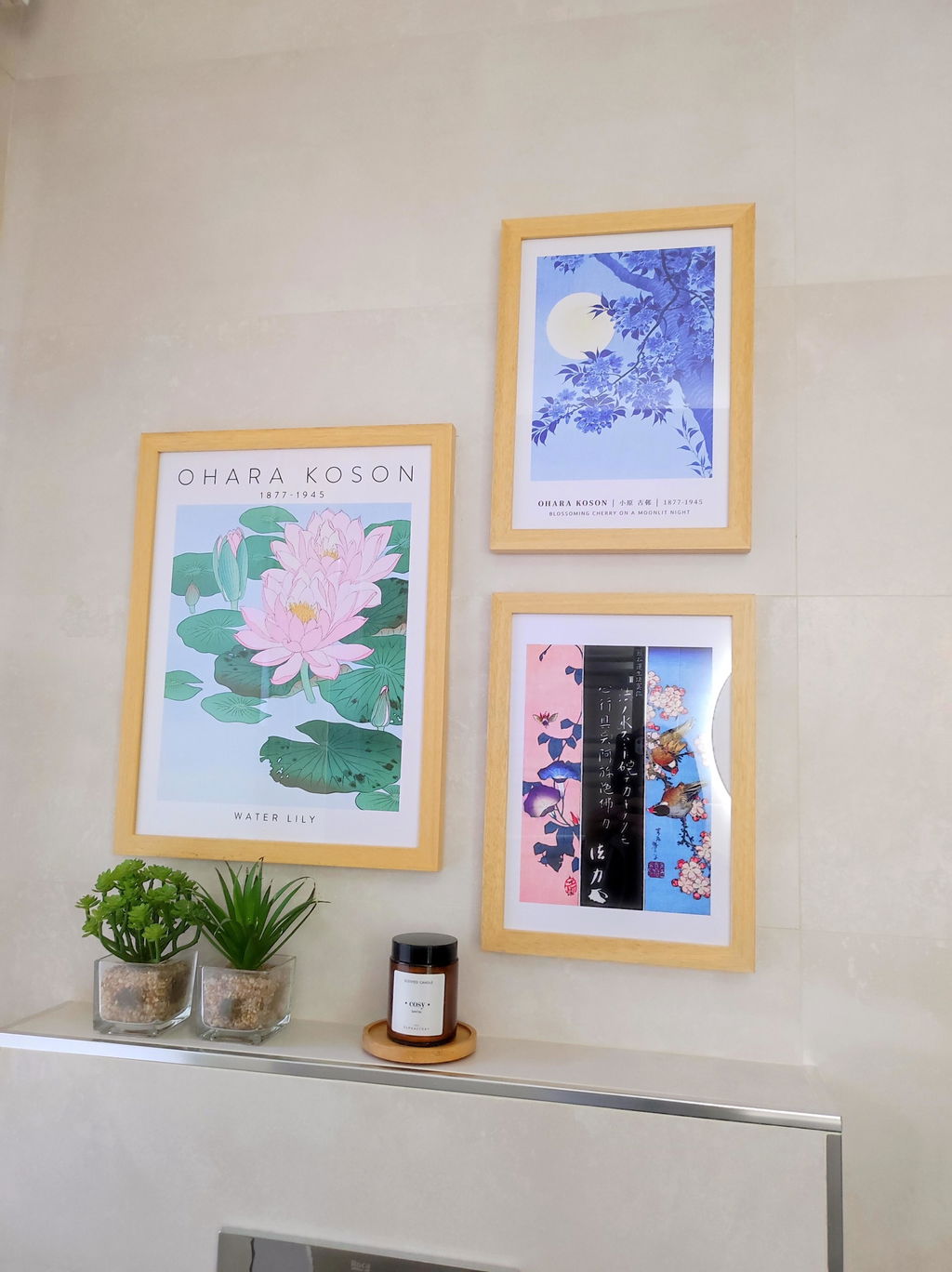
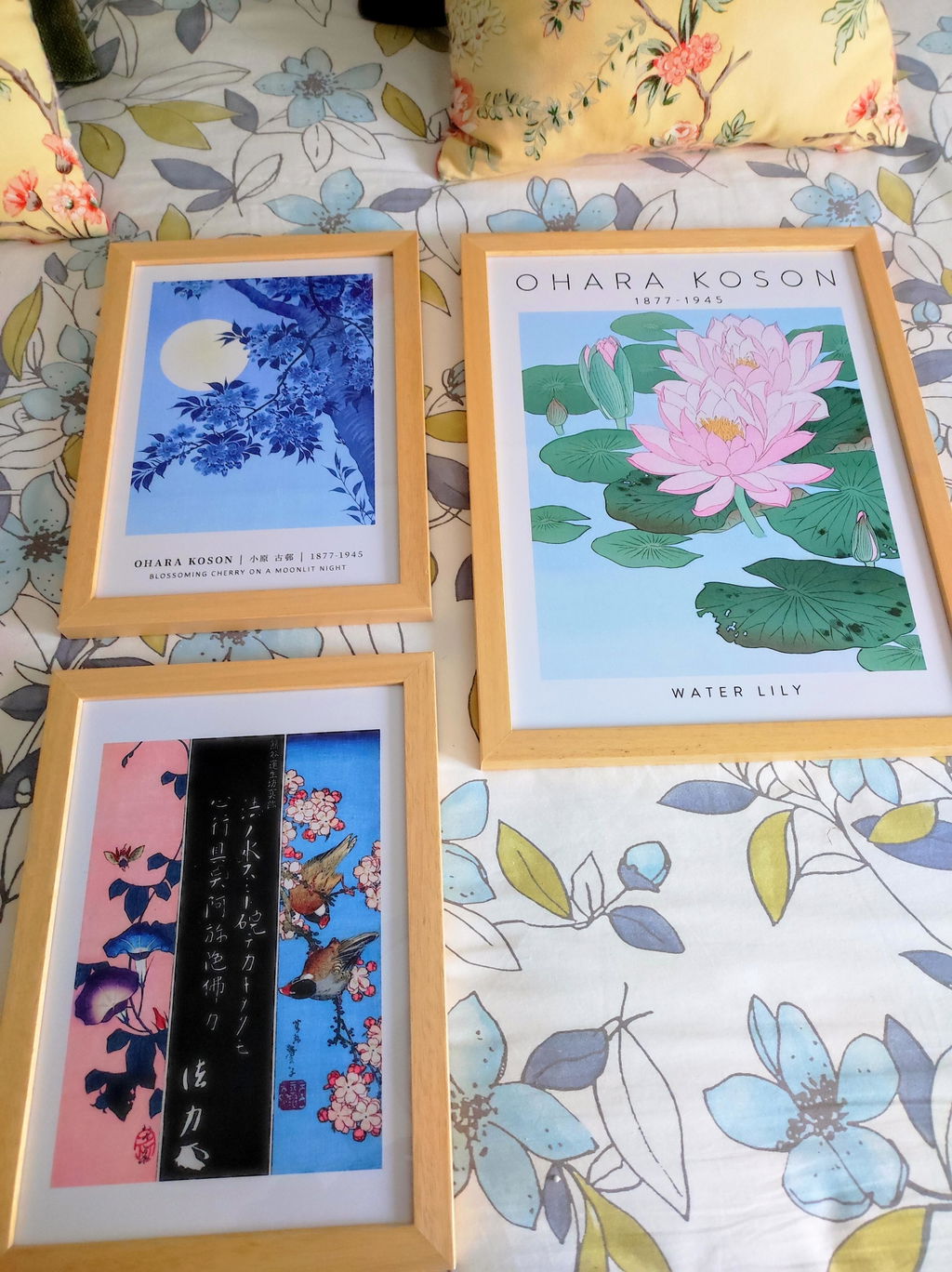
A flowering cherry leans across a dark sky while a pale moon hangs behind its branches. This is the work of Ohara Koson, a Japanese printmaker of the shin-hanga revival, who returned to the old bird-and-flower tradition of kachō-e in the early twentieth century. The cherry blossom, or sakura, carries the idea of mono no aware: the quiet awareness that beauty passes. Here the bloom is shown at night, at the moment it is fullest and closest to falling.
The image comes from the Japanese woodblock method, in which a design is cut into separate cherry-wood blocks and printed colour by colour onto absorbent paper. The technique gives flat, even fields of tone, soft gradations in the night sky, and the fine outline that holds each petal in place. Koson worked with publishers who kept these older hand-cutting and hand-printing methods alive.
On a wall the print stays calm. The dark ground reads as a deep, settled colour rather than a busy pattern, so it sits well in a b . . . Read More >>
A flowering cherry leans across a dark sky while a pale moon hangs behind its branches. This is the work of Ohara Koson, a Japanese printmaker of the shin-hanga revival, who returned to the old bird-and-flower tradition of kachō-e in the early twentieth century. The cherry blossom, or sakura, carries the idea of mono no aware: the quiet awareness that beauty passes. Here the bloom is shown at night, at the moment it is fullest and closest to falling.
The image comes from the Japanese woodblock method, in which a design is cut into separate cherry-wood blocks and printed colour by colour onto absorbent paper. The technique gives flat, even fields of tone, soft gradations in the night sky, and the fine outline that holds each petal in place. Koson worked with publishers who kept these older hand-cutting and hand-printing methods alive.
On a wall the print stays calm. The dark ground reads as a deep, settled colour rather than a busy pattern, so it sits well in a bedroom, a reading corner, or a hallway where you want quiet. It pairs easily with pale wood, linen, and neutral paint, and on paper and framed prints the gallery-style white margin gives the blossom room to breathe.
This is a gallery-style edition. On fine-art paper and framed prints, a wide printed border surrounds the image in the manner of a museum mat, holding the same proportion whether the sheet is small or large. The canvas edition is stretched over a solid wooden frame instead, and hangs without a border or additional framing. Each version is produced in Europe to order.
Frequently asked questions
What does the cherry blossom at night represent?
The night-blooming sakura points to mono no aware, the Japanese sense of beauty made moving by the fact that it does not last. The full bloom and the dark sky together mark a fleeting moment.
What art movement does this print belong to?
It belongs to shin-hanga, the early twentieth-century revival of Japanese woodblock printing, and within it to kachō-e, the bird-and-flower genre that Ohara Koson is known for.
How was the original image made?
It was produced as a colour woodblock print: the design was carved into wood blocks and printed one colour at a time by hand onto soft paper, which gives the flat tones and soft gradation in the sky.
Which rooms suit this print?
Its dark, even ground keeps it restful, so it works in a bedroom, a reading nook, or a hallway, and it sits comfortably alongside pale wood and neutral, natural materials.
<< Read Less
Japan historical period: Showa 昭和 (1926-1989)
Check out other artwork of Ohara Koson
#Aizuri-E
•
#Blossoms
•
#Blue
•
#Cherry Blossom
•
#Flowers
•
#Kacho-E
•
#Moon
•
#Moonlight
•
#Nature
•
#Night Scene
•
#Ohara Koson
•
#Shin-Hanga
•
#Spring
•
#Traditional Japanese Art