Kitagawa Utamaro (1753–1806) made this print around the turn of the 19th century, placing a group of elegantly dressed women among flowering cherry trees at Gotenyama — a famous blossom-viewing hill in present-day Shinagawa, Tokyo. The practice of hanami, the shared viewing of cherry blossoms, was one of the great seasonal pleasures of Edo. Utamaro rendered it with the deliberate, fashion-conscious attention to dress and gesture that distinguished his work within the bijin-ga tradition — the genre of pictures of beautiful people.
Utamaro joins the elaborate kimono patterning to the soft, almost abstract bloom of the cherry blossoms above. He uses the slightly stretched proportions characteristic of his figures — elongated neck lines, slender fingers — not for portrait likeness, but for a distilled quality of refinement. The composition runs horizontally, the women in a loose frieze before a background of pale blossom and open spring sky.
This print suits rooms whe . . . Read More >>
Kitagawa Utamaro (1753–1806) made this print around the turn of the 19th century, placing a group of elegantly dressed women among flowering cherry trees at Gotenyama — a famous blossom-viewing hill in present-day Shinagawa, Tokyo. The practice of hanami, the shared viewing of cherry blossoms, was one of the great seasonal pleasures of Edo. Utamaro rendered it with the deliberate, fashion-conscious attention to dress and gesture that distinguished his work within the bijin-ga tradition — the genre of pictures of beautiful people.
Utamaro joins the elaborate kimono patterning to the soft, almost abstract bloom of the cherry blossoms above. He uses the slightly stretched proportions characteristic of his figures — elongated neck lines, slender fingers — not for portrait likeness, but for a distilled quality of refinement. The composition runs horizontally, the women in a loose frieze before a background of pale blossom and open spring sky.
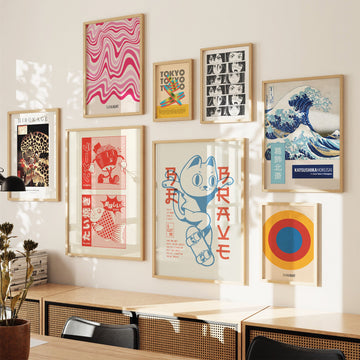
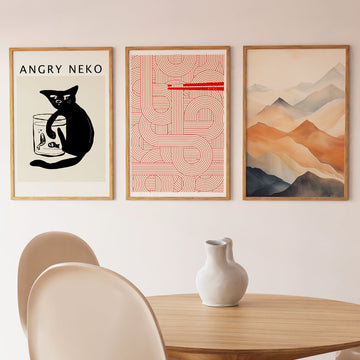
This print suits rooms where seasonal rhythm is valued — a dining room or bedroom where the soft pinks and ivory of the cherry blossoms bring warmth in cooler months. The lively kimono patterns carry visual interest without visual noise. It holds well as a single piece above a console or as part of a grouped arrangement.
Available as a fine-art paper print with faithful colour reproduction or as a framed print behind shatter-resistant acrylic glass. Made to order in several sizes.
Frequently asked questions
What was Gotenyama, and why was it significant in Edo?
Gotenyama was one of the most popular cherry-blossom viewing sites in Edo, in what is now the Shinagawa district. It was visited by merchants, geishas, and the urban elite during the brief blossom season each spring.
What is bijin-ga, the genre of this print?
Bijin-ga means “pictures of beautiful people” — a genre depicting idealised female figures, typically courtesans, geishas, or women of the merchant class. Utamaro was its foremost exponent in the late Edo period.
How does Utamaro render the cherry blossoms in relation to the figures?
The blossoms are rendered as a soft, diffuse background — deliberately less precise than the kimono patterns and faces. The blossoms are felt rather than counted.
Which room styles suit this print?
Dining rooms and living spaces with natural light are ideal. The soft pinks and ivory tones also make it a good choice for a bedroom beside light wood furniture.
<< Read Less
Japan historical period: Edo 江戸 (1603-1868)
Check out other artwork of Kitagawa Utamaro
#Art
•
#Blossoms
•
#Cherry Blossom
•
#Classic
•
#Geisha
•
#Japan
•
#Japanese
•
#Japanese Traditional
•
#Japanese Woodblock Print
•
#Kimono
•
#Kitagawa Utamaro
•
#Traditional
•
#Ukiyo-E
•
#Utamaro Kitagawa