A black cat is caught mid-hiss, back arched and mouth open, in this spare colour woodblock by Takahashi Shōtei (1871–1945), who worked under the name Hiroaki. Shōtei was among the first artists of shin-hanga, the new-print movement of the early twentieth century, and was prolific in small, immediate subjects. Here a single animal and a single moment carry the whole sheet.
The print was made in the nishiki-e tradition, from several hand-carved blocks pressed onto the paper in register. Its stark look comes from a near-monochrome palette: the deep-ink body set against an uncluttered ground, with only the lightest bokashi shading behind. The drawing is economical, every line doing its work.
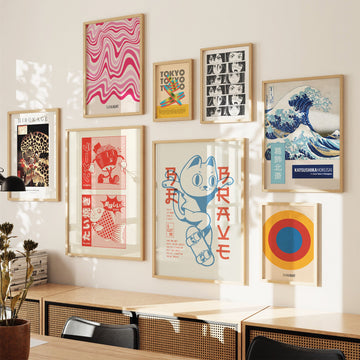
On a wall the image is bold and graphic, yet quiet in colour. Its black-and-pale contrast sits well in modern and minimalist rooms, beside pale wood, concrete or muted textiles, where one sharp form is wanted. It suits a study, a hallway, or a living room.
This is a galle . . . Read More >>
A black cat is caught mid-hiss, back arched and mouth open, in this spare colour woodblock by Takahashi Shōtei (1871–1945), who worked under the name Hiroaki. Shōtei was among the first artists of shin-hanga, the new-print movement of the early twentieth century, and was prolific in small, immediate subjects. Here a single animal and a single moment carry the whole sheet.
The print was made in the nishiki-e tradition, from several hand-carved blocks pressed onto the paper in register. Its stark look comes from a near-monochrome palette: the deep-ink body set against an uncluttered ground, with only the lightest bokashi shading behind. The drawing is economical, every line doing its work.
On a wall the image is bold and graphic, yet quiet in colour. Its black-and-pale contrast sits well in modern and minimalist rooms, beside pale wood, concrete or muted textiles, where one sharp form is wanted. It suits a study, a hallway, or a living room.
This is a gallery-style edition. On fine-art paper and framed prints, a wide printed border surrounds the image in the manner of a museum mat, holding the same proportion whether the sheet is small or large. The canvas edition is stretched over a solid wooden frame instead, and hangs without a border or additional framing. Each version is produced in Europe to order.
Frequently asked questions
What is happening in this image?
A spare study of a black cat caught mid-hiss, its back arched and mouth open, distilled to a single moment of animal tension.
How was this woodblock print produced?
It was printed in the nishiki-e tradition from several hand-carved blocks, one for each element, pressed onto the paper in careful registration.
What gives the print its stark look?
A near-monochrome palette, the deep-ink body set against an uncluttered ground, and only the lightest bokashi shading in the background.
Which interiors suit a hissing black cat print?
A study, hallway or living room; it works in modern and minimalist rooms beside pale wood, concrete or muted textiles.
<< Read Less
Japan historical period: Showa 昭和 (1926-1989)
Check out other artwork of Takahashi Shōtei
#Animal
•
#Animal Portrait
•
#Black
•
#Black Cat
•
#Cat
•
#Japanese Art
•
#Minimalist
•
#Shin-Hanga
•
#Stretching
•
#Takahashi Hiroaki (Shōtei)
•
#Takahashi Shōtei
•
#Yawning