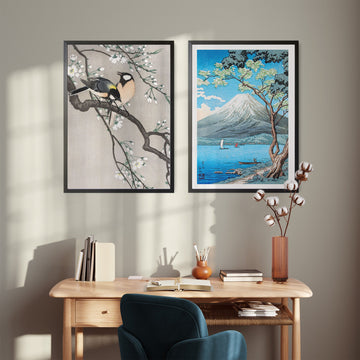
Mount Fuji rises over the countryside at Mizukubo in this view by Takahashi Shōtei (1871–1945), an artist who also signed his work Hiroaki. The print belongs to shin-hanga, the early twentieth-century movement that renewed the Japanese woodblock tradition for a new era, and Shōtei worked closely with Watanabe Shōzaburō, the publisher at the movement's centre. The mountain holds the distance with the calm authority it has carried in Japanese art for centuries.
Shin-hanga kept the old division of labour alive: the artist's design was carved into wooden blocks and printed by hand with water-based pigments, one colour to a block. What changed was the mood — softer light, atmospheric depth, an almost painterly attention to weather and hour. Each impression came off the blocks through the same patient, layered handwork as the ukiyo-e prints of a century before.
A Fuji view is a settling presence in a room. This one suits places of rest and focus — above a sofa, in a b . . . Read More >>
Mount Fuji rises over the countryside at Mizukubo in this view by Takahashi Shōtei (1871–1945), an artist who also signed his work Hiroaki. The print belongs to shin-hanga, the early twentieth-century movement that renewed the Japanese woodblock tradition for a new era, and Shōtei worked closely with Watanabe Shōzaburō, the publisher at the movement's centre. The mountain holds the distance with the calm authority it has carried in Japanese art for centuries.
Shin-hanga kept the old division of labour alive: the artist's design was carved into wooden blocks and printed by hand with water-based pigments, one colour to a block. What changed was the mood — softer light, atmospheric depth, an almost painterly attention to weather and hour. Each impression came off the blocks through the same patient, layered handwork as the ukiyo-e prints of a century before.
A Fuji view is a settling presence in a room. This one suits places of rest and focus — above a sofa, in a bedroom, over a desk — where its still horizon gives the eye somewhere quiet to land. It sits naturally in pale, uncluttered interiors of wood, linen and stone.
The artwork is available as a poster on thick snow-white paper, as a framed print in a wooden frame behind shatter-resistant acrylic glazing, and as a stretched satin-coated cotton canvas in artist quality. Each piece is produced to order.
Frequently asked questions
What is shin-hanga?
The "new prints" movement of the early twentieth century, which renewed the Japanese woodblock tradition with softer light and atmospheric landscape, carried by publishers such as Watanabe Shōzaburō.
Where is Mizukubo?
A rural place with an open view of Mount Fuji; Shōtei recorded several such quiet views around the mountain, this one subtitled Ukutsu after the local site.
How was the original print made?
As a woodblock print in the traditional division of labour: the design was carved into wooden blocks, one for each colour, and printed by hand onto paper with water-based pigments.
Which rooms does this artwork suit?
Places of rest and focus — above the sofa, in the bedroom, over a desk — especially in pale interiors of wood, linen and stone.
<< Read Less
Japan historical period: Showa 昭和 (1926-1989)
Place of origin:
Mizukubo,
Chubu region
Check out other artwork of Takahashi Shōtei
#Dawn
•
#Dusk
•
#Houses
•
#Japan
•
#Japanese Landscape
•
#Japanese Woodblock Print
•
#Landscape
•
#Moonlight
•
#Mount Fuji
•
#Nature
•
#Night
•
#Rural Scene
•
#Takahashi Hiroaki (Shōtei)
•
#Takahashi Shōtei
•
#Traditional
•
#Ukiyo-E
•
#Village