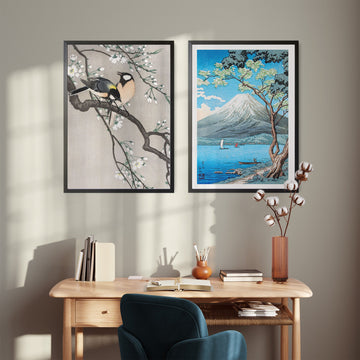
A quiet neighbourhood at Katsuyama settles into stillness in this early twentieth-century shin-hanga woodblock print. It was designed by Takahashi Shōtei (1871–1945), one of the first artists to work with the Tokyo publisher Watanabe Shōzaburō, whose workshop set the shin-hanga movement — the “new prints” revival — in motion. The view keeps to modest things: low rooftops, trees, and the soft weight of distance beyond them.
Shin-hanga prints were made the traditional way, as a collaboration between designer, blockcutter and printer. Each colour came from its own hand-carved block, and the gentle gradations of tone — a technique called bokashi — were wiped onto the wood by hand before printing. It is this graded light, more than any single detail, that carries the mood of the scene.
On a wall, the print behaves like a window left ajar. Its muted palette and unhurried composition suit a japandi or Scandinavian interior, where pale wood and clean lines ask for image . . . Read More >>
A quiet neighbourhood at Katsuyama settles into stillness in this early twentieth-century shin-hanga woodblock print. It was designed by Takahashi Shōtei (1871–1945), one of the first artists to work with the Tokyo publisher Watanabe Shōzaburō, whose workshop set the shin-hanga movement — the “new prints” revival — in motion. The view keeps to modest things: low rooftops, trees, and the soft weight of distance beyond them.
Shin-hanga prints were made the traditional way, as a collaboration between designer, blockcutter and printer. Each colour came from its own hand-carved block, and the gentle gradations of tone — a technique called bokashi — were wiped onto the wood by hand before printing. It is this graded light, more than any single detail, that carries the mood of the scene.
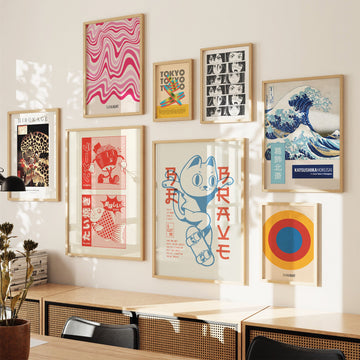
On a wall, the print behaves like a window left ajar. Its muted palette and unhurried composition suit a japandi or Scandinavian interior, where pale wood and clean lines ask for images that rest rather than perform. A bedroom, a hallway or a study all give it room to work quietly.
The work is available as an art print on thick matte paper, as a framed print behind shatter-resistant acrylic glazing, or on satin-coated cotton canvas. Each format preserves the soft gradations and calm tonality of the original woodblock design.
Frequently asked questions
What does this print show?
A quiet neighbourhood view at Katsuyama, rendered with the soft light and atmosphere typical of shin-hanga. The exact vantage point is not documented, so we describe the scene in general terms.
What is shin-hanga?
Shin-hanga, meaning “new prints”, was an early twentieth-century revival of Japanese woodblock printing. It kept the traditional crafts of carving and hand-printing while bringing a fresh feeling for light, weather and mood.
How was the print made?
Through the classic division of labour: the designer drew the image, a blockcutter carved a separate cherry-wood block for each colour, and a printer applied the pigments by hand, including the graded bokashi tones in the sky and shadows.
Which room suits this landscape?
Its calm tone fits a bedroom, a hallway or a study — any space where a soft, restful view helps the room feel settled.
<< Read Less
Japan historical period: Showa 昭和 (1926-1989)
Place of origin:
Katsuyama,
Chubu region
Check out other artwork of Takahashi Shōtei
#Evening
•
#Japan
•
#Japanese Woodblock Print
•
#Landscape
•
#Mount Fuji
•
#Mountain
•
#Mountain Landscape
•
#Nature
•
#Pine Tree
•
#Snow
•
#Sunrise
•
#Sunset
•
#Takahashi Hiroaki (Shōtei)
•
#Takahashi Shōtei
•
#Traditional Japanese Art
•
#Tree
•
#Ukiyo-E
•
#Winter