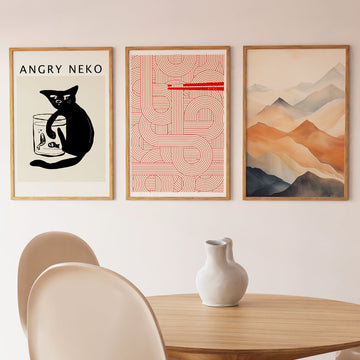
A black cat arches its back and hisses, alone on a plain ground. The design is by Takahashi Shōtei (1871–1945), also known as Hiroaki, who worked within the shin-hanga movement and is closely associated with the publisher Watanabe Shōzaburō. Among his many landscape designs from the early twentieth century, this unusually playful animal study stands apart.
The image is a colour woodblock print, drawn with great economy. A few hand-carved blocks carry the dark silhouette, the raised spine, and the open mouth. There is no setting and little detail; the empty ground gives the cat's posture its full weight.
The palette is nearly monochrome — black against a soft, neutral field. The effect is graphic and lightly humorous, at home in a hallway, a studio, or a child's room, and easy to place against plain or patterned walls. In a calm, pared-back interior it reads almost like a single brushstroke.
The work is available as an art print on thick matte paper, as a . . . Read More >>
A black cat arches its back and hisses, alone on a plain ground. The design is by Takahashi Shōtei (1871–1945), also known as Hiroaki, who worked within the shin-hanga movement and is closely associated with the publisher Watanabe Shōzaburō. Among his many landscape designs from the early twentieth century, this unusually playful animal study stands apart.
The image is a colour woodblock print, drawn with great economy. A few hand-carved blocks carry the dark silhouette, the raised spine, and the open mouth. There is no setting and little detail; the empty ground gives the cat's posture its full weight.
The palette is nearly monochrome — black against a soft, neutral field. The effect is graphic and lightly humorous, at home in a hallway, a studio, or a child's room, and easy to place against plain or patterned walls. In a calm, pared-back interior it reads almost like a single brushstroke.
The work is available as an art print on thick matte paper, as a framed print behind shatter-resistant acrylic glazing, or on satin-coated cotton canvas. Each version keeps the flat black and clean ground of the original design.
Frequently asked questions
What does this print show?
A black cat arching its back and hissing against a plain background — a single, bold animal study by Takahashi Shōtei.
What is shin-hanga?
Shin-hanga, or "new prints", was an early twentieth-century movement that renewed Japanese woodblock printing through close collaboration between artists, carvers, printers, and publishers.
Why is the background empty?
The bare ground is deliberate. With no setting to distract, the eye rests entirely on the cat's silhouette, raised spine, and open mouth.
Which rooms suit this print?
Its graphic black-on-neutral works well in a hallway, a studio, or a child's room, and pairs easily with both plain and patterned walls.
<< Read Less
Japan historical period: Showa 昭和 (1926-1989)
Check out other artwork of Takahashi Shōtei
#Animal
•
#Animal Portrait
•
#Black Cat
•
#Cat
•
#Domestic
•
#Japanese Art
•
#Japanese Woodblock Print
•
#Pet
•
#Stretching
•
#Takahashi Hiroaki (Shōtei)
•
#Takahashi Shōtei
•
#Ukiyo-E
•
#Yawning