Suzuki Harunobu (c.1725–1770) stands at a turning point in Japanese printmaking. In 1765 he was central to the arrival of full-colour nishiki-e, the “brocade prints” that brought many blocks and many colours to a craft once limited to a few tones. Here a bijin, a beautiful woman, pauses to pick a chrysanthemum — a flower tied in Japanese symbolism to autumn and to long life.
The print shows the qualities that made Harunobu admired in his own day. His figures are slender and lightly drawn, their proportions delicate, their gestures gentle. Soft, clear colour is laid in flat fields, and the fine outline carries the whole design. Nothing is overstated; the mood is quiet and lyrical.
On a wall the image keeps an intimate, graceful presence. Its soft palette and unhurried figure suit a bedroom, a dressing area, or a calm corner meant for pause. The print sits easily among natural wood and muted textiles, adding a note of refinement without raising the volume of the roo . . . Read More >>
Suzuki Harunobu (c.1725–1770) stands at a turning point in Japanese printmaking. In 1765 he was central to the arrival of full-colour nishiki-e, the “brocade prints” that brought many blocks and many colours to a craft once limited to a few tones. Here a bijin, a beautiful woman, pauses to pick a chrysanthemum — a flower tied in Japanese symbolism to autumn and to long life.
The print shows the qualities that made Harunobu admired in his own day. His figures are slender and lightly drawn, their proportions delicate, their gestures gentle. Soft, clear colour is laid in flat fields, and the fine outline carries the whole design. Nothing is overstated; the mood is quiet and lyrical.
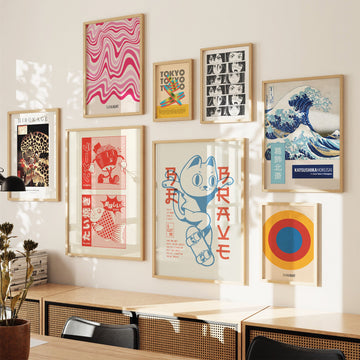
On a wall the image keeps an intimate, graceful presence. Its soft palette and unhurried figure suit a bedroom, a dressing area, or a calm corner meant for pause. The print sits easily among natural wood and muted textiles, adding a note of refinement without raising the volume of the room.
This is a gallery-style edition. On fine-art paper and framed prints, a wide printed border surrounds the image in the manner of a museum mat, holding the same proportion whether the sheet is small or large. The canvas edition is stretched over a solid wooden frame instead, and hangs without a border or additional framing. Each version is produced in Europe to order.
Frequently asked questions
What is the subject of this print?
A bijin, or beautiful woman, picking a chrysanthemum — a flower linked in Japanese symbolism to autumn and to longevity.
What is nishiki-e, and why does Harunobu matter to it?
Nishiki-e are full-colour “brocade prints” made with many blocks. Harunobu was a pioneer who helped introduce them around 1765, opening the way for richly coloured ukiyo-e.
What does the chrysanthemum signify?
In Japanese tradition the chrysanthemum is the flower of autumn and a symbol of long life, which gives the quiet scene its gentle resonance.
How would you describe Harunobu’s figures?
Slender and delicately proportioned, drawn with fine outlines and soft, flat colour, in a lyrical and understated manner.
<< Read Less
Japan historical period: Edo 江戸 (1603-1868)
Check out other artwork of Suzuki Harunobu
#Autumn
•
#Bijin-Ga
•
#Chrysanthemum
•
#Edo Period
•
#Flowers
•
#Japanese Art
•
#Japanese Woodblock Print
•
#Kimono
•
#Stream
•
#Suzuki Harunobu
•
#Ukiyo-E
•
#Water
•
#Waterside
•
#Woman