Two women cross paths in the rain, each sheltered beneath a wide umbrella, their robes drawn close against the weather. The scene comes from Ohara Koson (1877–1945), a leading figure of the shin-hanga movement that renewed Japanese woodblock printing in the early twentieth century. Koson is remembered above all for birds and flowers; a figural subject like this is uncommon in his catalogue, which gives the print a quiet rarity.
The shin-hanga method kept the old division of labour between artist, carver and printer, but pursued softer light and deeper atmosphere than the prints of earlier generations. Rain is rendered as fine vertical lines pressed across the sheet, and the muted ground lets the two figures and their umbrellas hold the eye. Flat planes of colour sit against carefully judged negative space.
On a wall the print reads as a calm, weather-soft image that suits a hallway, a reading corner or a bedroom. Its restrained palette settles easily beside wood, . . . Read More >>
Two women cross paths in the rain, each sheltered beneath a wide umbrella, their robes drawn close against the weather. The scene comes from Ohara Koson (1877–1945), a leading figure of the shin-hanga movement that renewed Japanese woodblock printing in the early twentieth century. Koson is remembered above all for birds and flowers; a figural subject like this is uncommon in his catalogue, which gives the print a quiet rarity.
The shin-hanga method kept the old division of labour between artist, carver and printer, but pursued softer light and deeper atmosphere than the prints of earlier generations. Rain is rendered as fine vertical lines pressed across the sheet, and the muted ground lets the two figures and their umbrellas hold the eye. Flat planes of colour sit against carefully judged negative space.
On a wall the print reads as a calm, weather-soft image that suits a hallway, a reading corner or a bedroom. Its restrained palette settles easily beside wood, linen and pale plaster, and the vertical rhythm of the rain gives a small sense of movement without noise.
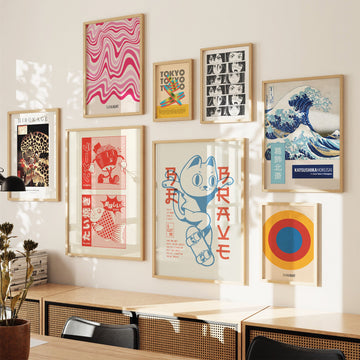
This is a gallery-style edition. On fine-art paper and framed prints, a wide printed border surrounds the image in the manner of a museum mat, holding the same proportion whether the sheet is small or large. The canvas edition is stretched over a solid wooden frame instead, and hangs without a border or additional framing. Each version is produced in Europe to order.
Frequently asked questions
What does this print show?
Two women walking in the rain, each beneath a wide umbrella, their robes pulled close against the weather.
Is a figural scene typical of Ohara Koson?
No. Koson is known chiefly for bird-and-flower subjects, so a human figural scene like this one is comparatively rare in his work.
What is shin-hanga?
An early twentieth-century revival of Japanese woodblock printing that kept traditional craft while pursuing softer light and atmosphere.
What does "gallery-style" mean here?
On fine-art paper and on framed prints, a wide border is printed around the image, like a matted gallery print. The border is part of the artwork and keeps its proportion at every size. The canvas edition is stretched over a wooden frame instead and hangs without a border.
<< Read Less
Japan historical period: Showa 昭和 (1926-1989)
Check out other artwork of Ohara Koson
#Atmospheric
•
#Japanese Fashion
•
#Japanese Woodblock Print
•
#Kimono
•
#Ohara Koson
•
#Rain
•
#Rainy Scene
•
#Shin-Hanga
•
#Traditional Japanese
•
#Ukiyo-E
•
#Umbrella
•
#Willow Tree
•
#Women