Two peacocks rest side by side on a single branch, their long trains falling in quiet parallel lines against a softly graded sky. The design is by Ohara Koson (1877–1945), the foremost kachō-e — bird-and-flower — designer of the shin-hanga movement, which renewed traditional Japanese printmaking in the early twentieth century. True to the genre, the birds carry the whole composition; everything else stays still.
The image is a woodblock print. The design was cut into wooden blocks, one for each colour, and printed onto paper in careful register. Koson's birds reward that patience: the eye-spots of the train, the layered wing feathers and the crest all depend on steady, exact line work, while the near-empty background takes a single graded wash of sky.
In a room, the print reads as calm rather than loud. Its muted blues and greens settle comfortably against pale walls, oak and linen, which makes it a natural companion to Japandi and softer Scandinavian interiors. . . . Read More >>
Two peacocks rest side by side on a single branch, their long trains falling in quiet parallel lines against a softly graded sky. The design is by Ohara Koson (1877–1945), the foremost kachō-e — bird-and-flower — designer of the shin-hanga movement, which renewed traditional Japanese printmaking in the early twentieth century. True to the genre, the birds carry the whole composition; everything else stays still.
The image is a woodblock print. The design was cut into wooden blocks, one for each colour, and printed onto paper in careful register. Koson's birds reward that patience: the eye-spots of the train, the layered wing feathers and the crest all depend on steady, exact line work, while the near-empty background takes a single graded wash of sky.
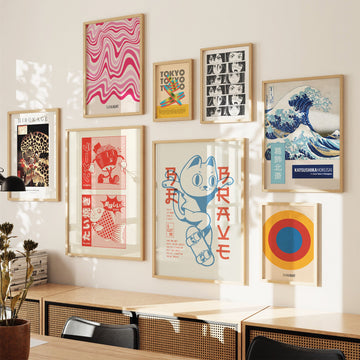
In a room, the print reads as calm rather than loud. Its muted blues and greens settle comfortably against pale walls, oak and linen, which makes it a natural companion to Japandi and softer Scandinavian interiors. It holds a bedroom or reading corner on its own and pairs easily with other bird-and-flower studies.
Each piece is made to order. Choose the print on thick snow-white paper, a framed edition behind shatter-resistant acrylic glass, or satin-coated cotton canvas in artist quality, stretched on a wooden frame. Available sizes are listed in the product options.
Frequently asked questions
What do the peacocks symbolise in this print?
In Japanese bird-and-flower art the peacock carries associations of dignity, beauty and protection. Here a pair rests together on one branch, adding a quiet note of companionship.
What is kachō-e?
Kachō-e is the Japanese genre of bird-and-flower pictures. Ohara Koson was its leading designer within the shin-hanga movement, and this peacock study is a characteristic example of his work.
Why is the background almost empty?
Koson set the finely drawn peacocks against a plain, graded sky. The simple ground keeps attention on the birds and gives the print its open, restful feel.
Which rooms suit this print?
Its muted palette and resting pair of birds suit bedrooms, living rooms and quiet corners, and the print sits naturally beside other bird-and-flower designs.
<< Read Less
Japan historical period: Taisho 大正 (1912-1925)
Check out other artwork of Ohara Koson
#Bird
•
#Blue
•
#Feathers
•
#Japanese Art
•
#Japanese Print
•
#Japanese Woodblock Print
•
#Kacho-E
•
#Nature
•
#Ohara Koson
•
#Peacock
•
#Pine Tree
•
#Traditional
•
#Tree
•
#Ukiyo-E
•
#Wildlife