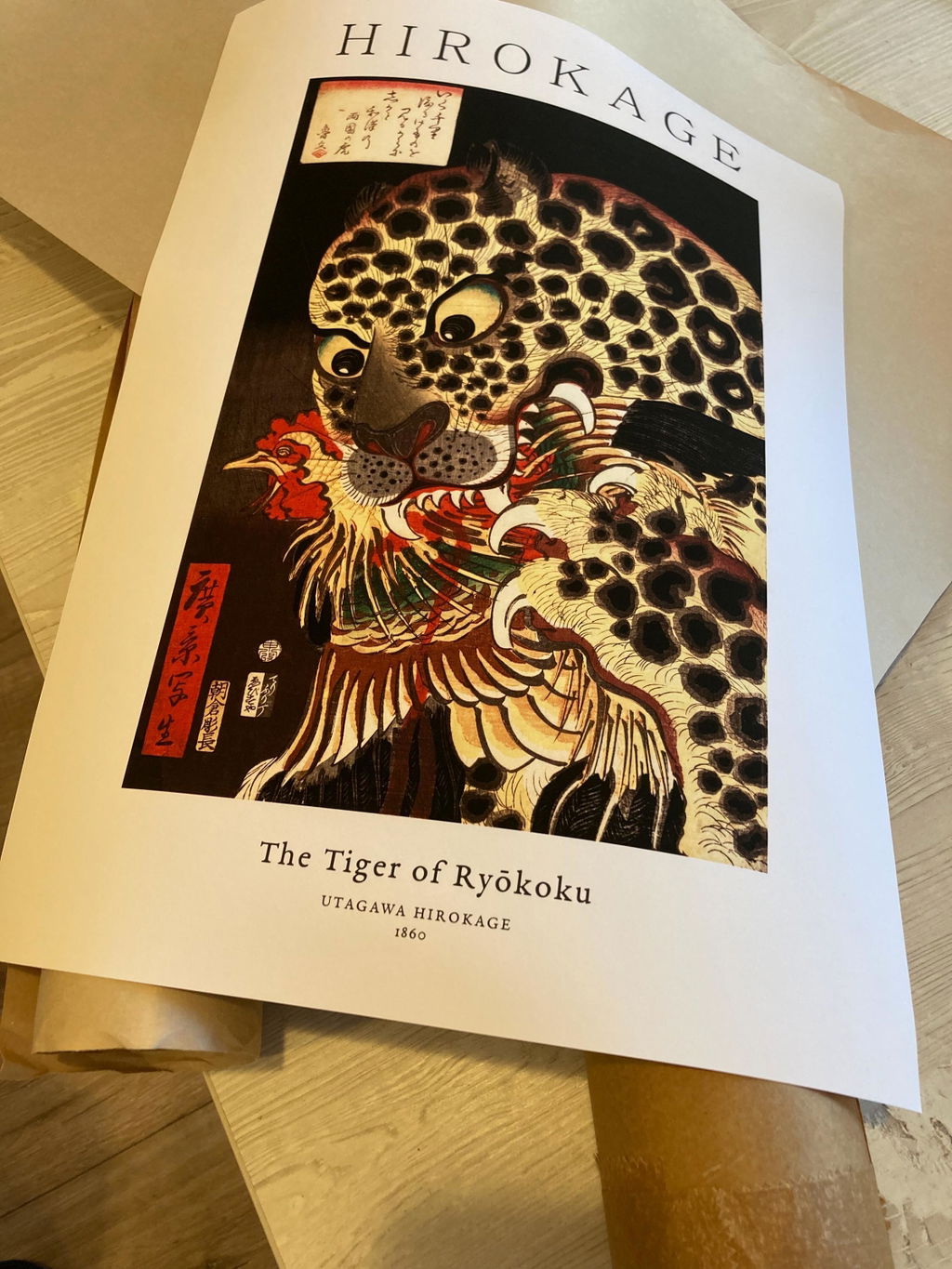
A tiger fills the sheet, its striped coat described stripe by stripe and its gaze level and watchful. The print is by Ohara Koson (1877–1945), best known for bird-and-flower work but also a maker of animal subjects within the shin-hanga revival of Japanese woodblock printing. The tiger had long held a place in Japanese art as a symbol of strength and protection.
Koson designed the image in the shin-hanga manner, with a carver and printer translating it into colour woodblock. The fur is built from many fine lines, the stripes laid down as flat dark bands, and soft tonal shifts give the body its weight. The animal is held against quiet ground so that its form carries the whole image.
On a wall the print brings a grounded, watchful presence. It suits a study, a living room or a hallway, and its warm browns, blacks and creams sit well beside wood, leather and natural textiles. The tiger gives the room a single strong focal point without crowding it.
This is a ga . . . Read More >>
A tiger fills the sheet, its striped coat described stripe by stripe and its gaze level and watchful. The print is by Ohara Koson (1877–1945), best known for bird-and-flower work but also a maker of animal subjects within the shin-hanga revival of Japanese woodblock printing. The tiger had long held a place in Japanese art as a symbol of strength and protection.
Koson designed the image in the shin-hanga manner, with a carver and printer translating it into colour woodblock. The fur is built from many fine lines, the stripes laid down as flat dark bands, and soft tonal shifts give the body its weight. The animal is held against quiet ground so that its form carries the whole image.
On a wall the print brings a grounded, watchful presence. It suits a study, a living room or a hallway, and its warm browns, blacks and creams sit well beside wood, leather and natural textiles. The tiger gives the room a single strong focal point without crowding it.
This is a gallery-style edition. On fine-art paper and framed prints, a wide printed border surrounds the image in the manner of a museum mat, holding the same proportion whether the sheet is small or large. The canvas edition is stretched over a solid wooden frame instead, and hangs without a border or additional framing. Each version is produced in Europe to order.
Frequently asked questions
What does this print show?
A single tiger filling the sheet, its striped coat rendered in fine line and flat dark bands.
Were tigers found in Japan?
No. Tigers were not native to Japan, so Japanese artists worked from imported skins, Chinese models and imagination rather than live animals.
Did Ohara Koson make animal subjects beyond birds?
Yes. Though best known for bird-and-flower work, Koson also depicted animals such as the tiger within the shin-hanga movement.
What does "gallery-style" mean here?
On fine-art paper and on framed prints, a wide border is printed around the image, like a matted gallery print. The border is part of the artwork and keeps its proportion at every size. The canvas edition is stretched over a wooden frame instead and hangs without a border.
<< Read Less
Japan historical period: Taisho 大正 (1912-1925)
Check out other artwork of Ohara Koson
#Animal
•
#Big Cat
•
#Feline
•
#Ink Painting
•
#Japanese Art
•
#Japanese Woodblock Print
•
#Ohara Koson
•
#Shin-Hanga
•
#Tiger
•
#Traditional
•
#Wildlife