Sparrows gather in the branches of a plum tree under fresh snow. The design is by Ohara Koson (1877–1945), the printmaker who gave the shin-hanga movement its finest kachō-e — bird-and-flower pictures. In Japan the plum is the first tree to flower, often while snow still lies on its branches, so a snowy plum carries a quiet promise: winter is already ending.
The snow in this print is, to a large degree, the paper itself. The printer left parts of the sheet untouched — a reserve of bare paper that reads as fresh snowfall — and deepened the sky with bokashi, the hand-wiped gradation of pigment on the block that shades one tone gently into another. Every impression was printed by hand from carved woodblocks, which is why the snow feels weightless and the small bodies of the sparrows so warm against it.
This is a print for the quiet places of a home. Its pale palette and seasonal stillness suit a bedroom, an entryway or a reading corner, where it works like a window . . . Read More >>
Sparrows gather in the branches of a plum tree under fresh snow. The design is by Ohara Koson (1877–1945), the printmaker who gave the shin-hanga movement its finest kachō-e — bird-and-flower pictures. In Japan the plum is the first tree to flower, often while snow still lies on its branches, so a snowy plum carries a quiet promise: winter is already ending.
The snow in this print is, to a large degree, the paper itself. The printer left parts of the sheet untouched — a reserve of bare paper that reads as fresh snowfall — and deepened the sky with bokashi, the hand-wiped gradation of pigment on the block that shades one tone gently into another. Every impression was printed by hand from carved woodblocks, which is why the snow feels weightless and the small bodies of the sparrows so warm against it.
This is a print for the quiet places of a home. Its pale palette and seasonal stillness suit a bedroom, an entryway or a reading corner, where it works like a window onto a cold, bright morning. In japandi and scandinavian interiors it sits naturally with pale wood, wool and white walls — a winter scene that calms rather than chills.
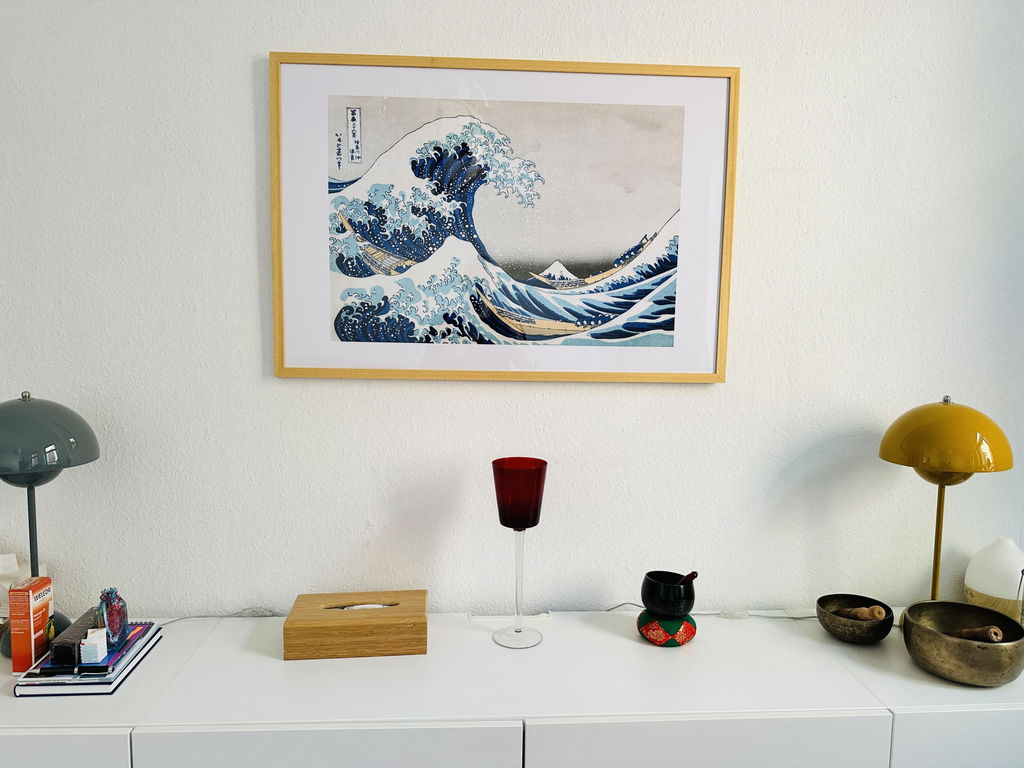
The artwork is offered as a print on thick snow-white paper, as a framed print in a wooden frame, or on artist-quality satin canvas. Every piece is hand-finished in Europe.
Frequently asked questions
How was the snow in this print made?
Largely with restraint. The printer reserved areas of bare, unprinted paper to stand for fresh snow, and used bokashi — hand-wiped gradation on the woodblock — to shade the sky and shadows softly around it.
What does the plum tree signify?
The plum is the earliest tree to bloom in Japan, often flowering while snow still lies. In art it stands for endurance and the first sign that winter is turning toward spring.
What is shin-hanga?
Shin-hanga, “new prints”, was an early twentieth-century revival of traditional Japanese woodblock printing. Designer, carver and printer worked together, as in the Edo period, with a renewed feeling for light and atmosphere.
Which rooms suit this print?
Bedrooms, entryways and reading corners, where its pale palette and stillness can be felt. It keeps its calm all year, not only in winter.
<< Read Less
Japan historical period: Meiji 明治 (1868-1912)
Check out other artwork of Ohara Koson
#Bird
•
#Birds In Flight
•
#Flying
•
#Japanese Art
•
#Japanese Painting (Nihonga)
•
#Japanese Woodblock Print
•
#Kacho-E
•
#Minimalist
•
#Nature
•
#Ohara Koson
•
#Plum Blossom
•
#Shin-Hanga
•
#Snow
•
#Sparrows
•
#Spring
•
#Wildlife
•
#Winter
•
#Winter Scene