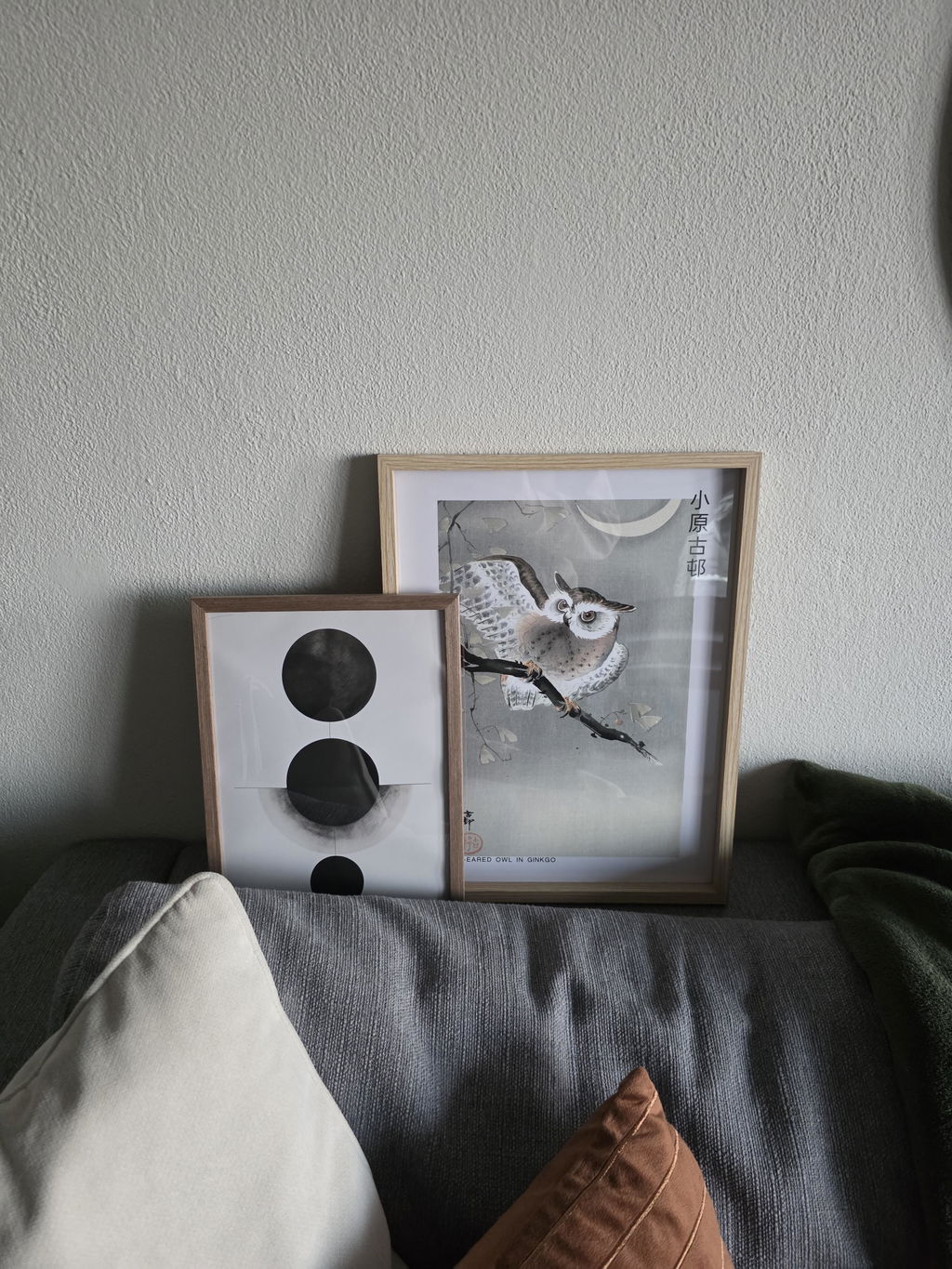
Long-Eared Owl in Ginkgo is a kachō-e woodblock print by Ohara Koson (1877–1945), made during the early decades of the shin-hanga movement. A long-eared owl clings to a branch of a ginkgo tree, its large eyes open and direct. The ginkgo leaves — fan-shaped and turning autumnal yellow — frame the bird and fill the upper part of the composition with warm colour against an open ground.
Koson structures the print with characteristic economy. The owl is placed with quiet authority at the composition’s centre, its feather pattern worked in soft brown and cream; the ginkgo leaves are rendered with clean, flat colour that contrasts with the owl’s softer gradations. The result is a composition of considerable visual balance — the bird holds the weight, the leaves provide warmth and seasonal context.
The owl is an uncommon subject in the kachō-e tradition, rarer than the songbirds, herons, and cranes that appear more frequently. Its nocturnal quality gives the image a dif . . . Read More >>
Long-Eared Owl in Ginkgo is a kachō-e woodblock print by Ohara Koson (1877–1945), made during the early decades of the shin-hanga movement. A long-eared owl clings to a branch of a ginkgo tree, its large eyes open and direct. The ginkgo leaves — fan-shaped and turning autumnal yellow — frame the bird and fill the upper part of the composition with warm colour against an open ground.
Koson structures the print with characteristic economy. The owl is placed with quiet authority at the composition’s centre, its feather pattern worked in soft brown and cream; the ginkgo leaves are rendered with clean, flat colour that contrasts with the owl’s softer gradations. The result is a composition of considerable visual balance — the bird holds the weight, the leaves provide warmth and seasonal context.
The owl is an uncommon subject in the kachō-e tradition, rarer than the songbirds, herons, and cranes that appear more frequently. Its nocturnal quality gives the image a different kind of quietness — watchful rather than still. This is a print that works throughout the year, in a study, a hallway, or a living room where the autumnal palette feels right.
The print is offered on thick, snow-white fine art paper, as a ready-to-hang framed edition with a wooden frame, or as a satin canvas stretched over a wooden frame.
Frequently asked questions
What tree does the owl sit in?
The owl is perched in a ginkgo tree. The fan-shaped ginkgo leaf, turning yellow in autumn, is one of Japan’s most recognised seasonal symbols and a frequent subject in Japanese decorative art.
How does Koson render the owl’s feathers?
Koson uses soft gradations of brown and cream for the feather pattern, with the owl’s eyes rendered in a rounder, more striking way — a balance of detailed observation and graphic clarity that is characteristic of his bird prints.
Is the owl a common subject in Japanese woodblock prints?
The owl is less common than songbirds, herons, or cranes in the kachō-e tradition. Its nocturnal quality makes it a distinctive and quieter subject within the genre.
What season does this print evoke?
Autumn — the yellowing ginkgo leaves are a clear seasonal marker. The palette of gold, brown, and cream gives the print a warm, considered quality.
<< Read Less
Japan historical period: Taisho 大正 (1912-1925)
Check out other artwork of Ohara Koson
#Bird
•
#Branch
•
#Crescent Moon
•
#Ginkgo Leaves
•
#Japanese Art
•
#Japanese Woodblock Print
•
#Kacho-E
•
#Moon
•
#Nature
•
#Night
•
#Night Scene
•
#Ohara Koson
•
#Owl
•
#Shin-Hanga
•
#Ukiyo-E
•
#Wildlife