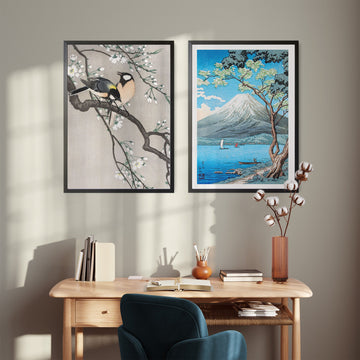
A great tit rests on a paulownia branch, framed by the tree's broad, heart-shaped leaves. The design belongs to the kachō-e — bird-and-flower — work of Ohara Koson (1877–1945), one of the most admired designers of the shin-hanga movement, which renewed the Japanese woodblock tradition in the early twentieth century. The bird is still; the branch carries it without effort; the rest of the sheet is left open and quiet.
The image is a colour woodblock print. Each tone was carved into its own block of wood and printed in sequence onto the paper, with soft gradations shading the leaves and the ground. Koson's drawing stays close and exact — the small body of the bird, the angle of the branch, the weight of each leaf — while unprinted paper holds the air around them.
In Japan the paulownia, or kiri, has long carried noble and auspicious associations, and Koson treats it with matching restraint. The muted greens and warm paper tone sit easily in a calm interior — a bed . . . Read More >>
A great tit rests on a paulownia branch, framed by the tree's broad, heart-shaped leaves. The design belongs to the kachō-e — bird-and-flower — work of Ohara Koson (1877–1945), one of the most admired designers of the shin-hanga movement, which renewed the Japanese woodblock tradition in the early twentieth century. The bird is still; the branch carries it without effort; the rest of the sheet is left open and quiet.
The image is a colour woodblock print. Each tone was carved into its own block of wood and printed in sequence onto the paper, with soft gradations shading the leaves and the ground. Koson's drawing stays close and exact — the small body of the bird, the angle of the branch, the weight of each leaf — while unprinted paper holds the air around them.
In Japan the paulownia, or kiri, has long carried noble and auspicious associations, and Koson treats it with matching restraint. The muted greens and warm paper tone sit easily in a calm interior — a bedroom, a study, a reading corner — alongside light wood, linen, and plants, in the quiet spirit shared by Japanese and Scandinavian rooms.
The work is available as an art print on thick matte paper, as a framed print behind shatter-resistant acrylic glazing, or on satin-coated cotton canvas. Each version keeps the soft colour and open spacing of the original design.
Frequently asked questions
What does this print show?
A great tit perched on a paulownia branch, framed by the tree's broad leaves — a close bird-and-flower study in Ohara Koson's quiet, observational manner.
What is kachō-e?
Kachō-e is the bird-and-flower genre of Japanese printmaking, devoted to calm, closely observed studies of birds, plants, and seasonal nature.
What does the paulownia tree signify?
The paulownia, or kiri, has long carried noble and auspicious associations in Japan, where its leaves and flowers also appear as a traditional crest motif.
Which rooms suit this print?
Its muted greens and open spacing settle well in calm rooms — a bedroom, a study, or a reading corner — especially near plants and natural wood.
<< Read Less
Japan historical period: Showa 昭和 (1926-1989)
Check out other artwork of Ohara Koson
#Autumn
•
#Berries
•
#Bird
•
#Branch
•
#Great Tit
•
#Japanese Art
•
#Japanese Print
•
#Japanese Woodblock Print
•
#Kacho-E
•
#Leaves
•
#Maple Leaves
•
#Nature
•
#Ohara Koson
•
#Shin-Hanga
•
#Vine
•
#Wildlife