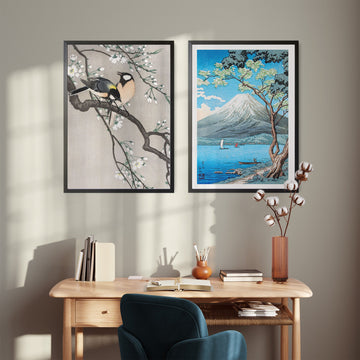
Ohara Koson (1877–1945) was among the leading bird-and-flower artists of the shin-hanga movement, which renewed Japanese woodblock printing in the early twentieth century. This print places a single great tit on a paulownia branch, the bird turned slightly as if it has just settled.
Koson works in the kachō-e tradition — the genre of birds and flowers — and lets the composition breathe. The branch enters from one side; the rest of the sheet is open ground. Graduated bokashi printing softens the background tones, and a few precise lines describe the bird's markings and the broad paulownia leaves.
A print like this asks for a quiet wall. Hung in a bedroom, study, or entryway, it reads as a small observed moment rather than a decorative flourish. The pale ground sits comfortably against natural wood and neutral textiles.
This is a gallery-style edition. On fine-art paper and framed prints, a wide printed border surrounds the image in the manner of a museum mat, . . . Read More >>
Ohara Koson (1877–1945) was among the leading bird-and-flower artists of the shin-hanga movement, which renewed Japanese woodblock printing in the early twentieth century. This print places a single great tit on a paulownia branch, the bird turned slightly as if it has just settled.
Koson works in the kachō-e tradition — the genre of birds and flowers — and lets the composition breathe. The branch enters from one side; the rest of the sheet is open ground. Graduated bokashi printing softens the background tones, and a few precise lines describe the bird's markings and the broad paulownia leaves.
A print like this asks for a quiet wall. Hung in a bedroom, study, or entryway, it reads as a small observed moment rather than a decorative flourish. The pale ground sits comfortably against natural wood and neutral textiles.
This is a gallery-style edition. On fine-art paper and framed prints, a wide printed border surrounds the image in the manner of a museum mat, holding the same proportion whether the sheet is small or large. The canvas edition is stretched over a solid wooden frame instead, and hangs without a border or additional framing. Each version is produced in Europe to order.
Frequently asked questions
What bird is shown in this print?
A great tit, a small songbird common across Japan and Eurasia, recognised by its black head, white cheeks, and the dark stripe down its breast.
What is kachō-e?
Kachō-e is the Japanese genre of bird-and-flower pictures. Koson specialised in it, treating each bird as an individual study set against open or lightly graded ground.
What is the paulownia branch's significance?
The paulownia is a fast-growing tree long valued in Japan for its broad leaves and pale timber; its foliage gives Koson a generous shape to set against the small, sharply drawn bird.
What is bokashi printing?
Bokashi is a woodblock technique in which pigment is graded across the block to produce a soft tonal fade rather than a flat colour — used here to keep the background quiet behind the bird.
<< Read Less
Japan historical period: Showa 昭和 (1926-1989)
Check out other artwork of Ohara Koson
#Autumn
•
#Berries
•
#Bird
•
#Branch
•
#Great Tit
•
#Japanese Art
•
#Japanese Woodblock Print
•
#Kacho-E
•
#Leaves
•
#Maple Leaves
•
#Nature
•
#Ohara Koson
•
#Paulownia
•
#Shin-Hanga
•
#Wildlife