This composition comes from the hand of Ohara Koson (1877–1945), one of the most prolific designers of the shin-hanga movement. A flock of dark birds moves through a stand of pines, their silhouettes cut against pale, misted sky. Below them a vermilion torii gate fixes the scene to the ground, marking the edge of a Shinto precinct within the forest. Koson worked almost entirely in kachō-e, the bird-and-flower genre, and this print shows the genre at its most atmospheric: a quiet woodland interior, read through the movement of birds passing through it.
The image was made the traditional way, through the collaborative woodblock system that shin-hanga inherited from the Edo workshops. The designer drew the composition; a carver cut a separate block for each colour; a printer pulled the sheet by hand, layer over layer. The soft graduation of tone in the sky is bokashi, a wiping technique that fades one colour into another across the block. Areas of bare paper are left unpri . . . Read More >>
This composition comes from the hand of Ohara Koson (1877–1945), one of the most prolific designers of the shin-hanga movement. A flock of dark birds moves through a stand of pines, their silhouettes cut against pale, misted sky. Below them a vermilion torii gate fixes the scene to the ground, marking the edge of a Shinto precinct within the forest. Koson worked almost entirely in kachō-e, the bird-and-flower genre, and this print shows the genre at its most atmospheric: a quiet woodland interior, read through the movement of birds passing through it.
The image was made the traditional way, through the collaborative woodblock system that shin-hanga inherited from the Edo workshops. The designer drew the composition; a carver cut a separate block for each colour; a printer pulled the sheet by hand, layer over layer. The soft graduation of tone in the sky is bokashi, a wiping technique that fades one colour into another across the block. Areas of bare paper are left unprinted, so the white of the sheet itself becomes the light behind the pines. The result is depth built from flat colour and restraint rather than shading.
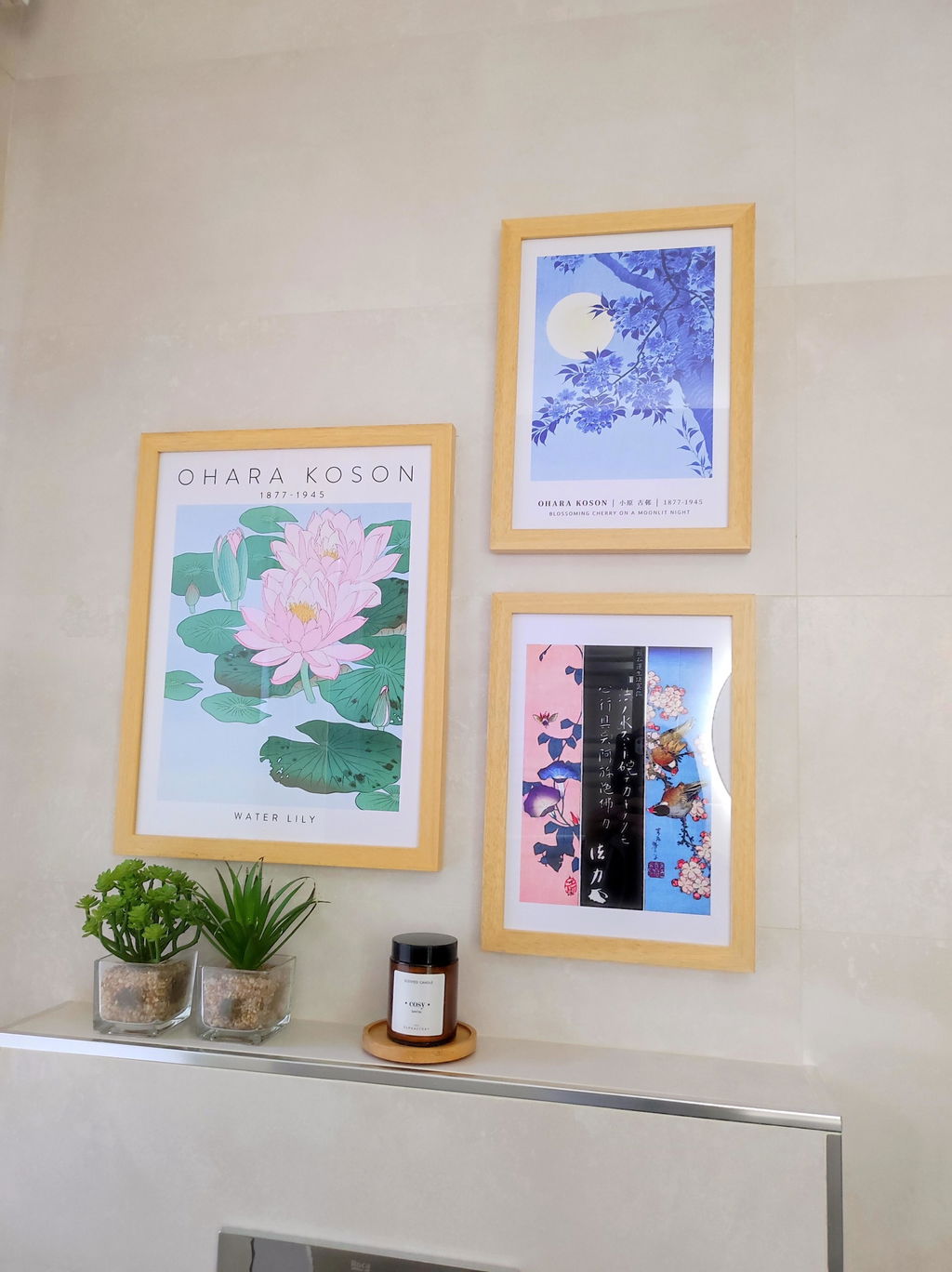
On a wall the print settles a room rather than crowding it. The muted palette — ink-dark birds, grey-green pines, a single note of vermilion — sits comfortably against plaster, linen, and pale wood, and reads as calm from across a room and detailed up close. It suits a reading corner, a hallway, or a bedroom wall, anywhere a slow image earns its place. Hung as a pair or a small group, the vertical format lends itself to a considered arrangement.
This is a gallery-style edition. On fine-art paper and framed prints, a wide printed border surrounds the image in the manner of a museum mat, holding the same proportion whether the sheet is small or large. The canvas edition is stretched over a solid wooden frame instead, and hangs without a border or additional framing. Each version is produced in Europe to order.
Frequently asked questions
What does the torii gate symbolise in Japanese art and culture?
A torii gate marks the boundary between the ordinary world and the precincts of a Shinto shrine. Passing under it is understood as a transition from the profane to the sacred — a moment of ritual purification. In kachō-e prints the torii often appears less as a devotional symbol and more as an architectural presence within a natural landscape, giving the image a structural anchor and invoking the long Japanese pictorial tradition of sacred sites set within forests and mountains.
What birds are depicted in Koson’s flock?
The birds in this composition appear to be crows or corvids — species that recur frequently in Japanese woodblock prints and classical poetry. Crows occupy an ambiguous symbolic position in Japanese tradition: associated with bad omens in some contexts, but also with divine messengers, particularly the three-legged crow Yatagarasu, a guide figure in Shinto mythology. Koson depicted them for their graphic qualities as much as their symbolism — the dark silhouettes cut sharply against pale sky.
What is shin-hanga and how did it change Japanese woodblock printing?
Shin-hanga (“new prints”) was a publishing movement that ran roughly from 1915 to the 1950s, led primarily by the publisher Watanabe Shōzaburō. It retained the collaborative studio system of Edo-period printing — artist, carver, printer, publisher — while taking in Western influences: naturalistic gradation, atmospheric light, and a more individual artistic identity. Koson was among its most prolific contributors in the bird-and-flower genre, producing several hundred designs over his career.
How does Koson typically integrate architecture into his kachō-e compositions?
Koson is best known for compositions focused on a single bird or small group against a minimal background. When he placed architecture in the image — a gate, a stone lantern, a bridge — it functioned as a compositional anchor: a fixed, human-made form that sets the scale and fixes the spatial depth, allowing the birds to read as genuinely in flight rather than floating on a flat surface. The torii here plays exactly that role, establishing the forest interior and making the birds’ movement through it legible.
<< Read Less