Five seagulls wheel above a heaving sea, their wings caught at different angles as the water breaks below. The print is by Ohara Koson (1877–1945), a leading bird-and-flower artist of the shin-hanga movement that renewed Japanese woodblock printing in the early twentieth century. Where many of his works hold a single still bird, this one is built on movement and weather.
In the shin-hanga method Koson designed the image, while a carver and printer brought it to the block in colour. The turbulent water is described with curving lines and graded tone, and the five birds are spaced across the sheet so the eye travels between them. The sense of wind comes from arrangement as much as from any single mark.
On a wall the print carries open air and a coastal mood. It suits a bathroom, a stairwell or a room that looks out on weather, and its cool greys, blues and whites settle easily beside wood, linen and stone. The composition reads clearly from across a room.
This . . . Read More >>
Five seagulls wheel above a heaving sea, their wings caught at different angles as the water breaks below. The print is by Ohara Koson (1877–1945), a leading bird-and-flower artist of the shin-hanga movement that renewed Japanese woodblock printing in the early twentieth century. Where many of his works hold a single still bird, this one is built on movement and weather.
In the shin-hanga method Koson designed the image, while a carver and printer brought it to the block in colour. The turbulent water is described with curving lines and graded tone, and the five birds are spaced across the sheet so the eye travels between them. The sense of wind comes from arrangement as much as from any single mark.
On a wall the print carries open air and a coastal mood. It suits a bathroom, a stairwell or a room that looks out on weather, and its cool greys, blues and whites settle easily beside wood, linen and stone. The composition reads clearly from across a room.
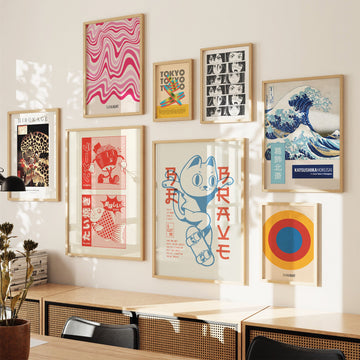
This is a gallery-style edition. On fine-art paper and framed prints, a wide printed border surrounds the image in the manner of a museum mat, holding the same proportion whether the sheet is small or large. The canvas edition is stretched over a solid wooden frame instead, and hangs without a border or additional framing. Each version is produced in Europe to order.
Frequently asked questions
What does this print show?
Five seagulls in flight above a rough, turbulent sea, their wings held at different angles.
How does the image convey movement?
The birds are spaced across the sheet and the water is drawn with curving, graded lines, so the eye travels and reads wind and motion.
Is this typical of Ohara Koson?
Koson is known for bird-and-flower subjects; this one is unusual in showing several birds in active flight rather than a single still bird.
What does "gallery-style" mean here?
On fine-art paper and on framed prints, a wide border is printed around the image, like a matted gallery print. The border is part of the artwork and keeps its proportion at every size. The canvas edition is stretched over a wooden frame instead and hangs without a border.
<< Read Less
Japan historical period: Taisho 大正 (1912-1925)
Check out other artwork of Ohara Koson
#Bird
•
#Japanese Art
•
#Japanese Woodblock Print
•
#Kacho-E
•
#Maritime
•
#Nature
•
#Ocean
•
#Ocean Waves
•
#Ohara Koson
•
#Sea
•
#Seagulls
•
#Seascape
•
#Shin-Hanga
•
#Sunset Sky
•
#Ukiyo-E
•
#Waves