This print presents a single peony after Ogawa Kazumasa, the Meiji-era photographer and publisher (1860–1929) who recorded the flowers of Japan for a wide audience. The peony has long stood for wealth and honour in East Asian art, a full, generous bloom often called the king of flowers. Ogawa's botanical plates brought such subjects to the page with a new clarity at the turn of the twentieth century.
The original is a hand-coloured collotype, not a woodblock. Collotype is a photographic printing process that holds very fine, continuous tone, capable of soft, smooth gradation across a petal. Over that photographic base, colour was applied by hand, so the bloom keeps both the precision of the camera and the warmth of a painted surface. The result sits between photograph and painting.
On the wall the peony reads as a quiet, generous form. Its soft colour and open ground suit a bedroom, a living room, or a hallway, and the palette sits easily with pale plaster, warm w . . . Read More >>
This print presents a single peony after Ogawa Kazumasa, the Meiji-era photographer and publisher (1860–1929) who recorded the flowers of Japan for a wide audience. The peony has long stood for wealth and honour in East Asian art, a full, generous bloom often called the king of flowers. Ogawa's botanical plates brought such subjects to the page with a new clarity at the turn of the twentieth century.
The original is a hand-coloured collotype, not a woodblock. Collotype is a photographic printing process that holds very fine, continuous tone, capable of soft, smooth gradation across a petal. Over that photographic base, colour was applied by hand, so the bloom keeps both the precision of the camera and the warmth of a painted surface. The result sits between photograph and painting.
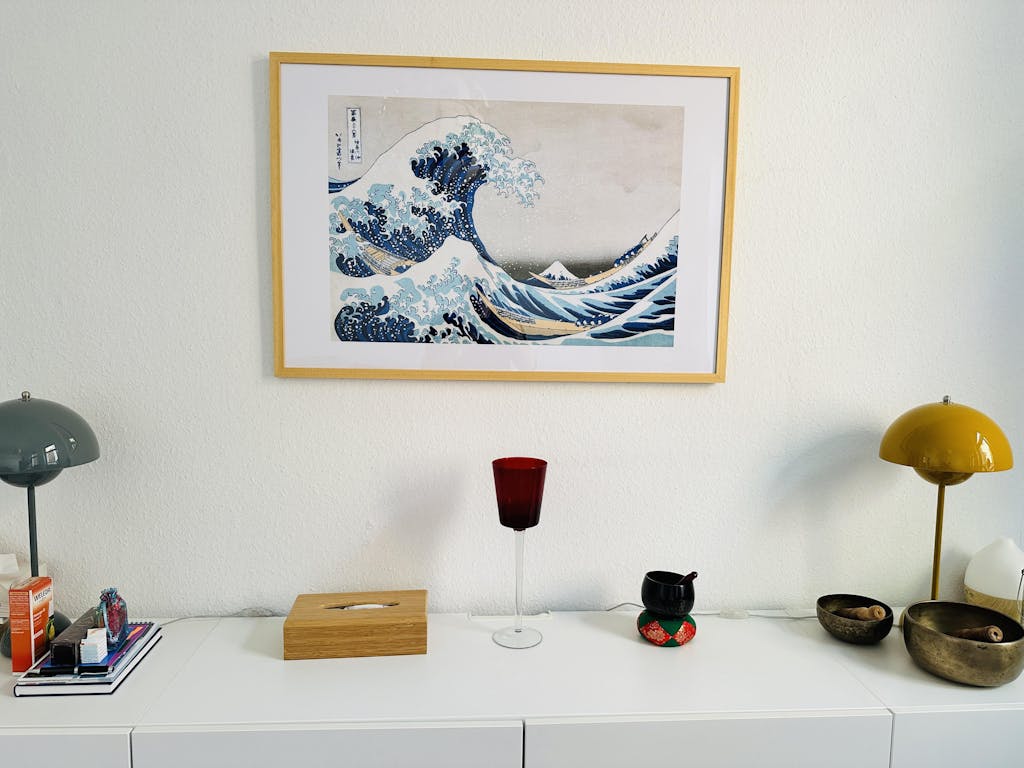
On the wall the peony reads as a quiet, generous form. Its soft colour and open ground suit a bedroom, a living room, or a hallway, and the palette sits easily with pale plaster, warm wood, and linen. Hung alone it works as a single botanical note; paired with other flower studies it builds a calm, considered group.
Available as a museum-grade fine art paper print, as a framed picture with shatter-resistant acrylic glazing, or as a satin-coated cotton canvas stretched on a wooden frame and ready to hang.
Frequently asked questions
What flower does this print show?
A single peony, the full bloom long regarded in East Asian art as the king of flowers.
Is this a woodblock print?
No. The original is a hand-coloured collotype, a photographic process with colour added by hand, not a woodblock.
What does the peony symbolise?
In East Asian tradition the peony stands for wealth, honour, and abundance.
Where does this print fit at home?
Its soft colour suits a bedroom, living room, or hallway, sitting well with pale plaster, warm wood, and linen.
<< Read Less
Japan historical period: Meiji 明治 (1868-1912)
Check out other artwork of Ogawa Kazumasa
#Botanical
•
#Botanical Photography
•
#Floral Painting
•
#Flower
•
#Japanese Art
•
#Kacho-E
•
#Nature
•
#Navy Blue
•
#Ogawa Kazumasa
•
#Peony
•
#Photography
•
#Pink
•
#Vintage
•
#White