Lotus Flowers is a photographic print by Ogawa Kazumasa (1860–1929), a pioneering Japanese photographer and publisher who played a central role in introducing photomechanical printing to Japan in the Meiji era. Where most contemporaries sought to document people or architecture, Ogawa turned his lens on botanical subjects, producing a body of close botanical studies — flowers, leaves, and plants — of extraordinary delicacy. The lotus image belongs to a series of floral photographs published in hand-coloured collotype editions during the 1890s.
The print combines photographic precision with the restrained hand-colouring typical of Ogawa’s studio: the lotus petals are rendered in soft pink and white, the broad leaves in muted green, the whole composition set against an open ground. It occupies a particular place in the history of Japanese visual art — neither woodblock print nor Western photography, but a hybrid form shaped by the Meiji encounter between two traditions.< . . . Read More >>
Lotus Flowers is a photographic print by Ogawa Kazumasa (1860–1929), a pioneering Japanese photographer and publisher who played a central role in introducing photomechanical printing to Japan in the Meiji era. Where most contemporaries sought to document people or architecture, Ogawa turned his lens on botanical subjects, producing a body of close botanical studies — flowers, leaves, and plants — of extraordinary delicacy. The lotus image belongs to a series of floral photographs published in hand-coloured collotype editions during the 1890s.
The print combines photographic precision with the restrained hand-colouring typical of Ogawa’s studio: the lotus petals are rendered in soft pink and white, the broad leaves in muted green, the whole composition set against an open ground. It occupies a particular place in the history of Japanese visual art — neither woodblock print nor Western photography, but a hybrid form shaped by the Meiji encounter between two traditions.
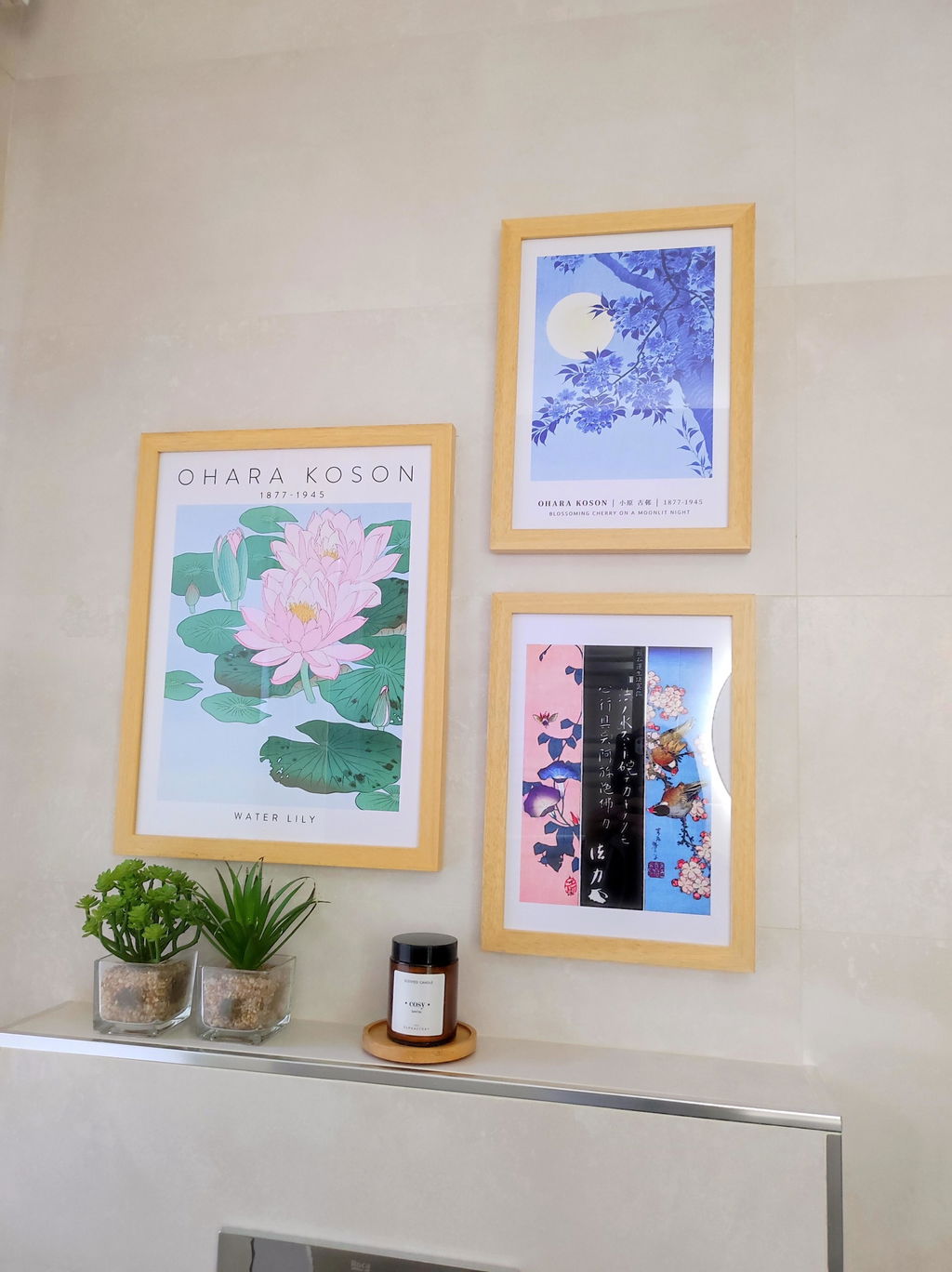
Lotus Flowers carries a quality of stillness. The lotus, rooted in water but flowering above it, has long carried associations of quiet emergence in East Asian visual culture; the image holds that quality without elaboration. It works well in a bedroom, a bathroom, or any quiet room, and pairs naturally with other botanical prints from the period.
The print is offered on thick, snow-white fine art paper, as a ready-to-hang framed edition with a wooden frame, or as a satin canvas stretched over a wooden frame.
Frequently asked questions
What technique did Ogawa Kazumasa use for this print?
Ogawa used collotype photomechanical printing, combined with delicate hand-colouring — a hybrid technique he introduced to Japan that blends photographic precision with the tonal qualities of the Japanese print tradition.
When was this lotus image made?
The image belongs to Ogawa’s botanical series of the 1890s, published during the Meiji period as part of his effort to document Japanese flora through the new medium of photography.
What does the lotus symbolise in Japanese culture?
The lotus grows in water and flowers above the surface — in East Asian visual culture it carries long associations of quiet emergence and clarity, appearing across Buddhist art and classical poetry.
How does this print work in a home?
Its stillness and soft palette suit a bedroom, a bathroom, or any quiet room. It pairs well with other botanical prints from the Meiji period.
<< Read Less
Japan historical period: Meiji 明治 (1868-1912)
Check out other artwork of Ogawa Kazumasa
#Botanical
•
#Botanical Art
•
#Botanical Illustration
•
#Botanical Print
•
#Bud
•
#Flora
•
#Floral
•
#Flowers
•
#Green
•
#Japanese Art
•
#Kacho-E
•
#Lotus
•
#Lotus Flower
•
#Minimalist Background
•
#Nature
•
#Nature Illustration
•
#Ogawa Kazumasa
•
#Pink
•
#Serene
•
#Stem
•
#Water Lily