Ogata Gekkō (1859–1920) brought the visual language of the Meiji period — its blend of traditional Japanese aesthetics and Western compositional influence — to subjects drawn from Japanese folklore. This print depicts a kitsune, a fox spirit who has assumed the form of an elegant woman, pausing beside a stream in a nocturnal landscape.
Gekkō builds the image from contrasts: the woman’s formal kimono and composed bearing against the wild quality of the night setting; the stillness of the figure against the suggested movement of water. A ghostly quality is introduced not through grotesque elements but through an ambiguity of presence — the figure is here, but not entirely.
Fox spirit imagery carries a long history in Japan, and the print works as a piece of that tradition presented with Meiji restraint. Hung in a bedroom, study, or creative space, it introduces nocturnal atmosphere and narrative depth without heaviness.
This is a gallery-style edition. On f . . . Read More >>
Ogata Gekkō (1859–1920) brought the visual language of the Meiji period — its blend of traditional Japanese aesthetics and Western compositional influence — to subjects drawn from Japanese folklore. This print depicts a kitsune, a fox spirit who has assumed the form of an elegant woman, pausing beside a stream in a nocturnal landscape.
Gekkō builds the image from contrasts: the woman’s formal kimono and composed bearing against the wild quality of the night setting; the stillness of the figure against the suggested movement of water. A ghostly quality is introduced not through grotesque elements but through an ambiguity of presence — the figure is here, but not entirely.
Fox spirit imagery carries a long history in Japan, and the print works as a piece of that tradition presented with Meiji restraint. Hung in a bedroom, study, or creative space, it introduces nocturnal atmosphere and narrative depth without heaviness.
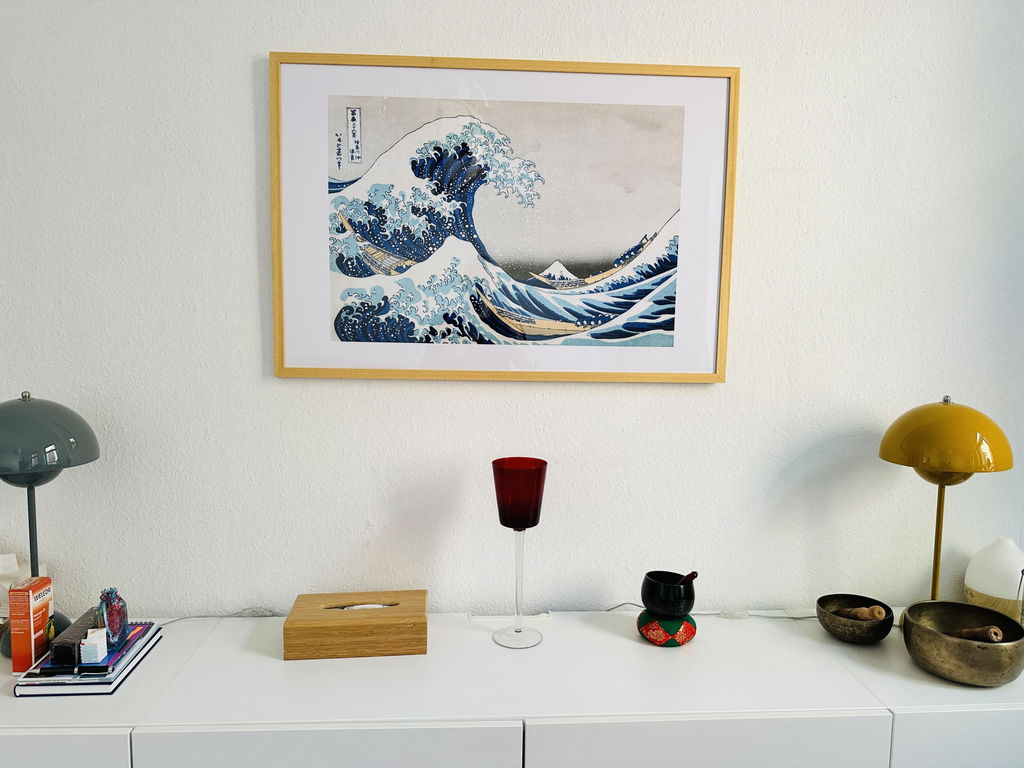
This is a gallery-style edition. On fine-art paper and framed prints, a wide printed border surrounds the image in the manner of a museum mat, holding the same proportion whether the sheet is small or large. The canvas edition is stretched over a solid wooden frame instead, and hangs without a border or additional framing. Each version is produced in Europe to order.
Frequently asked questions
What is a kitsune, and what powers does it have in Japanese folklore?
The kitsune is a fox spirit of great intelligence and longevity. As it ages, it gains additional tails — up to nine — and grows increasingly powerful. Kitsune can shape-shift into human form, most commonly appearing as women, and may be benevolent messengers of the god Inari or tricksters capable of deception.
How can you identify the supernatural nature of the figure in this print?
Gekkō suggests rather than declares. The woman’s bearing is composed, her nocturnal setting unusual. In traditional Japanese prints of kitsune in human form, subtle signs — an unusual shadow, the quality of the setting — alert the viewer without breaking the illusion entirely.
What is the kitsune’s connection to the Inari shrine?
Kitsune are closely associated with Inari, the Shintō deity of rice, fertility, and commerce. White fox statues guard Inari shrines across Japan; the kitsune is understood to be both Inari’s messenger and, in some traditions, Inari itself.
In what period was this print produced?
Gekkō worked through the Meiji era (1868–1912) into the early Taishō period. His folklore subjects drew on a tradition of supernatural imagery from ukiyo-e while treating the supernatural with a Meiji-era psychological subtlety rather than Edo-period theatrical boldness.
<< Read Less
Japan historical period: Meiji 明治 (1868-1912)
Check out other artwork of Ogata Gekko
#Bijin-Ga
•
#Floral
•
#Flowers
•
#Flute
•
#Fox-Spirit
•
#Japanese Art
•
#Japanese Woodblock Print
•
#Kimono
•
#Kitsune
•
#Ogata Gekko
•
#Parasol
•
#Stream
•
#Traditional
•
#Ukiyo-E
•
#Umbrella
•
#Woman