Ogata Gekkō (1859–1920) spent much of his career exploring how Fuji appears from every vantage point of the Japanese archipelago — hills, river mouths, and open sea. Fuji Seen From The Sea shows the mountain from a maritime perspective: dark waves and rocky shore fill the foreground, while the white cone of Fuji rises calmly above a layered sky. The composition places turbulence in the foreground and permanence in the distance — a pairing that carries both visual drama and quiet philosophical weight.
Gekkō worked in the Meiji period, when Japanese artists absorbed Western ideas of atmospheric light and natural movement without abandoning the woodblock tradition. His ocean here is closer to observation than the stylised waves of earlier printmakers — the water moves with unmeasured, physical force — while the mountain keeps the classic stillness of the Nihonga tradition. The gradations of the sky, ranging from warm amber at the horizon to pale grey above, suggest dusk or . . . Read More >>
Ogata Gekkō (1859–1920) spent much of his career exploring how Fuji appears from every vantage point of the Japanese archipelago — hills, river mouths, and open sea. Fuji Seen From The Sea shows the mountain from a maritime perspective: dark waves and rocky shore fill the foreground, while the white cone of Fuji rises calmly above a layered sky. The composition places turbulence in the foreground and permanence in the distance — a pairing that carries both visual drama and quiet philosophical weight.
Gekkō worked in the Meiji period, when Japanese artists absorbed Western ideas of atmospheric light and natural movement without abandoning the woodblock tradition. His ocean here is closer to observation than the stylised waves of earlier printmakers — the water moves with unmeasured, physical force — while the mountain keeps the classic stillness of the Nihonga tradition. The gradations of the sky, ranging from warm amber at the horizon to pale grey above, suggest dusk or dawn: a moment between two states.
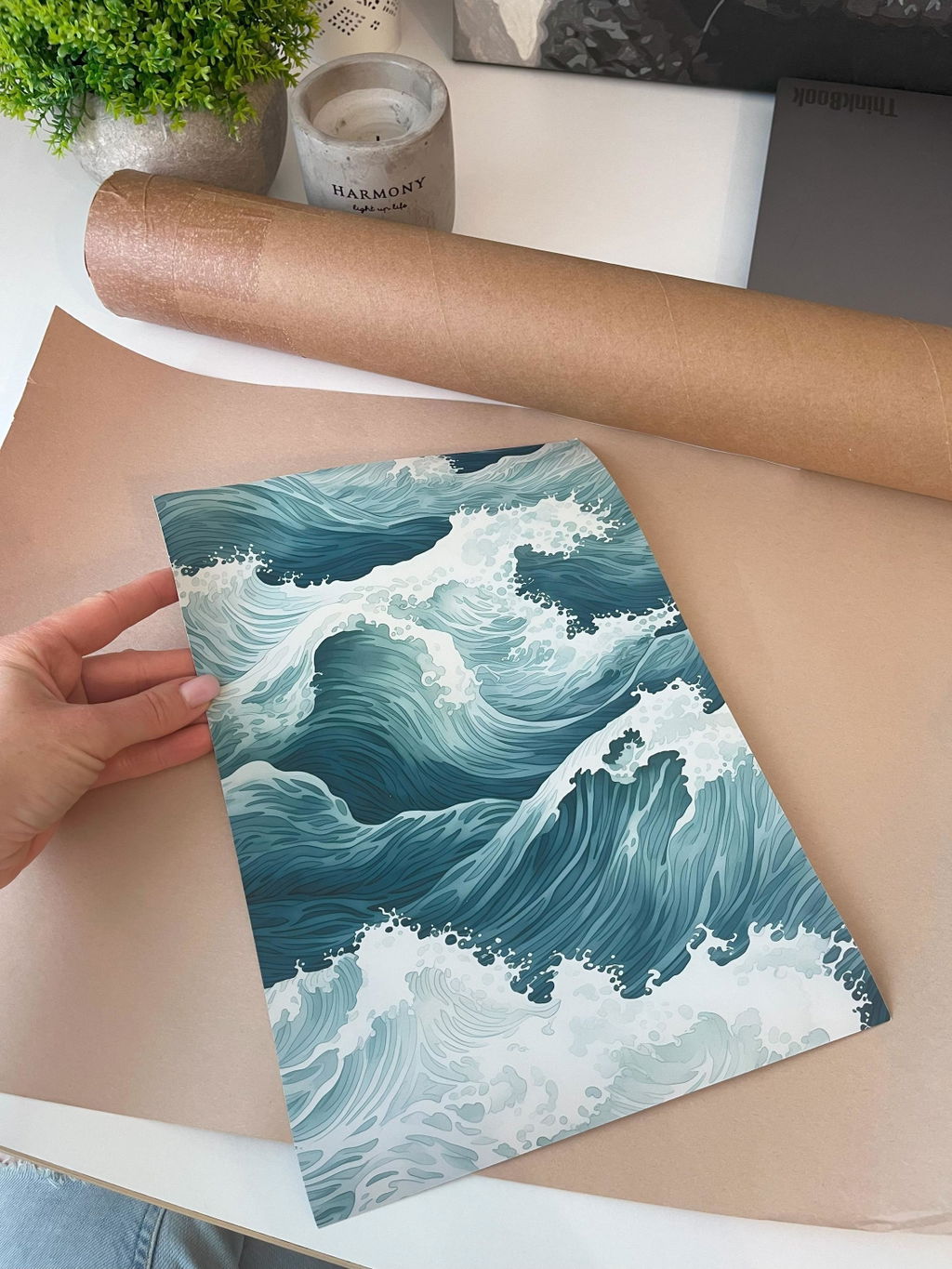
Against a white wall in an open living space, this print holds its own through contrast — the dark sea advancing, the white mountain constant. It harmonises well with light natural materials such as linen, untreated oak, and stone, where the earthy inks of the wave crests find an echo on the surrounding surfaces. The format suits both horizontal shelf display and vertical wall arrangements.
Available as a fine art paper poster or as a framed print behind shatter-resistant acrylic, which preserves the delicate tonal gradations in sky and water over time.
Frequently asked questions
What is the relationship between the waves and the mountain in this composition?
Gekkō sets the churning foreground waves in deliberate contrast to the still, distant peak. This tension between movement and permanence is a recurring motif in Japanese landscape art.
Is this part of a Fuji series?
Gekkō created several Fuji compositions, following a long tradition of Japanese printmaking from Hokusai's Thirty-six Views to Hiroshige's Fuji series. This maritime composition is among his most dramatic oceanic interpretations of the sacred mountain.
What time of day does the print suggest?
The warm amber tones at the horizon and the cooler grey above suggest dawn or dusk — a light Gekkō favoured for its atmospheric complexity and its resonance with ideas of impermanence.
Which interior styles suit this print?
The cool greens and greys harmonise particularly well in rooms with a Japandi or Scandinavian coastal style — spaces that favour natural materials and muted palettes.
<< Read Less
Japan historical period: Meiji 明治 (1868-1912)
Check out other artwork of Ogata Gekko
#Art
•
#Classic
•
#Japan
•
#Japanese
•
#Japanese Art
•
#Japanese Traditional
•
#Japanese Watercolor
•
#Japanese Woodblock Print
•
#Landscape
•
#Mount Fuji
•
#Ogata Gekko
•
#Seascape
•
#Sunset
•
#Ukiyo-E
•
#Water
•
#Watercolor
•
#Waves