Nakayama Sūgakudō worked in mid-19th-century Edo, in the kachō-e (bird-and-flower) tradition that flourished alongside late ukiyo-e. White Falcon and Five-Needled Pine belongs to his celebrated bird series published around 1859, pairing a snow-white falcon with the long needles of a pine bough. Both motifs carry strong associations in Japanese painting — the falcon with sharp vision and composure, the pine with endurance through winter.
The image was cut from cherry-wood blocks in the nishiki-e method, one block per colour, each pressed in sequence onto handmade washi paper. The falcon's plumage is built up in soft greys and ivories with bokashi shading that suggests the soft underside of feathers, while the pine needles are pressed in firmer lines. Wide negative space and a low horizon leave the bird carrying the field.
The muted palette settles easily into a calm room — pale oak, linen, off-white walls, brushed brass. It works above a low console, betwe . . . Read More >>
Nakayama Sūgakudō worked in mid-19th-century Edo, in the kachō-e (bird-and-flower) tradition that flourished alongside late ukiyo-e. White Falcon and Five-Needled Pine belongs to his celebrated bird series published around 1859, pairing a snow-white falcon with the long needles of a pine bough. Both motifs carry strong associations in Japanese painting — the falcon with sharp vision and composure, the pine with endurance through winter.
The image was cut from cherry-wood blocks in the nishiki-e method, one block per colour, each pressed in sequence onto handmade washi paper. The falcon's plumage is built up in soft greys and ivories with bokashi shading that suggests the soft underside of feathers, while the pine needles are pressed in firmer lines. Wide negative space and a low horizon leave the bird carrying the field.
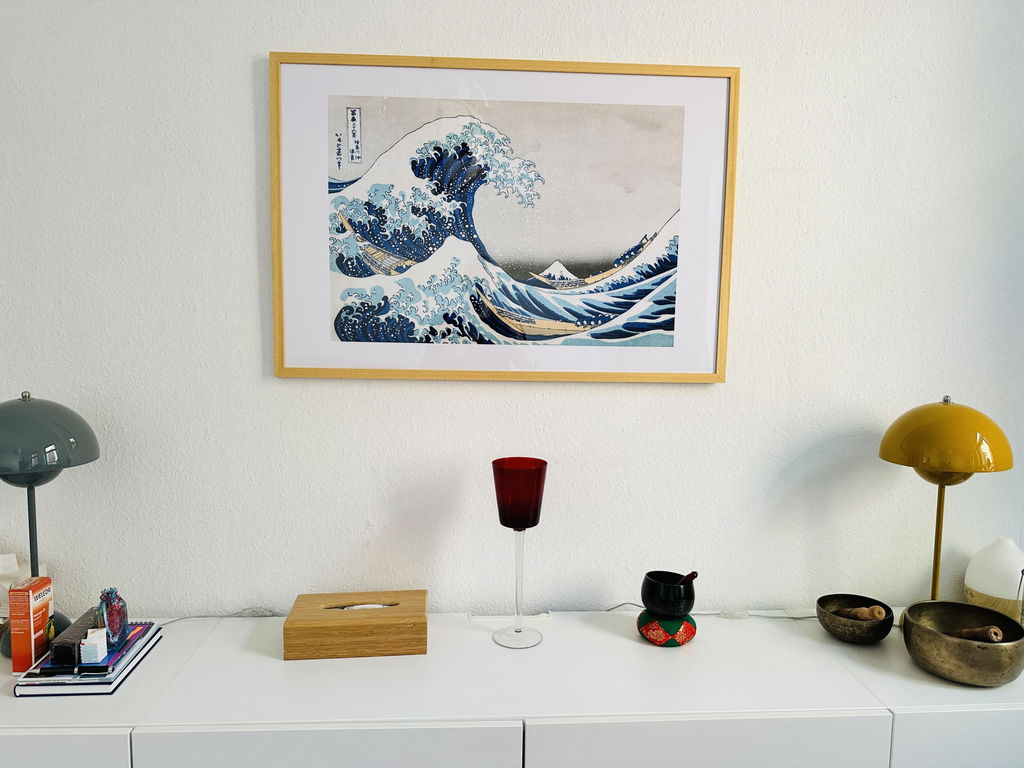
The muted palette settles easily into a calm room — pale oak, linen, off-white walls, brushed brass. It works above a low console, between two bedroom windows, or in a quiet corner of a reading nook. The image rewards distance and second looks, suiting spaces where attention slows down rather than sharpens.
Available as a museum-grade fine art paper print, as a framed picture with shatter-resistant acrylic glazing, or as a satin-coated cotton canvas stretched on a wooden frame and ready to hang.
Frequently asked questions
When was this print made?
Around 1859, in the late Edo period, as part of Sūgakudō's kachō-e bird-and-flower series published in Edo.
What does the white falcon represent?
In Japanese painting the falcon stands for sharpness of vision and quiet authority, and it was often given as a gift to mark composure under pressure.
Why is the pine paired with the bird?
The five-needled pine, with needles grouped in fives, has been linked since the Heian period with steadiness and resistance to winter, complementing the falcon's stillness.
Which interior style suits it best?
Cooler interiors with pale wood and off-white walls, where the snow-greys and ivory of the bird can read clearly without competing colour.
<< Read Less
Japan historical period: Edo 江戸 (1603-1868)
Place of origin:
Kanto region
Check out other artwork of Nakayama Sūgakudō
#Bird
•
#Falcon
•
#Japanese Wooblock Print
•
#Kacho-E
•
#Nakayama Sugakudo
•
#Ukiyo-E