Shrine in the Sun is a contemporary original composition. At its centre stands a pagoda — the multi-tiered tower that developed from the Buddhist stupa and became one of the defining structures of East Asian temple and shrine grounds. Here it appears in dark silhouette against a deep red sun, with layered hills falling away in front of it. The piece is not a copy of any historical print; it draws on the long Japanese tradition of reducing a landscape to its essential, recognisable forms.
The image is graphic, built from flat colour blocking and clean silhouettes. There is no shading; depth comes from the way the bands of colour overlap — pagoda over sun, sun over hills, hills over a warm neutral ground. The palette is warm and understated: a deep red disc, soft greens and ochres in the layered hills, a dark structure standing clear against them. It is landscape stripped to geometry while keeping its cultural legibility intact.
On a wall the piece reads as calm and . . . Read More >>
Shrine in the Sun is a contemporary original composition. At its centre stands a pagoda — the multi-tiered tower that developed from the Buddhist stupa and became one of the defining structures of East Asian temple and shrine grounds. Here it appears in dark silhouette against a deep red sun, with layered hills falling away in front of it. The piece is not a copy of any historical print; it draws on the long Japanese tradition of reducing a landscape to its essential, recognisable forms.
The image is graphic, built from flat colour blocking and clean silhouettes. There is no shading; depth comes from the way the bands of colour overlap — pagoda over sun, sun over hills, hills over a warm neutral ground. The palette is warm and understated: a deep red disc, soft greens and ochres in the layered hills, a dark structure standing clear against them. It is landscape stripped to geometry while keeping its cultural legibility intact.
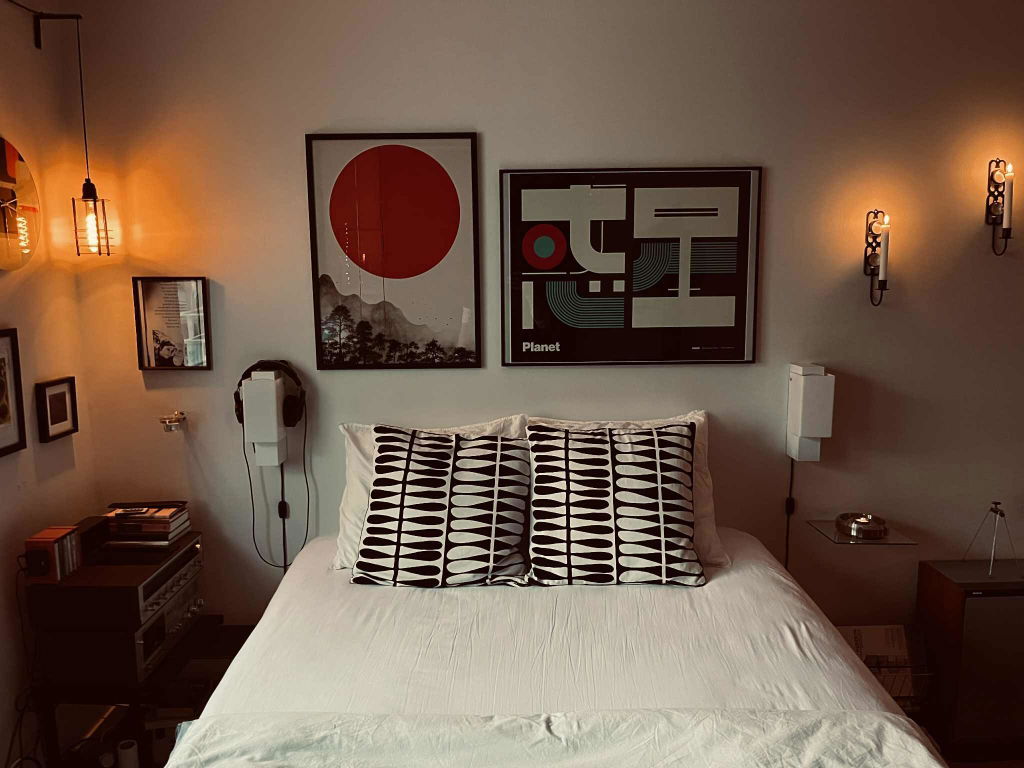
On a wall the piece reads as calm and warm rather than loud. The understated colours make it easy to place against a range of interior schemes, and the single tall structure gives a quiet vertical focus. It suits a living room, a bedroom, a study, or a hallway, and pairs naturally with linen, wood, and woven textures — the warm-neutral materials of a Japandi or Scandinavian room.
The print is available three ways: as an unframed fine-art paper print, framed behind shatter-resistant acrylic, or as a satin-coated cotton canvas. Each is produced in Europe to order.
Frequently asked questions
What type of Japanese building is depicted in this print?
The structure is a pagoda — a multi-tiered tower that developed from the Buddhist stupa and became one of the defining architectural forms of East Asian religious sites. In Japan, pagodas are typically found within shrine and temple complexes and are understood as sacred structures oriented toward the sky.
What visual tradition does this illustration draw on?
The print combines flat colour blocking and bold silhouettes — a graphic language with deep roots in Japanese design — with the landscape reduction common to contemporary Japandi aesthetics, stripping the scene to essential geometry while keeping strong cultural legibility.
What are the main colours in this composition?
A deep red for the sun, soft layered greens and ochres for the hills, and a dark silhouette for the pagoda against a warm neutral ground. The palette is warm and understated, making it easy to integrate into a range of interior colour schemes.
What interior styles does this print suit?
It fits well in Japandi, Scandinavian, and natural-material interiors that favour simplicity and warm neutrals. It works in living rooms, bedrooms, studies, and hallways, and pairs naturally with linen, wood, and woven textures.
<< Read Less
#Geometric Pattern
•
#Graphic Art
•
#Hills
•
#Japan
•
#Japanese Art
•
#Japanese Minimalist
•
#Landscape
•
#Minimalism
•
#Minimalist
•
#Minimalist Modern Graphic
•
#Modern
•
#Modern Japanese Inspired
•
#Pagoda
•
#Rising Sun
•
#Silhouette
•
#Stylized
•
#Sun
•
#Traditional Architecture
•
#Waves