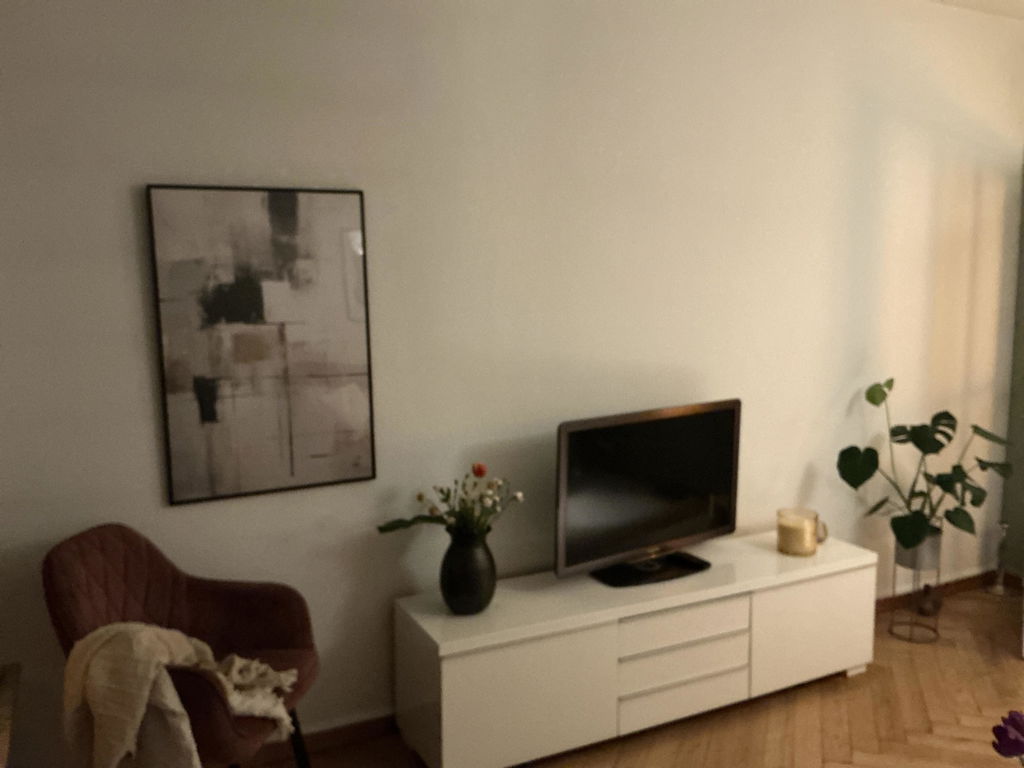
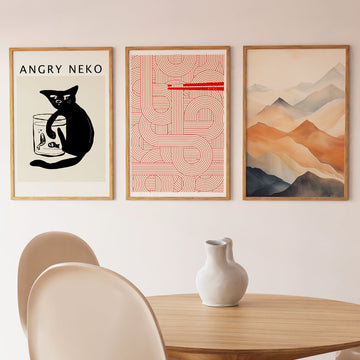
Soft horizontal brushstrokes drift across the composition in warm beige, sand and burnt sienna. The palette stays close — earth pigments laid wet against the cream ground — and the marks lean to the right, as if carried by a light wind. A small darker passage anchors the lower left, while the upper right opens into pale cream.
The work belongs to a fluid abstract tradition — Helen Frankenthaler's poured colour, Anni Albers' restrained palettes — adapted into a Japandi register where the marks stay calm and the field stays open. The pigments are applied in wet single strokes, the edges feathering naturally where they meet. There is no high contrast; warmth carries the whole composition.
The earth-toned palette settles into rooms already kept warm — linen, jute, oak and walnut, terracotta, brass. It reads calmly in bedrooms, living rooms with natural fibres, and dining rooms with stoneware on the table. The horizontal cadence works especially well above low furnitur . . . Read More >>
Soft horizontal brushstrokes drift across the composition in warm beige, sand and burnt sienna. The palette stays close — earth pigments laid wet against the cream ground — and the marks lean to the right, as if carried by a light wind. A small darker passage anchors the lower left, while the upper right opens into pale cream.
The work belongs to a fluid abstract tradition — Helen Frankenthaler's poured colour, Anni Albers' restrained palettes — adapted into a Japandi register where the marks stay calm and the field stays open. The pigments are applied in wet single strokes, the edges feathering naturally where they meet. There is no high contrast; warmth carries the whole composition.
The earth-toned palette settles into rooms already kept warm — linen, jute, oak and walnut, terracotta, brass. It reads calmly in bedrooms, living rooms with natural fibres, and dining rooms with stoneware on the table. The horizontal cadence works especially well above low furniture — a sofa, a sideboard, a bed.
Available as a fine-art print on acid-free paper, as a framed print behind shatter-resistant acrylic, or as satin-coated cotton canvas stretched over a solid wooden frame, ready to hang. Each format is made to order.
Frequently asked questions
What does the composition evoke?
The horizontal cadence and warm earth palette suggest wind moving over sand, or low desert light — but the work is abstract. The title is suggestive; viewers find their own image in the soft horizontal marks.
Which fluid painting traditions does this work draw on?
Helen Frankenthaler's soak-stain practice of poured colour and the restrained earth palettes of weavers and colourists such as Anni Albers — adapted into a quieter Japandi register with an open ground and no sharp contrast.
Which interior styles suit this print?
Warm-toned, natural-fibre rooms — linen, jute, oak, walnut, terracotta, brass. The palette sits well in bedrooms, living rooms and dining rooms where the colour scheme is already earth-based.
Why is there no strong focal point?
The composition builds on cadence rather than focus — soft horizontal marks drifting across an open field. The work is meant to calm a room rather than dominate it, in the Japandi tradition of restrained presence.
<< Read Less
#Abstract
•
#Abstract Minimalist
•
#Fluid Abstraction
•
#Minimalist
•
#Modern