Rectangular blocks fill the composition in dense, irregular rows — most in deep charcoal, a few catching pale silver-white. The blocks meet and overlap, their edges touching and parting, their surfaces carrying the dry drag of pigment laid down with weight. From a distance the field reads as solid dark; up close it resolves into a slow grid of accumulating texture.
The work belongs to the lineage of grid abstraction that runs from Russian constructivism to colour-field painting, and to the Japandi practice of registering hand-applied texture against geometric order. The grid is not mechanical: each block is its own gesture, and the small white passages act as breathing room, letting the eye rest within the dense field.
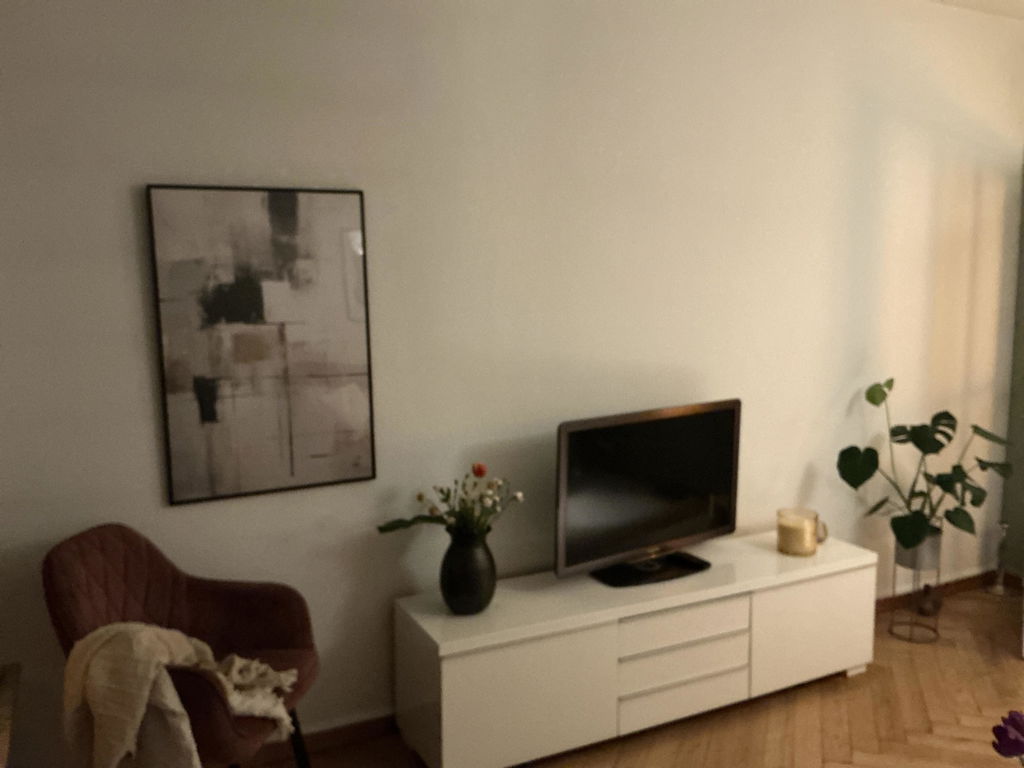
It reads strongest on a wall that can carry a darker tone. Above a console, in a contemporary living room or studio, it anchors the space without dominating it. The charcoal-silver palette stays grounded beside concrete, raw oak, blackened steel and . . . Read More >>
Rectangular blocks fill the composition in dense, irregular rows — most in deep charcoal, a few catching pale silver-white. The blocks meet and overlap, their edges touching and parting, their surfaces carrying the dry drag of pigment laid down with weight. From a distance the field reads as solid dark; up close it resolves into a slow grid of accumulating texture.
The work belongs to the lineage of grid abstraction that runs from Russian constructivism to colour-field painting, and to the Japandi practice of registering hand-applied texture against geometric order. The grid is not mechanical: each block is its own gesture, and the small white passages act as breathing room, letting the eye rest within the dense field.
It reads strongest on a wall that can carry a darker tone. Above a console, in a contemporary living room or studio, it anchors the space without dominating it. The charcoal-silver palette stays grounded beside concrete, raw oak, blackened steel and unbleached linen.
Available as a fine-art print on acid-free paper, as a framed print behind shatter-resistant acrylic, or as a satin-coated cotton canvas stretched over a solid wooden frame, ready to hang. Each format is made to order.
Frequently asked questions
What does the composition show?
A loose grid of overlapping rectangular blocks — most in deep charcoal, a few in pale silver-white — that gather into a textured dark field. The work is abstract; the subject is the rhythm and density of the marks themselves.
Does this artwork suit darker interiors?
Yes. The charcoal palette holds against dark walls and reads strongest in rooms with concrete, raw wood, blackened metal or unbleached linen. The few silver accents provide enough contrast to stay legible.
How was the texture in each block achieved?
Each block is a single dry-brush stroke, the pigment drawn so that the underlying ground shows through in places. The fine texture across the grid is part of the work, not a print artefact.
Will this print make a small room feel too dark?
The composition is dense, but the small silver passages keep light moving across the surface. In a smaller room it works best on a single, free wall, where it reads as a quiet anchor rather than a heavy block.
<< Read Less
#Abstract
•
#Abstract Minimalist
•
#Grid Abstraction
•
#Minimalist
•
#Modern
•
#Monochrome