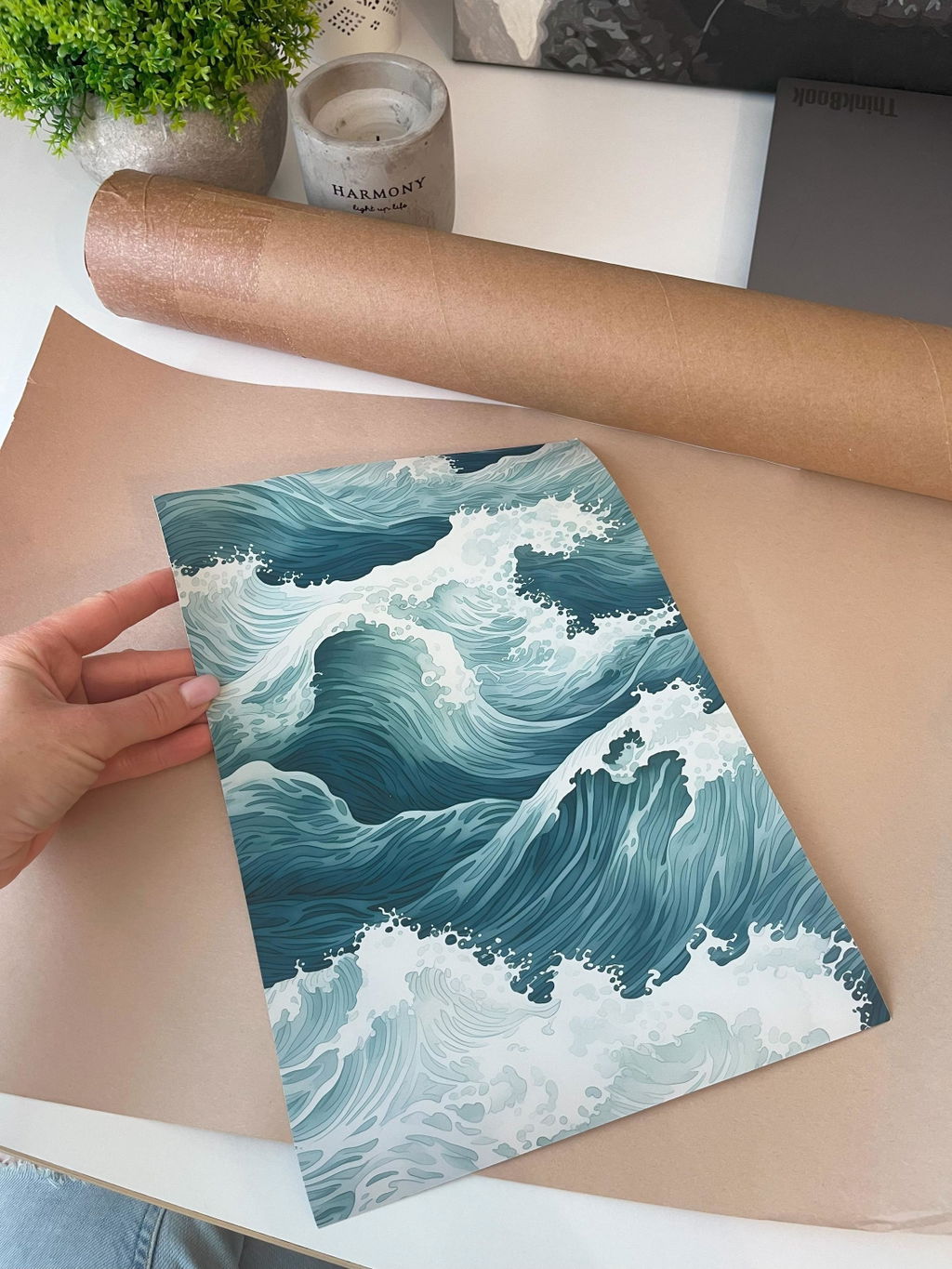
Topographic abstraction in soft monochrome — slow concentric waves, drawn like an elevation contour on a map, translated into a calm Japandi palette. The work belongs to the contemporary line of line-based minimalism: contour drawing, ink on rice paper, the cadence of a single repeated gesture.
Pale silver lines swing in nested layers, each tracing the path of the one before. The pattern reads as topography or marble: a record of slow movement, not the rendering of a particular landscape. The densities thicken and thin gently across the field, without breaking the rhythm.
It finds its place in rooms that serve slow attention — a bedroom, a study, a hallway with raw plaster. Pairs with limestone, light oak, brushed steel, undyed linen. Works especially well over a bed, beside a tall window, or as a quiet anchor on a long, otherwise empty wall.
Printed on museum-quality matte fine-art paper, framed in solid oak or black ash behind shatter-resistant acrylic gla . . . Read More >>
Topographic abstraction in soft monochrome — slow concentric waves, drawn like an elevation contour on a map, translated into a calm Japandi palette. The work belongs to the contemporary line of line-based minimalism: contour drawing, ink on rice paper, the cadence of a single repeated gesture.
Pale silver lines swing in nested layers, each tracing the path of the one before. The pattern reads as topography or marble: a record of slow movement, not the rendering of a particular landscape. The densities thicken and thin gently across the field, without breaking the rhythm.
It finds its place in rooms that serve slow attention — a bedroom, a study, a hallway with raw plaster. Pairs with limestone, light oak, brushed steel, undyed linen. Works especially well over a bed, beside a tall window, or as a quiet anchor on a long, otherwise empty wall.
Printed on museum-quality matte fine-art paper, framed in solid oak or black ash behind shatter-resistant acrylic glass, or stretched as a satin-finish cotton canvas on a wood stretcher frame. Each variant arrives ready to hang.
Frequently asked questions
Which style does Silver Serene Waves belong to?
A contemporary minimalist contour abstraction in a topographic register — nested curving lines, drawn in the cadence of a single repeated gesture. The line draws on East Asian ink drawing and Western minimalist drawing.
Does the pattern depict a real landscape?
No — the contour-like lines read as topography or marble veining, but the work stays abstract. The subject is the line itself and the way the pattern thickens and thins across the field.
Where does it work best?
Bedrooms, studies, hallways and stairwells — rooms that already invite slow attention. It harmonises especially well with raw plaster, light wood and stone, and opens up on a broad wall where it can breathe.
Which formats are available?
Poster on museum-quality matte fine-art paper, framed print in oak or black ash behind shatter-resistant acrylic glass, or satin-finish cotton canvas on a wood stretcher frame. All printed to order in Europe with archival pigment inks.
<< Read Less
#Abstract
•
#Abstract Contour
•
#Abstract Minimalist
•
#Line Art
•
#Marble
•
#Minimalist