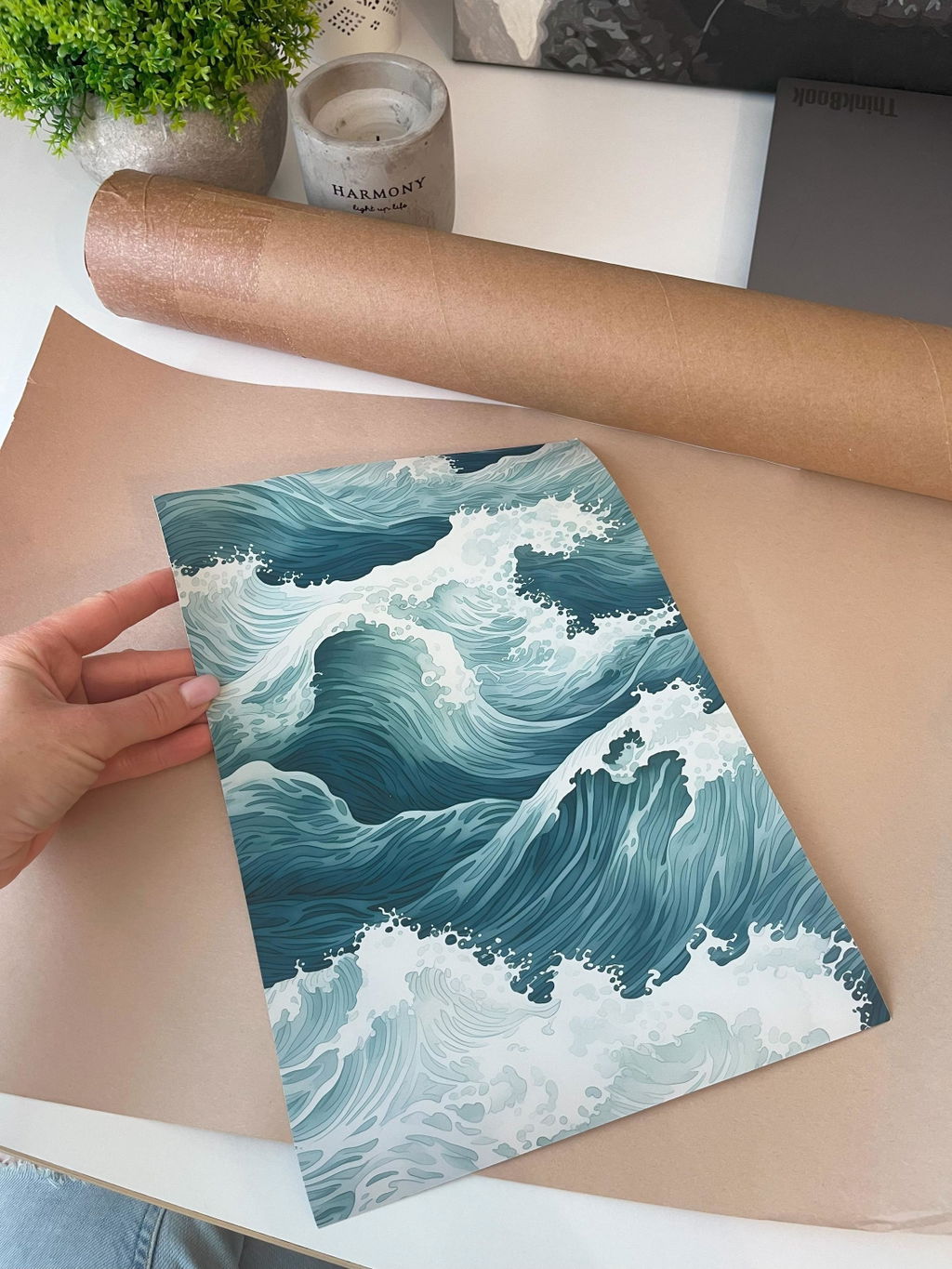
Line and wash, held at the quietest possible register — soft monochrome currents that read like a long breath outward. The work belongs to the contemporary minimalist tradition of contour painting and ink wash, with a Japandi calm that gives the surface time to settle.
Pale silver and dove-grey tones move in slow loops, drawn out of one another like the rings in polished stone or the slowest currents in clear water. No anchor, no centre — only the steady rhythm of one curve answering the next. The contrast stays delicate; nothing pulls the eye to itself.
At home in rooms that serve calm — a bedroom, a bathroom, a meditation corner. Pairs with travertine and limestone, brushed pewter, raw linen and light wood. Hangs over a bed, beside a tall window, above a basin, where the watery cadence finds an echo.
Printed on museum-quality matte fine-art paper, framed in solid oak or black ash behind shatter-resistant acrylic glass, or stretched as a satin-finish cotton . . . Read More >>
Line and wash, held at the quietest possible register — soft monochrome currents that read like a long breath outward. The work belongs to the contemporary minimalist tradition of contour painting and ink wash, with a Japandi calm that gives the surface time to settle.
Pale silver and dove-grey tones move in slow loops, drawn out of one another like the rings in polished stone or the slowest currents in clear water. No anchor, no centre — only the steady rhythm of one curve answering the next. The contrast stays delicate; nothing pulls the eye to itself.
At home in rooms that serve calm — a bedroom, a bathroom, a meditation corner. Pairs with travertine and limestone, brushed pewter, raw linen and light wood. Hangs over a bed, beside a tall window, above a basin, where the watery cadence finds an echo.
Printed on museum-quality matte fine-art paper, framed in solid oak or black ash behind shatter-resistant acrylic glass, or stretched as a satin-finish cotton canvas on a wood stretcher frame. Each variant arrives ready to hang.
Frequently asked questions
Which style does Silver Currents belong to?
A contemporary minimalist abstraction that draws on contour painting and East Asian ink wash — slow, curving forms in closely spaced monochrome tones. The visual logic is reductive: nothing but line and plane.
Why so little colour?
The work is meant to calm a room, not lead its palette. By staying within a narrow range between silver and dove grey, it reads as texture rather than colour — closer in spirit to brushed metal or wet stone than to a painted image.
Which rooms suit it best?
Bedrooms, bathrooms, dressing areas, meditation corners — anywhere the space is meant to serve quiet. It also calms busy walls: a quiet counterpoint to woven textiles, full bookshelves or a layered gallery wall.
Which formats are available?
Poster on museum-quality matte fine-art paper, framed print in oak or black ash behind shatter-resistant acrylic glass, or satin-finish cotton canvas on a wood stretcher frame. All printed to order in Europe with archival pigment inks.
<< Read Less
#Abstract
•
#Abstract Contour
•
#Abstract Minimalist
•
#Fluid
•
#Line Art
•
#Minimalist