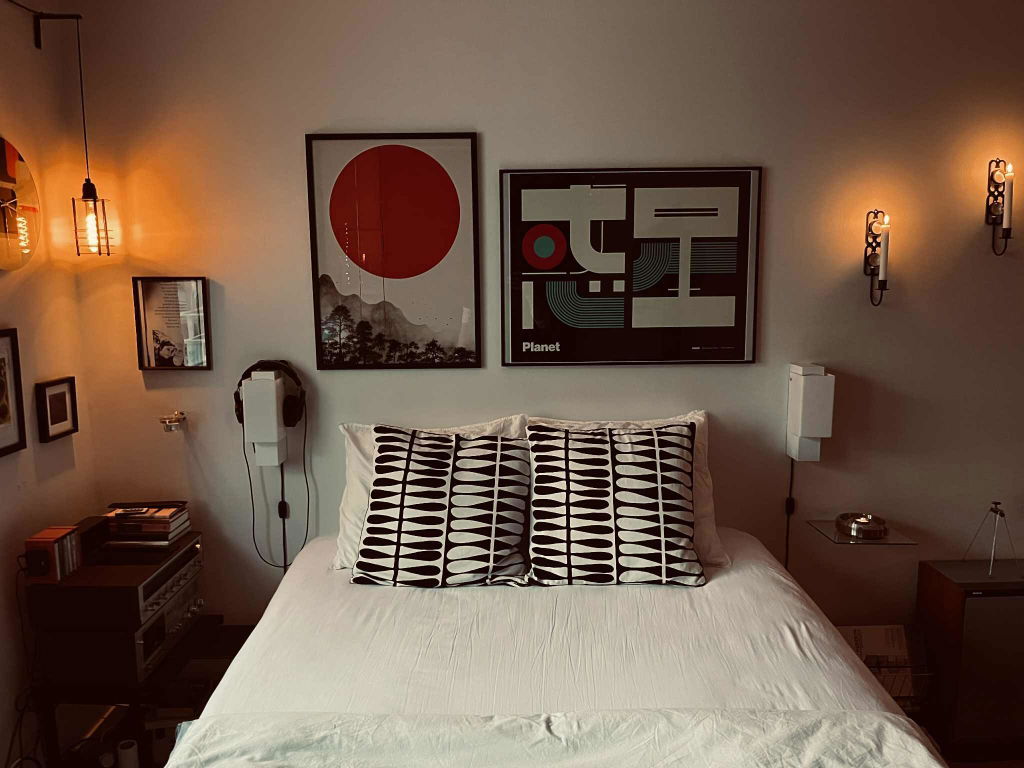
Stylised mountains fill the lower part of this composition; each peak is rendered in fine horizontal lines that map its height and shape. Above them a red sun rises — full and circular — behind the furthest ridge. The ground is cream, the palette reduced to two active elements: the linear mountain forms and the definite disc of the sun. Nothing else is needed.
The stylised mountain with line-rendered texture is a recurring convention in Japandi illustration, linking the topographic traditions of ukiyo-e woodblock print to the reductive clarity of Scandinavian graphic design. The red sun — one of the most recognisable symbols of Japanese visual identity — is placed without context or narrative, allowed to work as pure image: warmth, orientation, beginning.
The light ground and minimal palette make this work adaptable: it sits equally in a Japandi living room, a contemporary bedroom or a minimalist home office. In an entrance hall, the rising sun and mountain horizo . . . Read More >>
Stylised mountains fill the lower part of this composition; each peak is rendered in fine horizontal lines that map its height and shape. Above them a red sun rises — full and circular — behind the furthest ridge. The ground is cream, the palette reduced to two active elements: the linear mountain forms and the definite disc of the sun. Nothing else is needed.
The stylised mountain with line-rendered texture is a recurring convention in Japandi illustration, linking the topographic traditions of ukiyo-e woodblock print to the reductive clarity of Scandinavian graphic design. The red sun — one of the most recognisable symbols of Japanese visual identity — is placed without context or narrative, allowed to work as pure image: warmth, orientation, beginning.
The light ground and minimal palette make this work adaptable: it sits equally in a Japandi living room, a contemporary bedroom or a minimalist home office. In an entrance hall, the rising sun and mountain horizon set a definite tone for the space. The horizontal landscape orientation gives it a broad, panoramic quality that works well on longer stretches of wall.
Available as a print on smooth fine-art paper, as a framed print with shatter-resistant acrylic glazing, or on satin cotton canvas over a wooden stretcher. No assembly required for framed and canvas formats.
Frequently asked questions
What technique creates the mountain texture in this print?
The mountains are built from fine, closely spaced horizontal lines — a hatching technique that maps the terrain through tone and rhythm rather than colour fill. The technique references topographic illustration and the Meiji-era landscape print tradition.
What does the red sun symbolise here?
The red circle — hinode, sunrise — is among the most immediately recognisable symbols of Japanese visual identity. In this context it appears without further narrative and carries its full range of association: beginning, direction, warmth and the quality of morning light over high terrain.
Which rooms suit Sacred Gate Sunrise?
The horizontal composition works naturally above a sofa, a console or a bed. The warm red and cream palette suits rooms with natural-wood furniture, linen textiles and warm wall colours. The impression is calm, not insistent.
Does the title refer to a specific shrine or place?
The composition is not tied to a particular gate or location. The ‘sacred gate’ in the title refers to the torii tradition — the threshold between the everyday world and a sheltered space — applied here to the mountain horizon as a natural portal.
<< Read Less
#Flat Vector Japanese Minimalism
•
#Gallery-style
•
#Japan
•
#Japanese
•
#Japanese Minimalist
•
#Minimalist