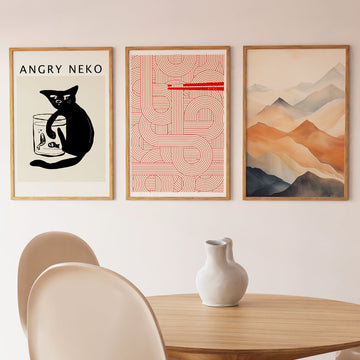
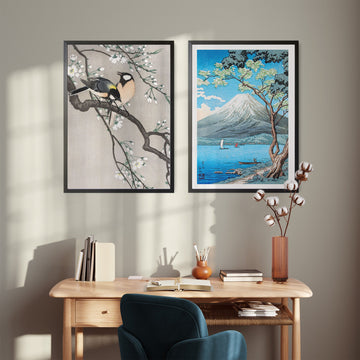
Misty Peaks holds layered mountain silhouettes that recede into atmospheric haze, the foreground rendered with slightly firmer presence, the distance dissolving toward the upper edge of the frame. The composition belongs to the East Asian atmospheric landscape tradition — to the shan shui painting of the Song dynasty (10th–13th century) and the related Japanese suiboku-ga ink-wash line — in which mountains are read through tonal weight rather than outline, and the empty register of fog carries as much meaning as the depicted form.
The technique is wet-in-wet watercolour wash with deliberately soft edges. Nearer ridges hold a slightly deeper tone; far ranges fade almost to the paper. There is no outline, no detail. The palette stays within a narrow band of cool grey, ash and pale beige, all close enough in value to read as a single atmospheric event.
The print belongs in rooms that ask for calm — bedrooms, reading corners, quiet hallways, meditation nooks. The cool . . . Read More >>
Misty Peaks holds layered mountain silhouettes that recede into atmospheric haze, the foreground rendered with slightly firmer presence, the distance dissolving toward the upper edge of the frame. The composition belongs to the East Asian atmospheric landscape tradition — to the shan shui painting of the Song dynasty (10th–13th century) and the related Japanese suiboku-ga ink-wash line — in which mountains are read through tonal weight rather than outline, and the empty register of fog carries as much meaning as the depicted form.
The technique is wet-in-wet watercolour wash with deliberately soft edges. Nearer ridges hold a slightly deeper tone; far ranges fade almost to the paper. There is no outline, no detail. The palette stays within a narrow band of cool grey, ash and pale beige, all close enough in value to read as a single atmospheric event.
The print belongs in rooms that ask for calm — bedrooms, reading corners, quiet hallways, meditation nooks. The cool pale palette sits naturally with white walls, light oak, pale linen and unglazed stoneware. The horizontal composition rewards a wider wall, above a low bed, behind a console or along the long wall of a living space.
Available as an art print on heavyweight paper, as a framed print behind shatter-resistant acrylic glazing, or as a satin-coated cotton canvas stretched over a solid wooden frame and ready to hang.
Frequently asked questions
What does Misty Peaks show?
Layered mountain silhouettes receding into atmospheric haze, the foreground slightly firmer, the distance dissolving toward the upper edge, in a cool palette of grey, ash and pale beige.
Which traditions shape the work?
The shan shui painting of the Song dynasty (10th–13th century) and the Japanese suiboku-ga ink-wash line, in which mountains are read through tonal weight rather than outline.
Are these specific mountains?
No particular place. The picture is a generalised mountain landscape, held at the edge of dissolving into fog — an atmospheric study rather than a record of a location.
Where does the print work well at home?
Above a low bed, behind a console or along the long wall of a living space, paired with white walls, light oak, pale linen and unglazed stoneware.
<< Read Less
#Abstract
•
#Abstract Minimalist
•
#Landscape
•
#Minimalist
•
#Modern
•
#Mountain
•
#Pastel
•
#Soft Mountainous