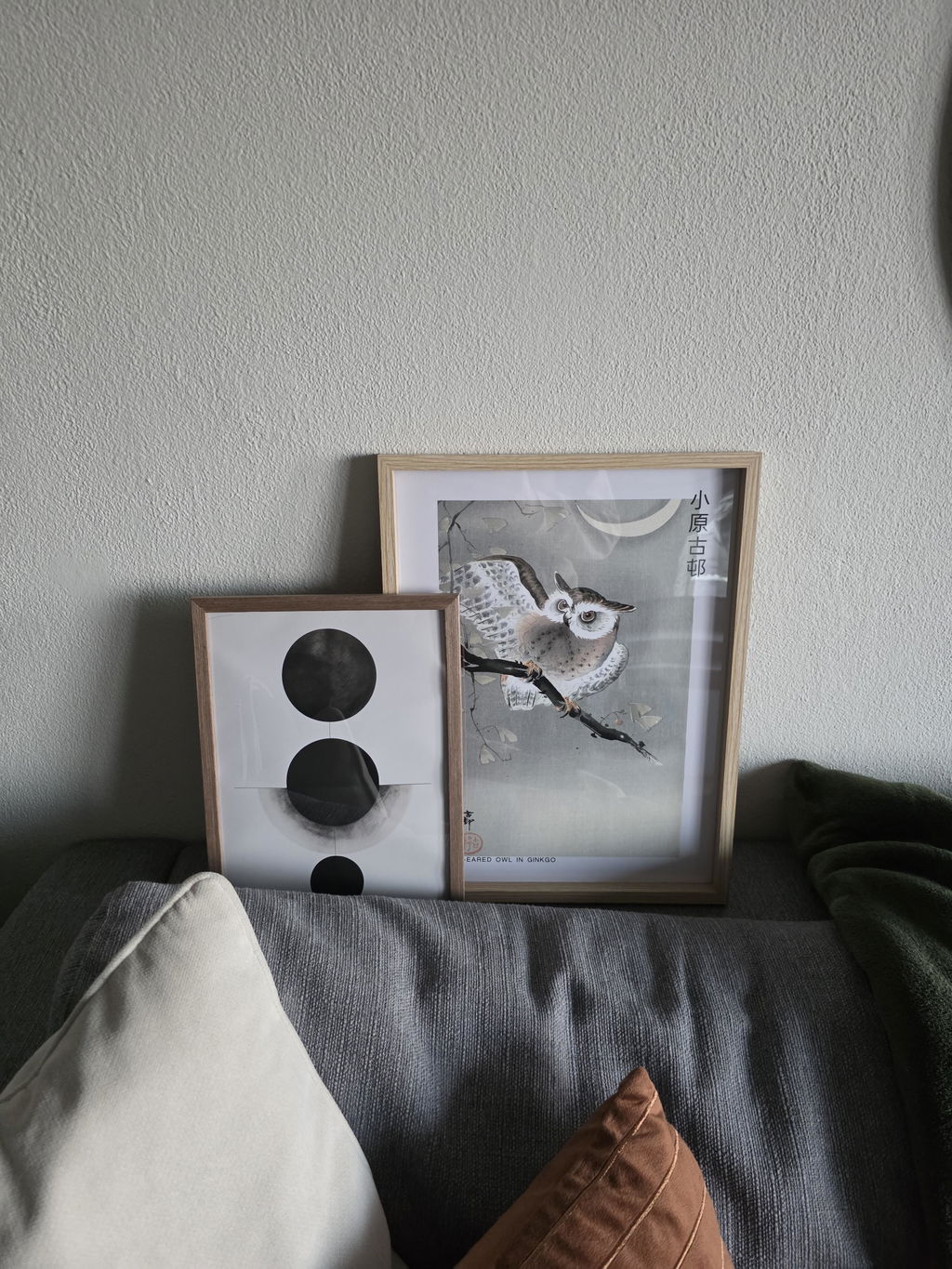
The moon — tsuki — has structured time, poetry and visual art in Japan for more than a thousand years. The monthly lunar phases gave the calendar its rhythm. Lunar Phases Balance carries that cyclical logic into geometric form: half-circles that overlap, each with its own surface and weight, together forming a composition that suggests completeness through accumulation.
Overlapping semi-circle forms with differing textured surfaces are arranged on a light beige ground. The overlap creates zones where surfaces meet, and the variety of textures — some warm, some a little cooler — introduces material differentiation without colour contrast. The beige ground is itself textured, giving the whole composition a warm, unified tone.
Lunar Phases Balance suits rooms where a warm, contemplative quality is wanted. A bedroom or living room with natural materials — unbleached linen, raw wood, stone or clay surfaces — provides the right setting.
Available as a fine-art pri . . . Read More >>
The moon — tsuki — has structured time, poetry and visual art in Japan for more than a thousand years. The monthly lunar phases gave the calendar its rhythm. Lunar Phases Balance carries that cyclical logic into geometric form: half-circles that overlap, each with its own surface and weight, together forming a composition that suggests completeness through accumulation.
Overlapping semi-circle forms with differing textured surfaces are arranged on a light beige ground. The overlap creates zones where surfaces meet, and the variety of textures — some warm, some a little cooler — introduces material differentiation without colour contrast. The beige ground is itself textured, giving the whole composition a warm, unified tone.
Lunar Phases Balance suits rooms where a warm, contemplative quality is wanted. A bedroom or living room with natural materials — unbleached linen, raw wood, stone or clay surfaces — provides the right setting.
Available as a fine-art print on museum paper or framed behind shatter-protected acrylic. Several sizes available.
Frequently asked questions
What do the overlapping semi-circles represent?
The semi-circles suggest the lunar phases — waxing and waning forms, each incomplete in itself. The overlap implies continuity: no phase exists in isolation; each leads to the next.
What surface treatment do the forms have?
Each semi-circle carries a textured surface that gives it material depth — closer to pigment or plaster than flat digital colour. The textures vary and introduce subtle warmth.
Which wall and material environment suits this print?
Light beige, cream or warm whites. Natural linen, raw wool and untreated oak and ash complement the textural quality of the print.
Which hanging context is recommended?
A bedroom or living room with natural materials. Also a reading nook or meditation space, where warmth without graphic complexity is wanted.
<< Read Less
#Abstract
•
#Geometric
•
#Geometric Abstract
•
#Geometric Minimalist
•
#Minimalist
•
#Modern