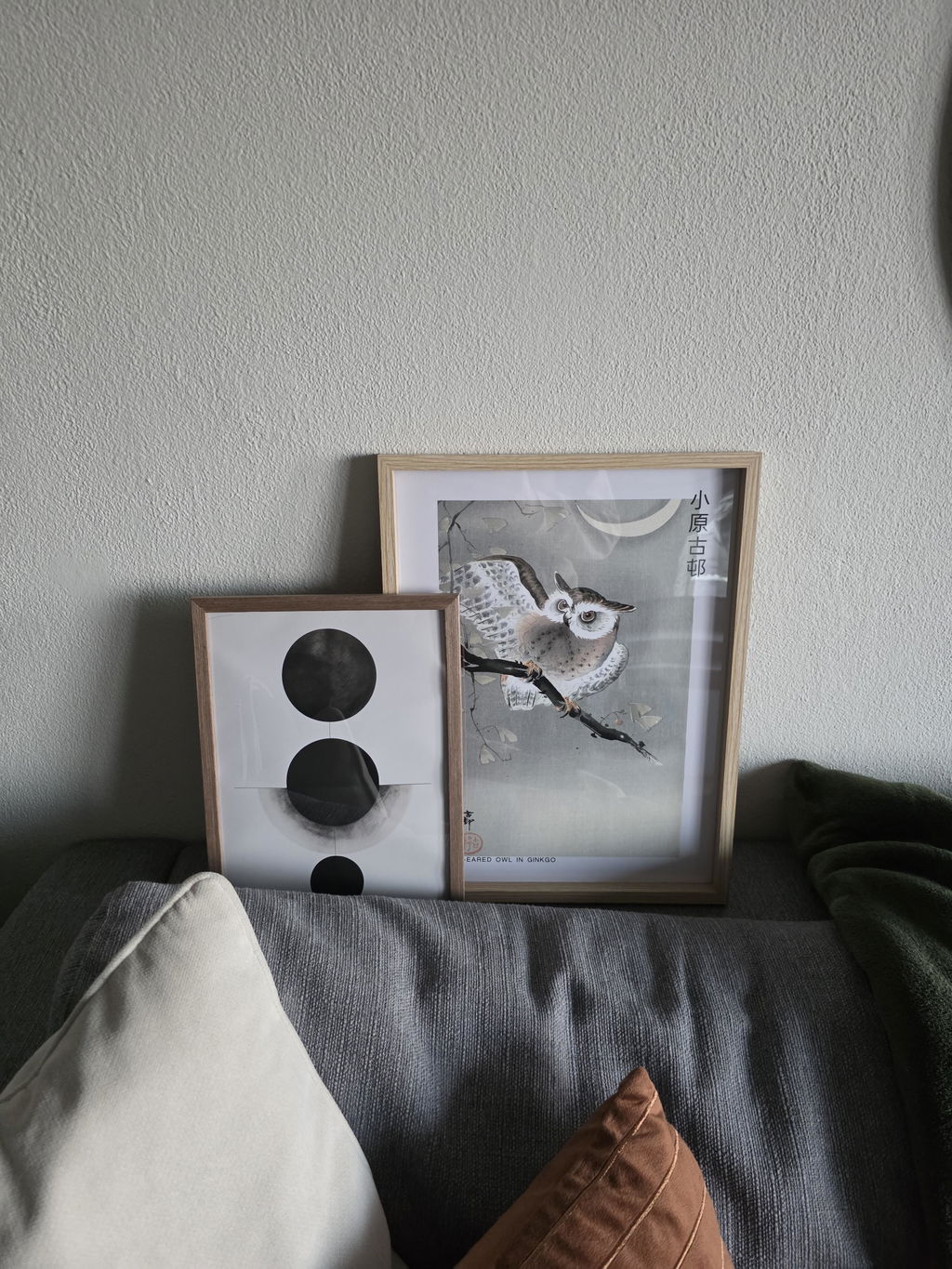
The lunar eclipse held deep cultural meaning in Japan — astronomers and poets regarded the darkened moon as a moment of transition, when the moon's familiar face disappeared into the earth's shadow. This print captures that liminal moment through overlapping circles in violet and indigo, each layer suggesting a different phase of the eclipse.
The composition pairs geometric precision with a fine surface texture, so the overlapping discs read as organic rather than mechanical. The palette runs from deep violet through sapphire blue to a quiet lavender at the edges, built up in layers that reward closer looking.
Particularly effective in rooms that favour depth and an evening atmosphere — a study, a reading corner or a bedroom wall, where the muted palette calms rather than demands. It harmonises with dark linen, slate ceramic and spaces that something contemplative on the wall enriches.
Available on archival fine-art paper and on canvas. The canvas variant ca . . . Read More >>
The lunar eclipse held deep cultural meaning in Japan — astronomers and poets regarded the darkened moon as a moment of transition, when the moon's familiar face disappeared into the earth's shadow. This print captures that liminal moment through overlapping circles in violet and indigo, each layer suggesting a different phase of the eclipse.
The composition pairs geometric precision with a fine surface texture, so the overlapping discs read as organic rather than mechanical. The palette runs from deep violet through sapphire blue to a quiet lavender at the edges, built up in layers that reward closer looking.
Particularly effective in rooms that favour depth and an evening atmosphere — a study, a reading corner or a bedroom wall, where the muted palette calms rather than demands. It harmonises with dark linen, slate ceramic and spaces that something contemplative on the wall enriches.
Available on archival fine-art paper and on canvas. The canvas variant carries the texture especially well, giving the overlapping forms a slight physical presence in the room.
Frequently asked questions
Which astronomical event inspired this print?
The composition refers to the lunar eclipse — in particular the moment of totality, when the moon lies fully in the earth's shadow and takes on those deep violet and ochre tones the palette reflects.
Are the violet and blue tones reproduced faithfully in the print?
Yes. The soft transitions between the overlapping circles are reproduced through high-resolution pigment printing, which preserves fine differences between the violet and indigo tones even in the darker areas.
Which wall colours does this image suit best?
The print harmonises with both light and darker walls — anthracite, slate grey and deep blue create especially atmospheric combinations, where the cooler violet tones come naturally into their own.
Are the circles arranged symmetrically?
The composition places the overlapping circles slightly off-centre, which gives the image movement rather than static balance — much like the actual astronomy of an eclipse, where the alignment is fleeting and dynamic.
<< Read Less
#Abstract
•
#Geometric
•
#Geometric Abstract
•
#Geometric Minimalist
•
#Minimalist
•
#Modern