Balance as a compositional aim — not symmetrical mirroring, but the quieter achievement of visual equilibrium among unequal parts — is a quality valued equally in Japanese garden design and in the Scandinavian graphic tradition. In the Japanese garden, each stone, each pine and each raked gravel plane contributes a different weight and scale; the garden works because nothing dominates. Geometric Balance applies this logic to a two-dimensional field of circles and half-circles.
Half-circles and circles in a selection of warm neutrals and muted tones are arranged on a textured light ground. No single shape dominates; each sits in a position that distributes the visual weight across the composition. The textured background takes part in the composition as a surface with a quiet quality of its own.
Geometric Balance is calm art in the best sense: present without insisting on itself, adding structure without weight, suggesting order without rigidity. It suits a reading . . . Read More >>
Balance as a compositional aim — not symmetrical mirroring, but the quieter achievement of visual equilibrium among unequal parts — is a quality valued equally in Japanese garden design and in the Scandinavian graphic tradition. In the Japanese garden, each stone, each pine and each raked gravel plane contributes a different weight and scale; the garden works because nothing dominates. Geometric Balance applies this logic to a two-dimensional field of circles and half-circles.
Half-circles and circles in a selection of warm neutrals and muted tones are arranged on a textured light ground. No single shape dominates; each sits in a position that distributes the visual weight across the composition. The textured background takes part in the composition as a surface with a quiet quality of its own.
Geometric Balance is calm art in the best sense: present without insisting on itself, adding structure without weight, suggesting order without rigidity. It suits a reading room, a bedroom or a dining-room wall.
Available as a fine-art print on museum-quality paper or framed behind shatter-resistant acrylic. Several sizes available.
Frequently asked questions
What does geometric balance mean in this composition?
The distribution of circles and half-circles achieves visual equilibrium without symmetry. Different shapes in different sizes and tones are placed so that no area feels too heavy or too empty.
Which tones are used?
Warm neutrals — cream, sand, ochre, warm grey — on shapes against a light textured ground. The restrained palette makes the balance visible.
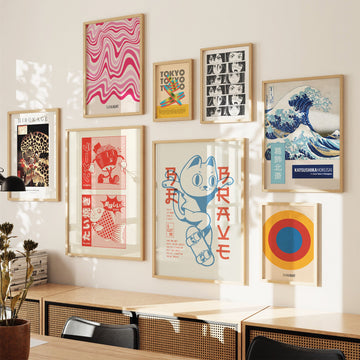
Can this print be used in a gallery wall?
Yes. Its balanced quality makes it a useful anchor in a larger arrangement, bringing formal clarity without competing for attention.
Which format suits it best?
Smaller sizes work for close-up detail; larger formats let the sense of balance carry across the room.
<< Read Less
#Abstract
•
#Arch
•
#Geometric
•
#Geometric Abstract
•
#Geometric Minimalist
•
#Minimalist
•
#Modern