A scattering of thin, fine lines moves in delicate arcs through this composition, some gathering, others fading into the white ground. Between and around the lines, soft beige washes settle — applied with water and a broad brush, their edges fading gently into the paper without a sharp boundary, only a quiet gradient from pigment to ground. The overall effect is of something caught in the moment of dissolving: marks that were made and then almost dispersed, leaving only a trace of their presence in the white field.
This is contemporary studio work in the Japandi minimalist tradition: ink and water on paper, a small number of gestures, and the ground itself treated as active content. The extreme restraint of the composition — so few marks, so much open space — reflects the East Asian principle that empty space is not absence but substance. Printed on acid-free art paper, the pale tones and fine lines of the composition are rendered precisely at any print size.
Beca . . . Read More >>
A scattering of thin, fine lines moves in delicate arcs through this composition, some gathering, others fading into the white ground. Between and around the lines, soft beige washes settle — applied with water and a broad brush, their edges fading gently into the paper without a sharp boundary, only a quiet gradient from pigment to ground. The overall effect is of something caught in the moment of dissolving: marks that were made and then almost dispersed, leaving only a trace of their presence in the white field.
This is contemporary studio work in the Japandi minimalist tradition: ink and water on paper, a small number of gestures, and the ground itself treated as active content. The extreme restraint of the composition — so few marks, so much open space — reflects the East Asian principle that empty space is not absence but substance. Printed on acid-free art paper, the pale tones and fine lines of the composition are rendered precisely at any print size.
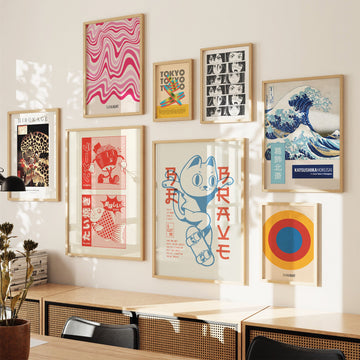
Because the work is very quiet, it functions well as part of a composed group of works rather than as a single statement. Beside a bolder composition it offers breathing room; in an assembly of similarly restrained works it completes a mood. In a bedroom or bathroom, where the overall register is calm, it can hold a wall without demanding attention. In a hallway, the delicacy of the marks rewards closer viewing over time.
Available as an art print on acid-free paper, as a framed print behind shatter-resistant acrylic, or as a satin-coated cotton canvas on a solid wood frame, ready to hang.
Frequently asked questions
Which technique is used in this composition?
The work combines thin ink lines with soft water-diluted pigment washes on a white paper ground. The washes pass into the paper without sharp edges, leaving only a gentle gradient of colour. The lines are drawn with a fine brush in a single pass and keep their natural variation.
Is this kind of minimal composition typical of Japandi design?
Yes — in both Japanese ink painting and Scandinavian design, restraint is understood as a positive quality. A composition with very few marks and much open space is not incomplete: the open space is part of the work, as much a subject as the marks themselves.
Where does this work best in a home?
Because it is very quiet, it works well in rooms where the overall atmosphere is calm: bedrooms, bathrooms, reading corners. It can also serve as breathing room beside a bolder work, or as part of a group of similarly restrained works.
Which formats are available?
Available in several standard sizes across three formats: art print, framed art print and canvas print. All options are listed on the product page.
<< Read Less
#Abstract
•
#Abstract Minimalist
•
#Expressive Abstraction
•
#Minimalist