Ethereal Contour Abstarct lays out a quiet field of overlapping forms. Fine curved lines and pale geometric planes cross one another, their edges transparent so the layers stay legible. There is no foreground figure; the image lives in the meeting of the shapes.
The composition draws on the geometric line that runs from the Bauhaus form studies into Italian mid-century design — in particular the transparent, overlapping forms of Bruno Munari. The Japandi reading holds the palette back — soft grey on cream — and lets each curve and each edge be read on its own, rather than as part of a busier field.
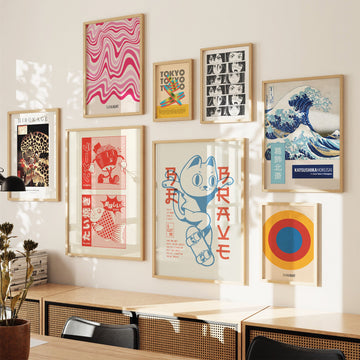
The print works as a quiet graphic anchor on a wall. It suits a study, a hallway, a bedroom or a spot above a desk; the pale palette sits with white plaster, light wood and brushed metal. It pairs well with other restrained geometric works in a small wall grouping.
The print is available in three formats. The paper version is printed on archival heavyweight paper, . . . Read More >>
Ethereal Contour Abstarct lays out a quiet field of overlapping forms. Fine curved lines and pale geometric planes cross one another, their edges transparent so the layers stay legible. There is no foreground figure; the image lives in the meeting of the shapes.
The composition draws on the geometric line that runs from the Bauhaus form studies into Italian mid-century design — in particular the transparent, overlapping forms of Bruno Munari. The Japandi reading holds the palette back — soft grey on cream — and lets each curve and each edge be read on its own, rather than as part of a busier field.
The print works as a quiet graphic anchor on a wall. It suits a study, a hallway, a bedroom or a spot above a desk; the pale palette sits with white plaster, light wood and brushed metal. It pairs well with other restrained geometric works in a small wall grouping.
The print is available in three formats. The paper version is printed on archival heavyweight paper, ready for a clip frame or custom framing. The framed version arrives ready to hang, behind shatter-resistant acrylic, which is lighter and safer than glass. The canvas version is printed on satin-coated cotton and stretched over a wood frame.
Frequently asked questions
What does the composition show?
Fine curved lines and pale geometric planes overlapping on a light ground. The edges are transparent, so all the layers stay legible; the composition is abstract.
Which traditions does the work draw on?
It belongs to the geometric line that runs from the Bauhaus form-and-colour studies to Italian mid-century design — in particular Bruno Munari's transparent overlapping forms — in a Japandi-restrained palette.
Why are the forms transparent?
The partial transparency keeps each shape legible where they cross. The work is about the meeting of the edges, not about a single solid figure.
Where does this print work best?
In a study, a hallway, a bedroom or above a desk. The pale grey-on-cream palette suits white plaster, light wood and brushed metal.
<< Read Less
#Abstract
•
#Abstract Minimalist
•
#Geometric
•
#Illustration
•
#Line Art
•
#Minimalist