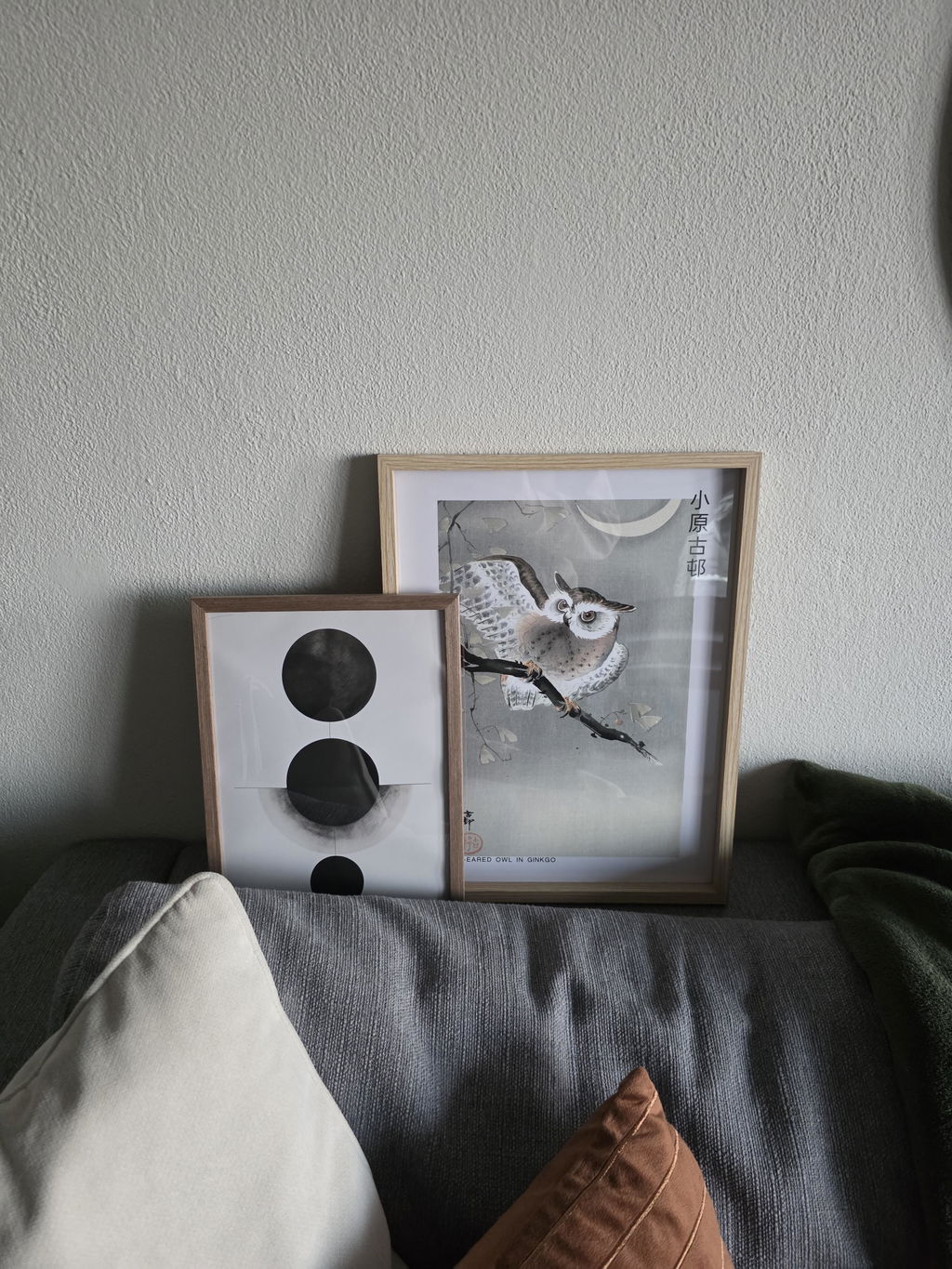
A grey watercolour circle holds the upper left of the composition, its outline soft, its surface uneven. Below it and to the right sits a small black painted square in a warm beige wash. Around them, fine drawn lines describe a second circle, sometimes crossing the painted shapes, sometimes drifting free. The cream ground holds it all without asserting itself.
The work belongs to a contemporary mixed-media tradition in which painted mark, geometric form and drawn line are allowed to coexist on a single surface. Watercolour pools, dry-brush passages of pigment and graphite-fine lines are layered with the patience of a studio sketch developed over time. The Japandi reading welcomes the visible traces of reworking.
Against a pale wall it settles into a room rather than animating it. It reads well in studies, reading corners, bedrooms and home offices — places where the eye is allowed to rest on detail. Over a desk or a low bench, the layered marks reward close lookin . . . Read More >>
A grey watercolour circle holds the upper left of the composition, its outline soft, its surface uneven. Below it and to the right sits a small black painted square in a warm beige wash. Around them, fine drawn lines describe a second circle, sometimes crossing the painted shapes, sometimes drifting free. The cream ground holds it all without asserting itself.
The work belongs to a contemporary mixed-media tradition in which painted mark, geometric form and drawn line are allowed to coexist on a single surface. Watercolour pools, dry-brush passages of pigment and graphite-fine lines are layered with the patience of a studio sketch developed over time. The Japandi reading welcomes the visible traces of reworking.
Against a pale wall it settles into a room rather than animating it. It reads well in studies, reading corners, bedrooms and home offices — places where the eye is allowed to rest on detail. Over a desk or a low bench, the layered marks reward close looking; from across the room the composition resolves into balance.
Available as a fine-art print on acid-free paper, as a framed print behind shatter-resistant acrylic, or as a satin-coated cotton canvas, stretched over a solid wood frame, ready to hang. Each format is made to order.
Frequently asked questions
What are the elements in this composition?
A soft grey watercolour circle in the upper part, a small black painted square in a warm beige wash below it, and fine drawn lines describing a second open circle through both — three painted marks and a drawn line, layered on a cream ground.
Which style or medium does the work combine?
It combines watercolour, dry-brush pigment and fine graphite-line drawing — a mixed-media studio technique. The layered marks belong to contemporary Japandi minimalism, which welcomes visible reworking.
Is this a good print for a quiet room?
Yes. The composition is calm and rewards close looking, which makes it suited to reading corners, studies, bedrooms and small offices. It is restrained enough to settle into a room rather than dominate it.
Why are the lines and circles only partly drawn?
The unfinished circle and the lines that break away from the painted shapes are intentional — the visible studio process is part of the work. Nothing is corrected or closed, in the spirit of wabi-sabi acceptance of imperfection.
<< Read Less
#Abstract
•
#Abstract Minimalist
•
#Minimalist
•
#Modern
•
#Structured Circles