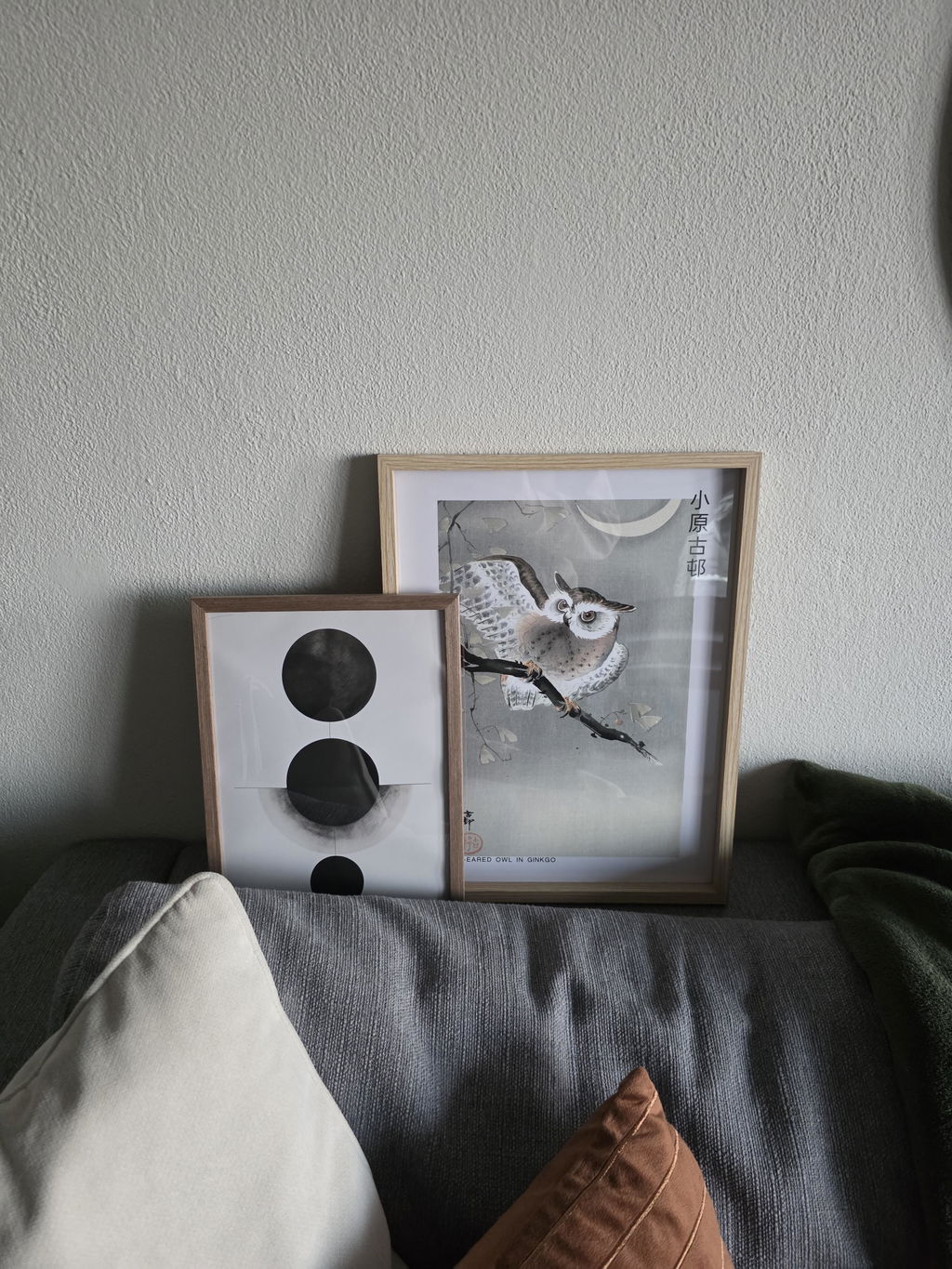
Two circular forms — one filled solid black, one drawn as a bold outline — share the picture field of this composition in close proximity, their edges lightly overlapping, their centres offset. A fine grid of lines lies beneath the whole surface, visible in the pale off-white of the paper ground, adding a secondary structural register below the dominant circle forms. The composition is simple in its elements but considered in its relationships: the filled circle is dense and heavy; the outlined circle is open and suggests the same form in a different state.
This contemporary studio work in the Japandi geometric tradition joins the visual discipline of East Asian ink composition with the graphic rigour of Scandinavian design. The juxtaposition of a filled and an outlined circle — the same form in two states — draws on the Japanese philosophical interest in things considered in relation to their own opposites: presence and outline, weight and lightness, the resolved and t . . . Read More >>
Two circular forms — one filled solid black, one drawn as a bold outline — share the picture field of this composition in close proximity, their edges lightly overlapping, their centres offset. A fine grid of lines lies beneath the whole surface, visible in the pale off-white of the paper ground, adding a secondary structural register below the dominant circle forms. The composition is simple in its elements but considered in its relationships: the filled circle is dense and heavy; the outlined circle is open and suggests the same form in a different state.
This contemporary studio work in the Japandi geometric tradition joins the visual discipline of East Asian ink composition with the graphic rigour of Scandinavian design. The juxtaposition of a filled and an outlined circle — the same form in two states — draws on the Japanese philosophical interest in things considered in relation to their own opposites: presence and outline, weight and lightness, the resolved and the open.
The work reads well from a distance — the two circles register at once as a paired composite — and holds interest up close, where the ink texture of the filled circle and the precision of the drawn outline become visible. The subtle under-grid gives the composition a quiet structure without imposing itself visually. This quality makes the work adaptable: it suits minimalist contemporary settings, Japandi interiors and rooms where clear geometry is valued alongside the evidence of the hand.
Available as a fine art print on archival paper, as a framed print behind shatter-resistant acrylic glazing, or as a satin-coated cotton canvas on a solid wooden frame, ready to hang.
Frequently asked questions
What does this composition show?
Two circles — one filled solid black, one drawn as a bold outline — occupy the composition in close proximity, their edges lightly overlapping. Beneath lies a fine grid of lines in the pale off-white ground. The relationship between the two circle states — filled and open — is the central subject of the work.
Does the pairing of filled and outlined circle carry a particular meaning?
The pairing plays with the idea of the same form in two different states: present and outlined, full and empty. In East Asian philosophical thought, the relationship between a form and its outline carries connotations of presence and potential. Here the two circles are compositional elements first; the philosophical resonance is available in the reading.
What kind of interior suits this work?
The clear geometry and graphic precision make it especially suited to minimalist contemporary and Japandi interiors. It sits well beside architectural elements such as shelves, door frames or posts, and can stand as a single work or as part of a composed group.
Which sizes and formats are available?
Available in several standard sizes across three formats: fine art print, framed fine art print and canvas print. All options are listed on the product page.
<< Read Less
#Abstract
•
#Abstract Minimalist
•
#Geometric
•
#Geometric Abstract
•
#Minimalist