Desert Dawn Silhouette belongs to the quiet meeting of two reductive traditions. On one side sits the Scandinavian and Swiss poster art of the mid-20th century, in which landscape was distilled to flat form and restrained colour. On the other sits the Japanese woodblock landscape — Hokusai and Hiroshige — in which mountains were drawn as overlapping silhouettes against open sky. The print is a contemporary studio work, not a reproduction, but it borrows its visual grammar from both lines.
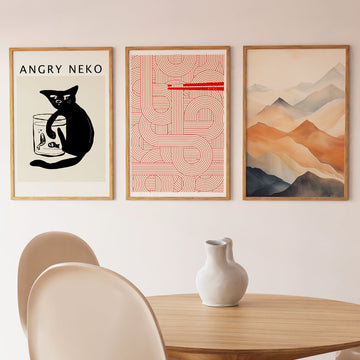
The image is built from layered mountain silhouettes in warm neutral tones — sand, taupe, dusty rose, a deeper umber at the base. The forms overlap and suggest depth without perspective lines. Above them lies a soft, even sky in pale apricot, with no sun drawn in. The treatment is graphic rather than illusionistic; the edges are clean, the planes flat, and the image reads like a calm diagram of a desert sunrise.
The print sits well in Japandi interiors and pared-back Nordic rooms . . . Read More >>
Desert Dawn Silhouette belongs to the quiet meeting of two reductive traditions. On one side sits the Scandinavian and Swiss poster art of the mid-20th century, in which landscape was distilled to flat form and restrained colour. On the other sits the Japanese woodblock landscape — Hokusai and Hiroshige — in which mountains were drawn as overlapping silhouettes against open sky. The print is a contemporary studio work, not a reproduction, but it borrows its visual grammar from both lines.
The image is built from layered mountain silhouettes in warm neutral tones — sand, taupe, dusty rose, a deeper umber at the base. The forms overlap and suggest depth without perspective lines. Above them lies a soft, even sky in pale apricot, with no sun drawn in. The treatment is graphic rather than illusionistic; the edges are clean, the planes flat, and the image reads like a calm diagram of a desert sunrise.
The print sits well in Japandi interiors and pared-back Nordic rooms — light oak floors, lime-plaster walls, linen curtains, a sheepskin on a low bench. The warm neutrals meet the natural materials, and the absence of a strong focal point lets the image settle into the room rather than dominate it. In a hallway, above a console or in a quiet bedroom, it adds depth without weight.
Available as a fine-art paper poster, as a framed print behind shatter-resistant acrylic in a handmade wooden frame, or as a satin-coated cotton canvas on a solid wood frame, ready to hang.
Frequently asked questions
Which design traditions shape this print?
The Scandinavian and Swiss poster art of the mid-20th century and the Japanese woodblock landscape with its layered mountain silhouettes. Both reduce landscape to flat form and restrained colour.
Is the motif a real place?
No. The image is a contemporary studio composition that suggests a desert sunrise through layered mountain silhouettes, but it depicts no specific location.
How does it fit a Japandi room?
Very directly — the warm neutrals meet light oak, lime plaster and linen, and the flat forms pick up the reductive logic of Japanese and Scandinavian design. The image reads as calm rather than decorative.
Which format suits a hallway?
A paper poster in a slim wooden frame works well in a hallway, since the image rewards a closer look at the layered forms. The canvas version suits longer walls, where the ready-to-hang format gives a cleaner edge.
<< Read Less
#Abstract
•
#Abstract Minimalist
•
#Art
•
#Minimalist
•
#Mountain
•
#Tones