This contemporary illustration draws on two distinct lines: the Japanese bijin-ga portrait tradition of Edo-period ukiyo-e, and the graphic poster art that emerged in Japan during the 1960s and 70s around figures such as Tadanori Yokoo and Kiyoshi Awazu. These postwar designers carried bijin-ga composition into a flat, sign-like poster language. The studio piece here continues that conversation without imitating any single source.
A figure in a red kimono stands before overlapping circular forms in soft neutral tones. The circles read as a geometric backdrop — beige, sand, ivory — printed without modelling, so the eye stays with the silhouette. The kimono is built from clear reds, the line work even and quiet, with small areas of pattern that catch the light against the matte ground.
The composition is graphic and balanced, so it carries a wall on its own, above a sideboard or in a stairwell. It sits with pale oak, plaster, undyed wool and matte ceramic, and works . . . Read More >>
This contemporary illustration draws on two distinct lines: the Japanese bijin-ga portrait tradition of Edo-period ukiyo-e, and the graphic poster art that emerged in Japan during the 1960s and 70s around figures such as Tadanori Yokoo and Kiyoshi Awazu. These postwar designers carried bijin-ga composition into a flat, sign-like poster language. The studio piece here continues that conversation without imitating any single source.
A figure in a red kimono stands before overlapping circular forms in soft neutral tones. The circles read as a geometric backdrop — beige, sand, ivory — printed without modelling, so the eye stays with the silhouette. The kimono is built from clear reds, the line work even and quiet, with small areas of pattern that catch the light against the matte ground.
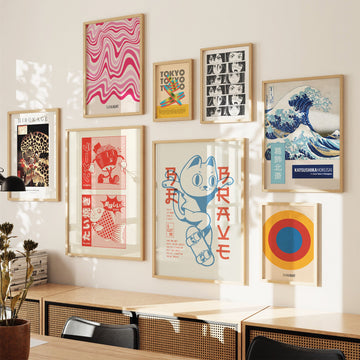
The composition is graphic and balanced, so it carries a wall on its own, above a sideboard or in a stairwell. It sits with pale oak, plaster, undyed wool and matte ceramic, and works in Japandi interiors where warm neutrals dominate. The red holds attention without competing with the textiles around it.
Available as a fine-art paper poster, as a framed print behind shatter-resistant acrylic in a handmade wooden frame, or as a satin-coated cotton canvas on a solid wood frame, ready to hang.
Frequently asked questions
Which traditions shape this print?
It draws on bijin-ga, the Edo-period ukiyo-e tradition of figurative portraiture, and on the Japanese graphic poster movement of the 1960s and 70s around designers such as Tadanori Yokoo and Kiyoshi Awazu, named here as a line of context.
What does the image show?
A figure in a red kimono stands before overlapping circles in soft neutrals — beige, sand and ivory — forming a flat, poster-like composition in which the silhouette reads clearly against the geometric backdrop.
Where does this print work best?
Above a sideboard, in a stairwell or on a hallway wall, paired with pale oak, plaster, undyed wool and matte ceramic. The red carries the wall without competing with neighbouring textiles.
Which formats are available?
Available as a fine-art paper poster, as a framed print behind shatter-resistant acrylic in a handmade wooden frame, or as a satin-coated cotton canvas on a solid wood frame, ready to hang.
<< Read Less
#Contemporary Portrait
•
#Japanese
•
#Kimono
•
#Modern
•
#Modern Japanese Art
•
#Portrait