Blooming Folklore fills the picture plane with a dense, layered arrangement of stylised flowers and foliage — peach, orange, and green forms spread across the composition without leaving open ground. Individual blooms are clearly legible: round-petalled and flat-faced, rendered in bold outline against their neighbours. The density is deliberate, the palette warm without being loud.
The tradition behind Blooming Folklore is European folk-art botany: the richly filled flower fields found in Hungarian embroidery, Polish paper-cutting, and Scandinavian painted furniture — patterns in which abundance is itself a value, where the multiplication of plant forms carries a decorative and cultural charge. The graphic simplification applied here — flat colour, bold outline, no shadow — brings that tradition into dialogue with the restrained visual language of contemporary Japandi design.
The peach, orange, and green palette works well in rooms that lean warm: dining rooms, li . . . Read More >>
Blooming Folklore fills the picture plane with a dense, layered arrangement of stylised flowers and foliage — peach, orange, and green forms spread across the composition without leaving open ground. Individual blooms are clearly legible: round-petalled and flat-faced, rendered in bold outline against their neighbours. The density is deliberate, the palette warm without being loud.
The tradition behind Blooming Folklore is European folk-art botany: the richly filled flower fields found in Hungarian embroidery, Polish paper-cutting, and Scandinavian painted furniture — patterns in which abundance is itself a value, where the multiplication of plant forms carries a decorative and cultural charge. The graphic simplification applied here — flat colour, bold outline, no shadow — brings that tradition into dialogue with the restrained visual language of contemporary Japandi design.
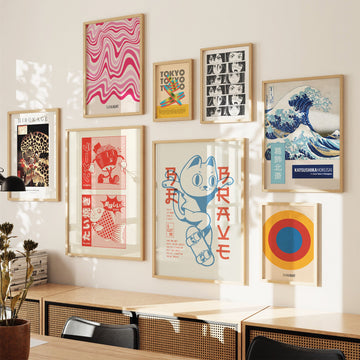
The peach, orange, and green palette works well in rooms that lean warm: dining rooms, living rooms, and entrance halls where a confident, coloured print is wanted. It reads just as well in a child's room or a kitchen. The print can anchor a wall on its own or sit as part of a group with other botanical prints.
Available as a print on fine-art paper, as a framed print with shatter-resistant acrylic, or on satin cotton canvas. Made to order.
Frequently asked questions
Which tradition does Blooming Folklore come from?
The richly filled flower field connects to European folk traditions — Hungarian embroidery, Polish paper-cutting, Scandinavian painted furniture — in which floral abundance is a primary decorative value. The graphic simplification (flat colour, bold outline) brings this into dialogue with contemporary Japandi design.
Which flowers and plants are shown?
The composition shows various stylised blooms — round-petalled, daisy-like, and abstract flower forms — along with leaf and foliage elements in sage and olive grey. Individual elements are recognisable types, not botanically precise species.
Which colour palettes complement this print?
The peach, orange, and green palette pairs well with cream-white walls, natural wood tones, and terracotta or warm ceramic accessories. It contrasts well against dark walls in a dining or kitchen setting.
Is Blooming Folklore a repeat pattern or a single composition?
It is a single composition — the flower and leaf arrangement is contained within the print boundaries and does not repeat. The density of forms gives it the feel of an all-over pattern, but it is designed as a complete, self-contained image.
<< Read Less
#Botanical
•
#Botanical Illustration
•
#Floral
•
#Geometric
•
#Illustration
•
#Minimalist
•
#Minimalist Botanical
•
#Pattern