This poster reworks one of the most endearing creatures in Japanese ink painting: the seated toad of Matsumoto Hōji, a late-Edo, early-nineteenth-century ink painter. His original sumi-e study reduced a plain amphibian to a few sure strokes, a hallmark of the Edo painting tradition, which valued the economical brushmark above ornament.
The source was made with sumi ink on paper, where one fully loaded brush drew the soft, rounded body and the watchful, faintly comic expression in a single pass. This edition keeps the original brush figure and rebuilds the surrounding space as a contemporary graphic composition: the toad sits against a bold circular motif and clean display typography. A centuries-old creature shares the wall with modern poster design.
On the wall the print brings a quiet good humour to the room. Its reduced palette and generous open space suit a reading nook, a hallway, or a study, and sit easily with pale plaster, warm oak, linen, and the other na . . . Read More >>
This poster reworks one of the most endearing creatures in Japanese ink painting: the seated toad of Matsumoto Hōji, a late-Edo, early-nineteenth-century ink painter. His original sumi-e study reduced a plain amphibian to a few sure strokes, a hallmark of the Edo painting tradition, which valued the economical brushmark above ornament.
The source was made with sumi ink on paper, where one fully loaded brush drew the soft, rounded body and the watchful, faintly comic expression in a single pass. This edition keeps the original brush figure and rebuilds the surrounding space as a contemporary graphic composition: the toad sits against a bold circular motif and clean display typography. A centuries-old creature shares the wall with modern poster design.
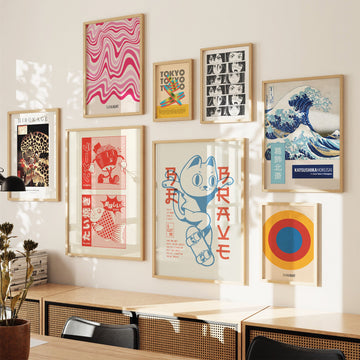
On the wall the print brings a quiet good humour to the room. Its reduced palette and generous open space suit a reading nook, a hallway, or a study, and sit easily with pale plaster, warm oak, linen, and the other natural materials of the Japandi look. Hung alone it works as a single graphic accent; grouped with other ink studies it anchors a small gallery wall.
Available as a museum-grade fine art paper print, as a framed picture with shatter-resistant acrylic glazing, or as a satin-coated cotton canvas stretched on a wooden frame and ready to hang.
Frequently asked questions
What animal does this poster show?
It is the seated toad from Matsumoto Hōji's well-known ink study, a relaxed amphibian drawn in a few strokes, here set into a modern graphic layout.
How does this version differ from the ink original?
The original brush figure is kept, while the background is rebuilt as a contemporary streetart composition with a bold circular motif and display lettering.
Does the frog carry meaning in Japanese culture?
The frog, kaeru, sounds like the Japanese word for returning home, so the motif is often linked with safe return and good fortune.
Where does this print work best at home?
Its calm colour and open space suit a hallway, reading nook, or study, sitting well with oak, linen, and pale walls.
<< Read Less
Japan historical period: Edo 江戸 (1603-1868)
Check out other artwork of Matsumoto Hoji
#Animal
•
#Frog
•
#Humorous
•
#Japanese Pop Art
•
#Matsumoto Hoji
•
#Minimalist
•
#Modern Graphic Design
•
#Pop Art
•
#Retro
•
#Streetart
•
#Typography