A beauty attends to her hair, a comb, or kushi, at hand, in this colour woodblock after Kitagawa Utamaro (c. 1753–1806), the master most associated with bijin-ga, the picture of a beautiful woman. Utamaro favoured such intimate, everyday moments over grand scenes, drawing a private gesture with unhurried attention. The comb gives the print its name and a quiet focus.
The print is made from several hand-carved blocks, one per colour, printed onto paper. Utamaro's hand shows most in line: the supple, flowing contour of the figure, restrained colour, and a generous use of empty space that keeps attention on the sitter. The result is a portrait that feels close and calm.
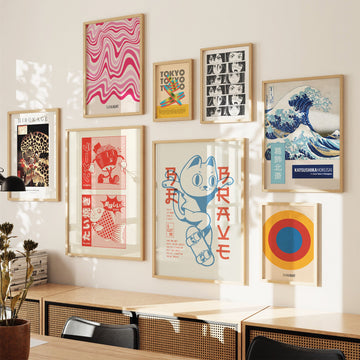
On a wall the image is gentle and composed. Its soft palette and open ground settle easily beside wood, linen and neutral tones, in the manner of a pared-back room. It suits a bedroom, a dressing area, or a quiet sitting room.
This is a gallery-style edition. On fine-art paper and framed prin . . . Read More >>
A beauty attends to her hair, a comb, or kushi, at hand, in this colour woodblock after Kitagawa Utamaro (c. 1753–1806), the master most associated with bijin-ga, the picture of a beautiful woman. Utamaro favoured such intimate, everyday moments over grand scenes, drawing a private gesture with unhurried attention. The comb gives the print its name and a quiet focus.
The print is made from several hand-carved blocks, one per colour, printed onto paper. Utamaro's hand shows most in line: the supple, flowing contour of the figure, restrained colour, and a generous use of empty space that keeps attention on the sitter. The result is a portrait that feels close and calm.
On a wall the image is gentle and composed. Its soft palette and open ground settle easily beside wood, linen and neutral tones, in the manner of a pared-back room. It suits a bedroom, a dressing area, or a quiet sitting room.
This is a gallery-style edition. On fine-art paper and framed prints, a wide printed border surrounds the image in the manner of a museum mat, holding the same proportion whether the sheet is small or large. The canvas edition is stretched over a solid wooden frame instead, and hangs without a border or additional framing. Each version is produced in Europe to order.
Frequently asked questions
What does this print depict?
A beauty attending to her hair, with a comb (kushi) at hand, an intimate everyday moment in the bijin-ga tradition of portraits of beautiful women.
What is a kushi?
Kushi is the Japanese word for a comb, a recurring motif in Utamaro's portraits and a quiet emblem of grooming and personal care.
What makes Utamaro's style recognisable?
Utamaro is known for the flowing, supple line of his figures, restrained colour, and generous use of empty space to focus attention on the sitter.
Where does this print suit best?
Its calm palette suits a bedroom, dressing area or quiet sitting room, pairing well with wood, linen and soft neutral tones.
<< Read Less
Japan historical period: Edo 江戸 (1603-1868)
Check out other artwork of Kitagawa Utamaro
#Bijin-Ga
•
#Colorful
•
#Fan
•
#Fashion
•
#Japanese Art
•
#Kimono
•
#Kitagawa Utamaro
•
#Pattern
•
#Pink
•
#Portrait
•
#Traditional
•
#Ukiyo-E
•
#Woman
•
#Ōkubi-E