This plate is part of Collected Illustrations of Japanese Toys, the woodblock album in which Kawasaki Kyōsen (1877–1942) recorded the folk playthings of old Japan. As an omocha-e, a toy picture, it shows a large black whale toy, its body arched and a fine spray rising from its blowhole, resting on a low base patterned with stylised waves.
Kyōsen drew the toy from observation and cut it as a woodblock. The deep black of the whale, the red of its open mouth and the blue-and-cream wave pattern below are laid in as flat, confident colour. The thin lines of the spout lift the eye, while the cream paper keeps the heavy black shape clear and grand.
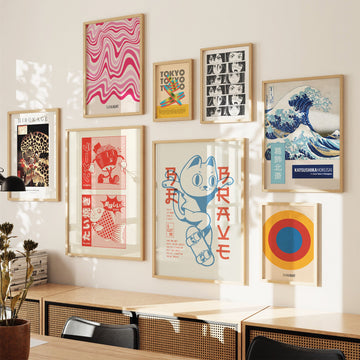
On a wall the plate has a calm, surprising presence. The whale is bold yet drawn with the album's quiet hand, an emblem of the sea brought indoors as a child's toy. It suits a child's room, a bathroom, or a cool corner that enjoys an unexpected subject.
Printed on heavy fine-art paper with a soft natura . . . Read More >>
This plate is part of Collected Illustrations of Japanese Toys, the woodblock album in which Kawasaki Kyōsen (1877–1942) recorded the folk playthings of old Japan. As an omocha-e, a toy picture, it shows a large black whale toy, its body arched and a fine spray rising from its blowhole, resting on a low base patterned with stylised waves.
Kyōsen drew the toy from observation and cut it as a woodblock. The deep black of the whale, the red of its open mouth and the blue-and-cream wave pattern below are laid in as flat, confident colour. The thin lines of the spout lift the eye, while the cream paper keeps the heavy black shape clear and grand.
On a wall the plate has a calm, surprising presence. The whale is bold yet drawn with the album's quiet hand, an emblem of the sea brought indoors as a child's toy. It suits a child's room, a bathroom, or a cool corner that enjoys an unexpected subject.
Printed on heavy fine-art paper with a soft natural-white surface. Framed editions arrive behind shatter-resistant acrylic in a slim wooden moulding; the canvas option is a satin-coated cotton weave. The black stays deep without overwhelming.
Frequently asked questions
What is shown in this print?
A large black whale toy with an arched body and a fine spout of water, resting on a base patterned with stylised waves — drawn from the actual toy.
Why a whale toy?
The sea and its creatures were a favourite folk-toy subject; a spouting whale gave children a bold, lively plaything tied to good fortune from the ocean.
Which album is this from?
It is plate Nr. 9 of Kyōsen's Collected Illustrations of Japanese Toys (Kyōsen Omocha-shū), a record of traditional folk toys.
Where does this print fit at home?
Its calm, surprising presence suits a child's room, a bathroom, or a cool corner with an unexpected subject.
<< Read Less
Japan historical period: Taisho 大正 (1912-1925)
Check out other artwork of Kawasaki Kyosen
#Art
•
#Bold Graphic
•
#Classic
•
#Geometric
•
#Illustration
•
#Japanese
•
#Japanese Illustration
•
#Kawasaki Kyosen
•
#Modern
•
#Modern Japanese Art
•
#Sketch