This plate comes from Collected Illustrations of Japanese Toys, the woodblock album recorded by Kawasaki Kyosen (1877–1942) in the early twentieth century. Across the series Kyosen documented the folk playthings of Japan one sheet at a time, and here he gathers a decorated festival fan crowned with radiating rays, a small red-faced mask, and a folk dog toy at the lower edge.
The print belongs to the genre of omocha-e, or pictures of toys. Kyosen drew each object from observation and had it cut and printed by hand, so the flat planes of vermilion, ochre and ink sit cleanly against the bare cream ground. Nothing is staged in a scene; the toys float on the page the way a collector might lay them out for study.
On a wall the sheet reads as quiet pattern rather than busy illustration. The wide margins and the single group of objects give the eye room to rest, which suits a reading corner, a hallway, or a shelf above a low cabinet. It also sits natural . . . Read More >>
This plate comes from Collected Illustrations of Japanese Toys, the woodblock album recorded by Kawasaki Kyosen (1877–1942) in the early twentieth century. Across the series Kyosen documented the folk playthings of Japan one sheet at a time, and here he gathers a decorated festival fan crowned with radiating rays, a small red-faced mask, and a folk dog toy at the lower edge.
The print belongs to the genre of omocha-e, or pictures of toys. Kyosen drew each object from observation and had it cut and printed by hand, so the flat planes of vermilion, ochre and ink sit cleanly against the bare cream ground. Nothing is staged in a scene; the toys float on the page the way a collector might lay them out for study.
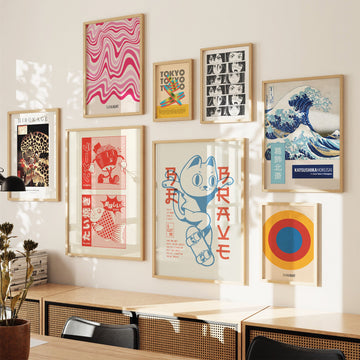
On a wall the sheet reads as quiet pattern rather than busy illustration. The wide margins and the single group of objects give the eye room to rest, which suits a reading corner, a hallway, or a shelf above a low cabinet. It also sits naturally beside other plates from the same album when hung as a small grid.
Available as an unframed print on thick matte paper, framed behind shatter-resistant acrylic, or as a satin-coated cotton canvas. Each option keeps the soft paper tone and the crisp woodblock line of the original sheet.
Frequently asked questions
What is shown in this print?
A folk festival fan with radiating rays, a small red toy mask, and a papier-mâché dog toy — a group of traditional Japanese playthings drawn from life.
Who recorded this image and when?
Kawasaki Kyosen (1877–1942) documented it for his album of Japanese toys in the early twentieth century, working in the woodblock tradition.
What does omocha-e mean?
Omocha-e are woodblock pictures of toys. The genre treats everyday folk objects as worthy subjects, recording their shapes and colours with care.
Where does this print work best at home?
Its calm composition and wide margins suit a reading nook, hallway or shelf, and it groups well with other plates from the same toy series.
<< Read Less
Japan historical period: Taisho 大正 (1912-1925)
Check out other artwork of Kawasaki Kyosen
#Art
•
#Classic
•
#Haunting Mask Display
•
#Japanese
•
#Japanese Traditional
•
#Japanese Woodblock Print
•
#Kawasaki Kyosen
•
#Sketch
•
#Ukiyo-E