This plate from the Collected Illustrations of Japanese Toys (Kyōsen Omocha-shū) by Kawasaki Kyosen (1877–1942) shows a rabbit puppet mounted on a red stick-frame above a white rabbit toy with red-tipped ears. The rabbit, a creature of the moon and of good fortune in Japan, was a recurring folk-toy subject, and Kyosen recorded these two among the playthings he gathered across the country.
The sheet is omocha-e, the picture of toys, drawn from life and printed by woodblock. The puppet's red frame is set against the open paper, the white rabbit laid in soft colour below with its ears tipped in red, and a red seal placed at the side. The flat colour and calm line keep the toys light and clear.
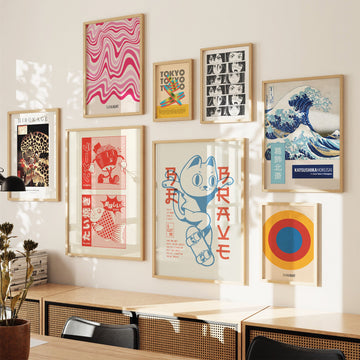
On a wall the print is playful and gentle. The two rabbits give a room a soft, good-humoured focus against the pale ground. It suits a child's room, a nursery, or a hallway, and pairs naturally with pale wood and other folk-art prints.
Each print is made to order on thick . . . Read More >>
This plate from the Collected Illustrations of Japanese Toys (Kyōsen Omocha-shū) by Kawasaki Kyosen (1877–1942) shows a rabbit puppet mounted on a red stick-frame above a white rabbit toy with red-tipped ears. The rabbit, a creature of the moon and of good fortune in Japan, was a recurring folk-toy subject, and Kyosen recorded these two among the playthings he gathered across the country.
The sheet is omocha-e, the picture of toys, drawn from life and printed by woodblock. The puppet's red frame is set against the open paper, the white rabbit laid in soft colour below with its ears tipped in red, and a red seal placed at the side. The flat colour and calm line keep the toys light and clear.
On a wall the print is playful and gentle. The two rabbits give a room a soft, good-humoured focus against the pale ground. It suits a child's room, a nursery, or a hallway, and pairs naturally with pale wood and other folk-art prints.
Each print is made to order on thick, smooth fine-art paper, framed behind shatter-resistant acrylic, or as a satin-coated cotton canvas. Choose the format that suits your wall.
Frequently asked questions
What does this print show?
A rabbit puppet on a red stick-frame above a white rabbit toy with red-tipped ears, drawn from life.
Why a rabbit?
In Japan the rabbit is a creature of the moon and of good fortune, a recurring subject among folk toys and festival charms.
Where does the image come from?
From Kawasaki Kyosen's Collected Illustrations of Japanese Toys, an album of omocha-e recording the folk toys of early twentieth-century Japan.
Where does it suit best?
In a child's room, a nursery, or a hallway, where the two rabbits add a soft, good-humoured note.
<< Read Less
Japan historical period: Taisho 大正 (1912-1925)
Check out other artwork of Kawasaki Kyosen
#Art
•
#Classic
•
#Folk
•
#Japanese
•
#Japanese Traditional
•
#Kawasaki Kyosen
•
#Puppet Performance Art
•
#Rabbit
•
#Sketch
•
#Uncategorized