This plate is part of Collected Illustrations of Japanese Toys, the woodblock album in which Kawasaki Kyōsen (1877–1942) recorded the folk playthings of old Japan. As an omocha-e, a toy picture, it presents a decorated festival horse toy — a red body with a beaded saddle, a flowing black mane and slender carrying poles — standing alone on the open sheet.
Kyōsen drew the toy from observation and cut it as a woodblock. The deep red of the body, the patterned saddlecloth and the heavy black of the mane and tail are laid in as flat, confident colour. The cream paper around the horse stays clear, so the single object holds the whole sheet.
On a wall the plate has a proud, upright presence. The festival horse reads as both plaything and emblem, its rich red giving the room a warm focal point. It suits an entryway, a study, or a child's room that can carry one strong colour.
Printed on heavy fine-art paper with a soft natural-white surface. Framed . . . Read More >>
This plate is part of Collected Illustrations of Japanese Toys, the woodblock album in which Kawasaki Kyōsen (1877–1942) recorded the folk playthings of old Japan. As an omocha-e, a toy picture, it presents a decorated festival horse toy — a red body with a beaded saddle, a flowing black mane and slender carrying poles — standing alone on the open sheet.
Kyōsen drew the toy from observation and cut it as a woodblock. The deep red of the body, the patterned saddlecloth and the heavy black of the mane and tail are laid in as flat, confident colour. The cream paper around the horse stays clear, so the single object holds the whole sheet.
On a wall the plate has a proud, upright presence. The festival horse reads as both plaything and emblem, its rich red giving the room a warm focal point. It suits an entryway, a study, or a child's room that can carry one strong colour.
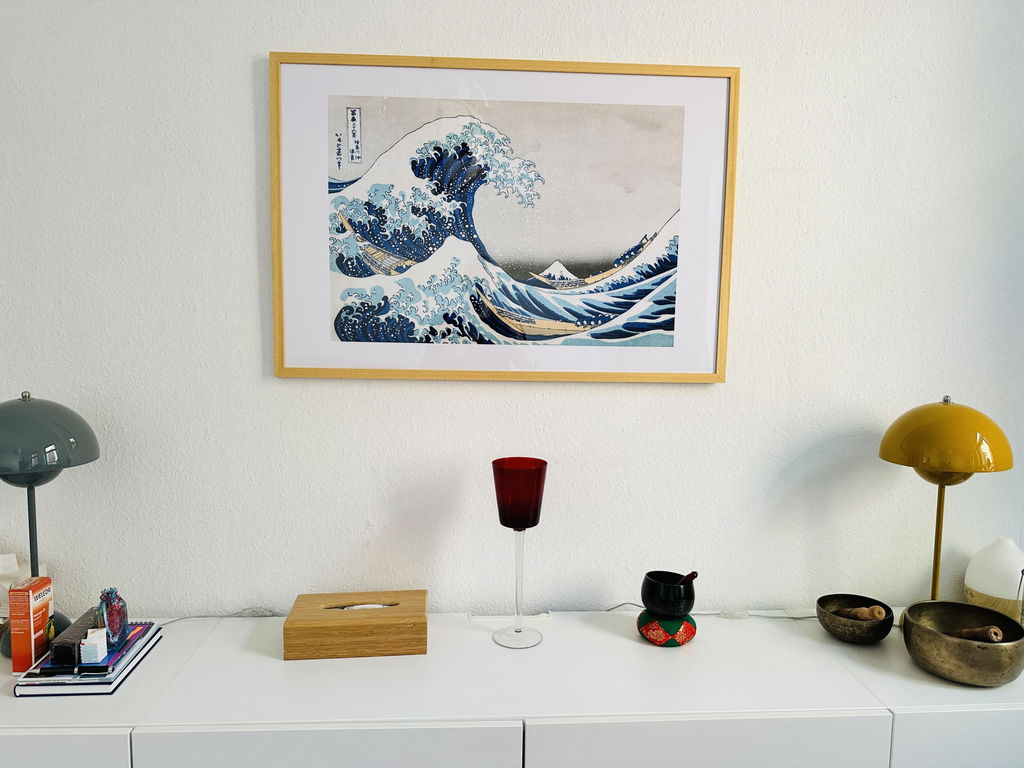
Printed on heavy fine-art paper with a soft natural-white surface. Framed editions arrive behind shatter-resistant acrylic in a slim wooden moulding; the canvas option is a satin-coated cotton weave. The red stays deep without overwhelming.
Frequently asked questions
What is shown in this print?
A decorated festival horse toy — red body, beaded saddle, black mane and carrying poles — drawn alone from the toy itself.
What were horse toys used for?
Decorated horse toys appeared in festivals and as children's playthings, the horse long valued as a symbol of strength and good fortune.
Which album is this from?
It is plate Nr. 31 of Kyōsen's Collected Illustrations of Japanese Toys (Kyōsen Omocha-shū), a survey of traditional folk toys.
Where does this print fit at home?
Its proud, upright presence suits an entryway, a study, or a child's room that can carry one strong colour.
<< Read Less
Japan historical period: Taisho 大正 (1912-1925)
Check out other artwork of Kawasaki Kyosen
#Art
•
#Classic
•
#Folk
•
#Folk Art
•
#Illustration
•
#Japanese
•
#Japanese Folk Art
•
#Japanese Traditional
•
#Kawasaki Kyosen
•
#Painted Folk‐Toy Illustration
•
#Sketch