The original is a small ink sketch sometimes attributed to Ike no Taiga (1723–1776), one of the major painters of the Nanga (Southern School) tradition, and sometimes to Matsumoto Hōji, an 18th-century Zen artist whose Frog became one of the most reproduced sumi-e of the period. The composition is unmistakable: a single rounded form, head tucked low, suggesting a frog — though some scholars read it as a curled shorebird — drawn with very few brushstrokes against open paper.
This streetart treatment keeps the source ink intact and rebuilds the field around it. The body sits as a near-perfect closed shape recalling an ensō, the Zen circle of enlightenment that stands for unity and the void. A circular frame, modern typography and a flat background turn the meditation into a poster, where the green of the body reads as graphic colour and the red seal works as a single warm punctuation.
It fits rooms where calmness is the rule rather than the exception — bedrooms, med . . . Read More >>
The original is a small ink sketch sometimes attributed to Ike no Taiga (1723–1776), one of the major painters of the Nanga (Southern School) tradition, and sometimes to Matsumoto Hōji, an 18th-century Zen artist whose Frog became one of the most reproduced sumi-e of the period. The composition is unmistakable: a single rounded form, head tucked low, suggesting a frog — though some scholars read it as a curled shorebird — drawn with very few brushstrokes against open paper.
This streetart treatment keeps the source ink intact and rebuilds the field around it. The body sits as a near-perfect closed shape recalling an ensō, the Zen circle of enlightenment that stands for unity and the void. A circular frame, modern typography and a flat background turn the meditation into a poster, where the green of the body reads as graphic colour and the red seal works as a single warm punctuation.
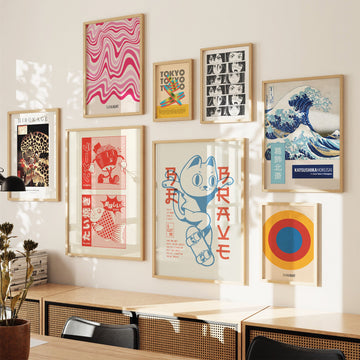
It fits rooms where calmness is the rule rather than the exception — bedrooms, meditation corners, reading nooks, hallways that lead somewhere quiet. In a Japandi or Scandinavian-leaning interior, the round shape sits as both image and decorative object, and works well above a low bench, beside a plant, or in a stairwell.
Available as a museum-grade fine art paper print, as a framed picture with shatter-resistant acrylic glazing, or as a satin-coated cotton canvas stretched on a wooden frame and ready to hang.
Frequently asked questions
Who is the original author?
The image is attributed in different sources both to Ike no Taiga (1723–1776), a major Nanga painter, and to Matsumoto Hōji, an 18th-century Zen artist; it is listed here under Ike no Taiga's name as it most often appears in collectors' catalogues.
Is it a frog or a bird?
The body is read as either a crouched frog or a curled shorebird; the original is sparing enough to leave both readings open.
Why does the shape look like a circle?
The figure is composed close to an ensō, the Zen circle of enlightenment that symbolises unity, the void and the entire universe drawn in a single breath.
Where does the print sit best?
Quiet rooms — bedrooms, meditation corners, reading nooks and hallways leading somewhere calm — where the closed round shape and open negative space can be felt.
<< Read Less
Japan historical period: Edo 江戸 (1603-1868)
Check out other artwork of Ike no Taiga
#Animal
•
#Circle
•
#Frog
•
#Humorous
•
#Ike no Taiga
•
#Japanese Pop Art
•
#Minimalist
•
#Modern Graphic Design
•
#Pop Art
•
#Retro
•
#Streetart
•
#Typography