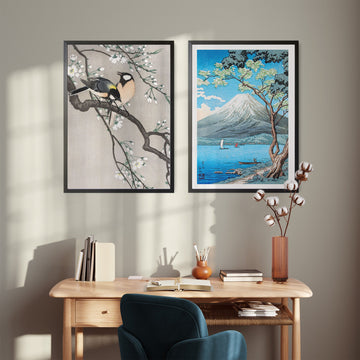
Mount Fuji rises across the still water of Lake Yamanaka, with cherry blossom at the shore and small boats resting on the surface — a spring morning held in suspension. The view comes from Takahashi Shōtei (1871–1945), who also signed his work Hiroaki, one of the artists who carried the Japanese landscape print into the early twentieth century. The scene belongs to the shin-hanga movement, which renewed the old woodblock craft for a new era.
Shin-hanga kept the traditional division of labor — designer, carver, printer — but asked more of atmosphere than its Edo predecessors: graded skies, reflections on water, the soft light of a particular hour. Shōtei was a master of these small distances. Here the mountain stands far and pale, the blossom close and delicate, and the lake carries the space between them.
Few subjects settle a room like Fuji over water. The horizontal calm of the composition, its restrained palette of blues and blossom tones, suits bedrooms, liv . . . Read More >>
Mount Fuji rises across the still water of Lake Yamanaka, with cherry blossom at the shore and small boats resting on the surface — a spring morning held in suspension. The view comes from Takahashi Shōtei (1871–1945), who also signed his work Hiroaki, one of the artists who carried the Japanese landscape print into the early twentieth century. The scene belongs to the shin-hanga movement, which renewed the old woodblock craft for a new era.
Shin-hanga kept the traditional division of labor — designer, carver, printer — but asked more of atmosphere than its Edo predecessors: graded skies, reflections on water, the soft light of a particular hour. Shōtei was a master of these small distances. Here the mountain stands far and pale, the blossom close and delicate, and the lake carries the space between them.
Few subjects settle a room like Fuji over water. The horizontal calm of the composition, its restrained palette of blues and blossom tones, suits bedrooms, living rooms, and any wall where the day should end quietly. In a japandi or Scandinavian interior it reads almost as a window: distance, light, and stillness in one frame.
This is a gallery-style edition. On fine-art paper and framed prints, a wide printed border surrounds the image in the manner of a museum mat, holding the same proportion whether the sheet is small or large. The canvas edition is stretched over a solid wooden frame instead, and hangs without a border or additional framing. Each version is produced in Europe to order.
Frequently asked questions
What does the print show?
Mount Fuji seen across Lake Yamanaka, one of the Fuji Five Lakes, with cherry blossom and small boats marking the near shore. It is a spring scene, composed around stillness and distance.
What is shin-hanga?
Shin-hanga ("new prints") was an early twentieth-century movement that revived the traditional Japanese woodblock workshop — designer, carver, printer — with a new attention to light, weather, and atmosphere. Shōtei was among its noted landscape designers.
What does "gallery-style" mean?
On fine-art paper and on framed prints, the artwork is set within a wide printed border carrying the title and the artist's name in restrained modern type. The border works like a museum mat: it gives the image room to breathe and makes the piece look composed even in a simple frame. The canvas edition is stretched over a wooden frame instead and hangs without a border.
Which rooms suit this print?
Rooms meant for rest: bedrooms, living rooms, reading corners. The horizontal composition and quiet palette pair naturally with pale wood, linen, and low, simple furniture.
<< Read Less
Japan historical period: Showa 昭和 (1926-1989)
Place of origin:
Chubu region
Check out other artwork of Takahashi Shōtei
#Blossoms
•
#Boat
•
#Cherry Blossom
•
#Hiroaki Takahashi
•
#Japan
•
#Japanese Art
•
#Japanese Woodblock Print
•
#Lake
•
#Lake Yamanaka
•
#Landscape
•
#Mount Fuji
•
#Nature
•
#Shin-Hanga
•
#Spring
•
#Takahashi Shōtei
•
#Tree