Takahashi Shōtei (1871–1945) returned repeatedly to Mount Fuji as a subject — not as a topographic exercise but as an atmospheric study. This view from the Hakone highlands shows the peak rising above successive ridges, its snow cap sharp against a sky that grades from deep blue at the top to pale pink at the horizon.
Shōtei used graduated bokashi printing across multiple blocks to build the sky’s colour transition. The mountain itself is defined by minimal but decisive line — quiet ridges receding into haze below the central summit. The composition is horizontal, unhurried, panoramic in feel without being wide in format.
Mount Fuji prints have occupied Japanese walls for centuries, but Shōtei’s version is distinctly modern in its restraint. The receding planes of the landscape and the cool-to-warm sky gradation adapt naturally to Japandi interiors alongside natural wood and neutral textiles.
This is a gallery-style edition. On fine-art paper and framed p . . . Read More >>
Takahashi Shōtei (1871–1945) returned repeatedly to Mount Fuji as a subject — not as a topographic exercise but as an atmospheric study. This view from the Hakone highlands shows the peak rising above successive ridges, its snow cap sharp against a sky that grades from deep blue at the top to pale pink at the horizon.
Shōtei used graduated bokashi printing across multiple blocks to build the sky’s colour transition. The mountain itself is defined by minimal but decisive line — quiet ridges receding into haze below the central summit. The composition is horizontal, unhurried, panoramic in feel without being wide in format.
Mount Fuji prints have occupied Japanese walls for centuries, but Shōtei’s version is distinctly modern in its restraint. The receding planes of the landscape and the cool-to-warm sky gradation adapt naturally to Japandi interiors alongside natural wood and neutral textiles.
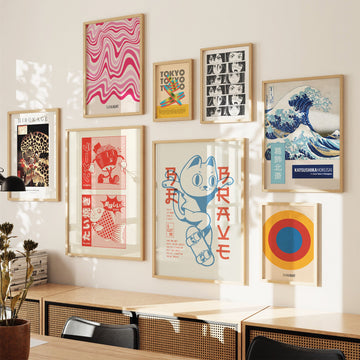
This is a gallery-style edition. On fine-art paper and framed prints, a wide printed border surrounds the image in the manner of a museum mat, holding the same proportion whether the sheet is small or large. The canvas edition is stretched over a solid wooden frame instead, and hangs without a border or additional framing. Each version is produced in Europe to order.
Frequently asked questions
How does Shōtei’s Fuji differ from Hokusai’s Thirty-Six Views?
Hokusai’s Fuji views are compositionally dynamic — the mountain anchors bold foreground action. Shōtei’s approach is calmer: Fuji appears at distance across layered hills and atmospheric haze, the image built from mood rather than drama.
What makes Hakone a distinctive vantage point for Fuji?
The Hakone mountain pass sits at over 700 metres elevation, offering a view of Fuji across a broad valley. In the shin-hanga period it was a resort area easily reached from Tokyo, which made it a subject of both artistic and popular interest.
What is bokashi, and how does it appear in this print?
Bokashi is a woodblock printing technique in which pigment is applied unevenly to the block, creating a gradual colour fade rather than a flat tone. Shōtei used it extensively in skies and water to achieve the atmospheric depth characteristic of his landscapes.
Is Mount Fuji still a common subject in contemporary Japanese art?
Yes. Fuji remains Japan’s most painted and photographed natural subject. Shin-hanga prints from Shōtei’s era are now among the most sought-after in the Western secondary market for Japanese art.
<< Read Less
Japan historical period: Showa 昭和 (1926-1989)
Place of origin:
Hakone,
Kanto region
Check out other artwork of Takahashi Shōtei
#Dawn
•
#Dusk
•
#Hakone
•
#Hiroaki Takahashi
•
#Japan
•
#Japanese Art
•
#Japanese Woodblock Print
•
#Landscape
•
#Mount Fuji
•
#Mountain
•
#Nature
•
#Shin-Hanga
•
#Takahashi Hiroaki
•
#Takahashi Shōtei
•
#Ukiyo-E