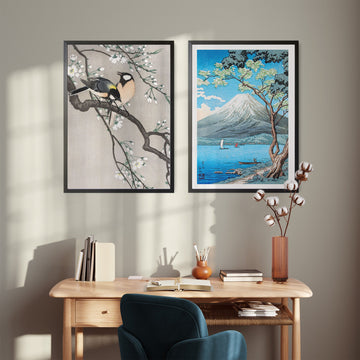
Beyond the rooftops and trees of the Katsuyama area, Mount Fuji stands broad and pale. Snow seems to rest on the houses and the ground between them, and the light suggests a short winter day fading toward dusk. The view is by Takahashi Shōtei, a defining figure of the shin-hanga movement of the early twentieth century, which revived the Japanese woodblock print with a new sensitivity to season and atmosphere.
The original was made as a colour woodblock print. In the shin-hanga workshop tradition, the artist's design passed through the hands of carvers and printers, each colour laid down from its own block. Gentle gradations of tone, known as bokashi, give the sky and the mountain their soft, unhurried depth.
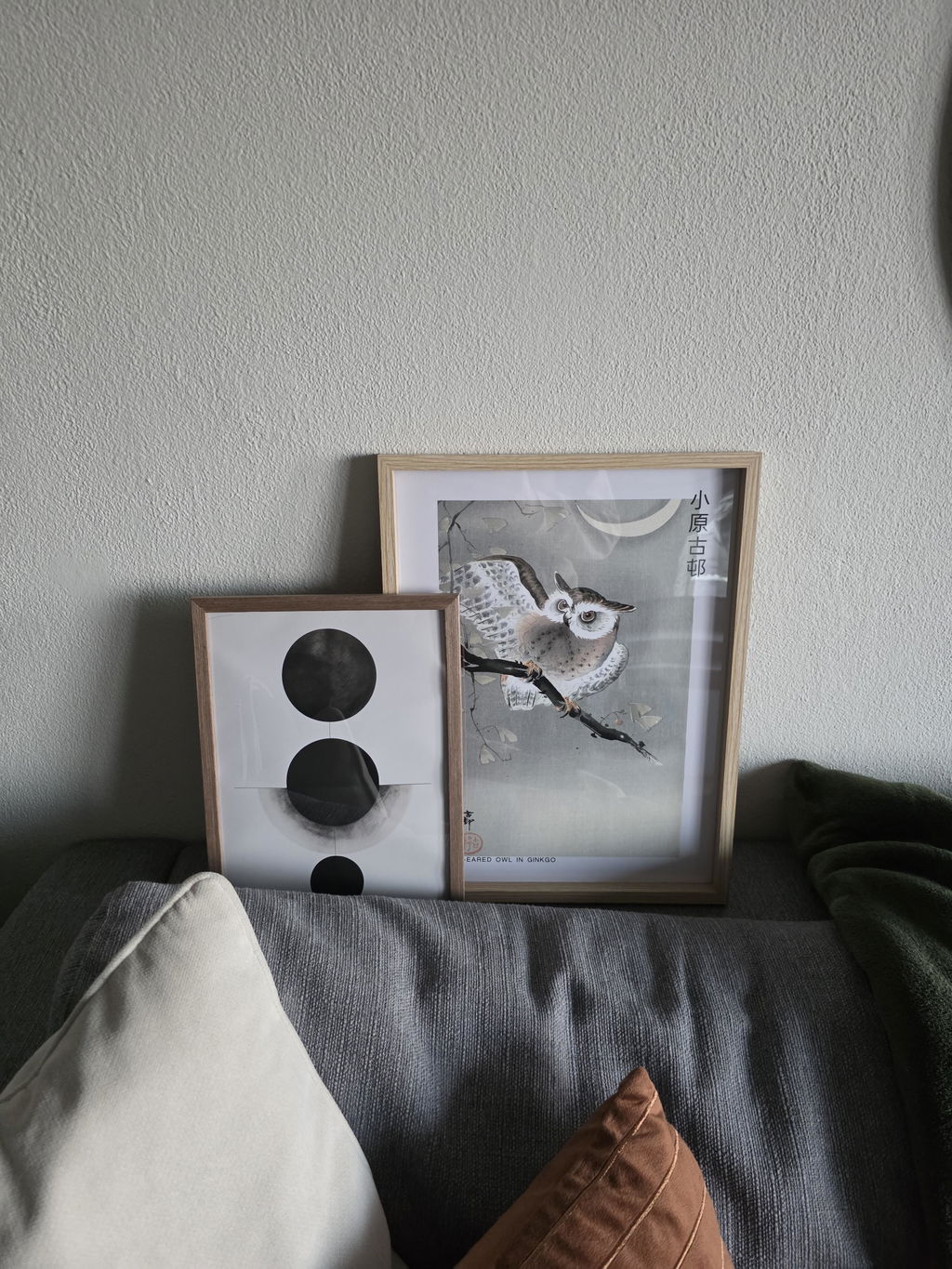
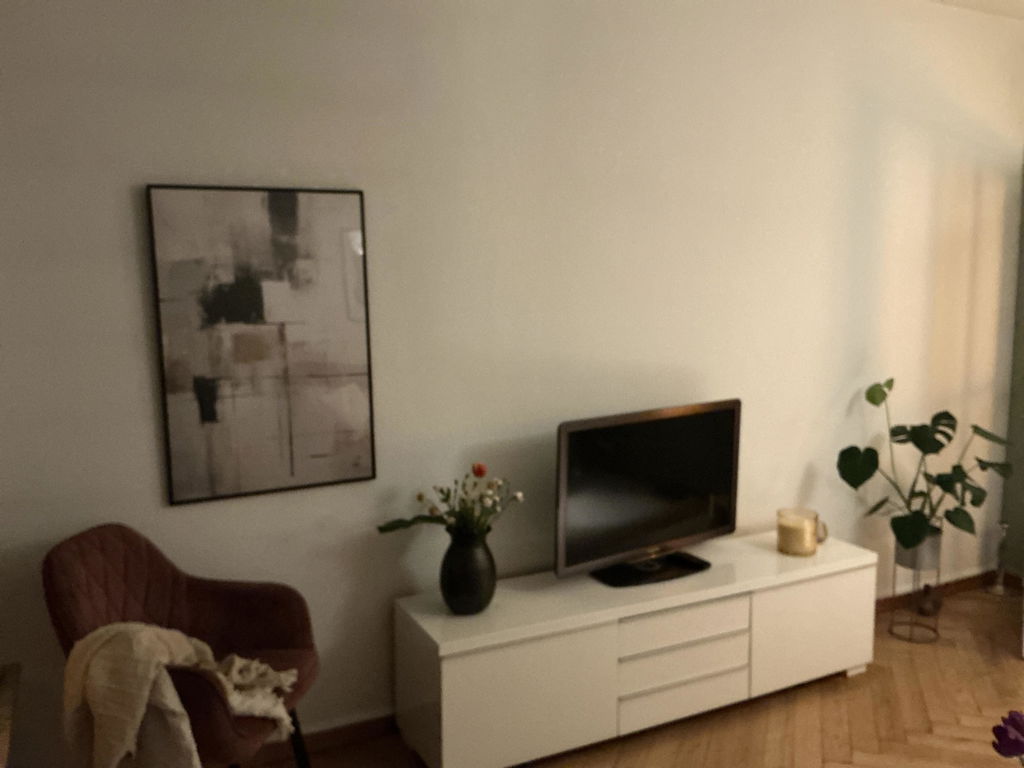
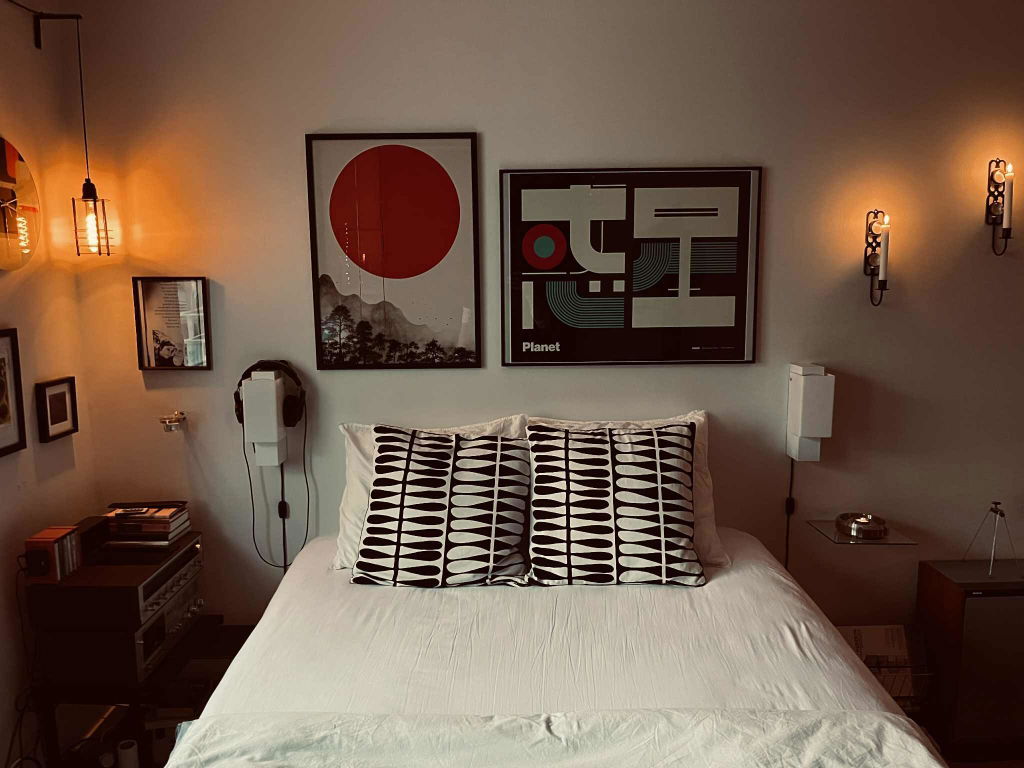
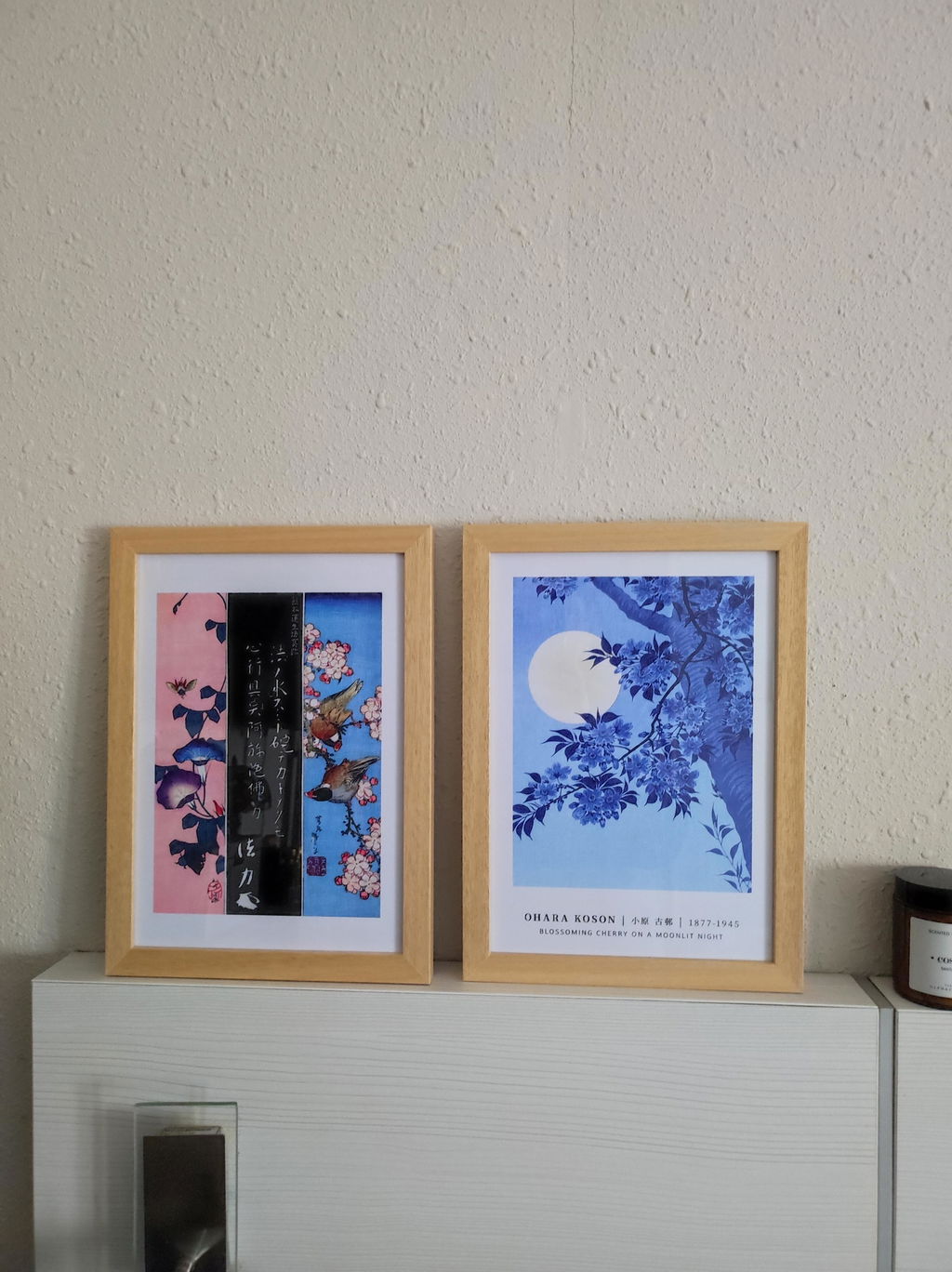
At home, the print brings the hush of a winter evening indoors. Its muted whites, greys and cool blues sit naturally in quiet rooms: above a sofa, in a bedroom, beside a desk. In a japandi or Scandinavian interior it reads as a window onto stillness, holding . . . Read More >>
Beyond the rooftops and trees of the Katsuyama area, Mount Fuji stands broad and pale. Snow seems to rest on the houses and the ground between them, and the light suggests a short winter day fading toward dusk. The view is by Takahashi Shōtei, a defining figure of the shin-hanga movement of the early twentieth century, which revived the Japanese woodblock print with a new sensitivity to season and atmosphere.
The original was made as a colour woodblock print. In the shin-hanga workshop tradition, the artist's design passed through the hands of carvers and printers, each colour laid down from its own block. Gentle gradations of tone, known as bokashi, give the sky and the mountain their soft, unhurried depth.
At home, the print brings the hush of a winter evening indoors. Its muted whites, greys and cool blues sit naturally in quiet rooms: above a sofa, in a bedroom, beside a desk. In a japandi or Scandinavian interior it reads as a window onto stillness, holding its own without demanding attention.
This is a gallery-style edition. On fine-art paper and framed prints, a wide printed border surrounds the image in the manner of a museum mat, holding the same proportion whether the sheet is small or large. The canvas edition is stretched over a solid wooden frame instead, and hangs without a border or additional framing. Each version is produced in Europe to order.
Frequently asked questions
What does this print show?
A view of Mount Fuji from the Katsuyama area. Houses and trees occupy the foreground, with the mountain rising behind; the soft light and pale tones suggest a winter scene near dusk.
What is shin-hanga?
Shin-hanga, or "new prints", was an early twentieth-century movement that renewed the Japanese woodblock tradition. Artists, carvers and printers worked together, with a strong focus on light, weather and mood — qualities this landscape shows clearly.
What does gallery-style mean?
On fine-art paper and on framed prints, the artwork sits within a wide printed border carrying the title and artist in restrained modern type, similar to a museum mat. The piece arrives as a finished gallery presentation, ready to hang or frame. The canvas edition is stretched over a wooden frame instead and hangs without a border.
Which interiors does it suit?
Its wintry palette of whites, greys and cool blues suits calm, pared-back rooms. It pairs well with pale wood, wool and linen — the quiet materials of japandi and Scandinavian homes.
<< Read Less
Japan historical period: Showa 昭和 (1926-1989)
Place of origin:
Katsuyama,
Chubu region
Check out other artwork of Takahashi Shōtei
#Dusk
•
#Hiroaki Takahashi
•
#Japan
•
#Japanese Art
•
#Japanese Woodblock Print
•
#Landscape
•
#Mount Fuji
•
#Mountain
•
#Nature
•
#Rural
•
#Shin-Hanga
•
#Snow
•
#Sunrise
•
#Sunset
•
#Takahashi Shōtei
•
#Tree
•
#Ukiyo-E
•
#Winter